8 Best Competitive Intelligence Tools in 2026
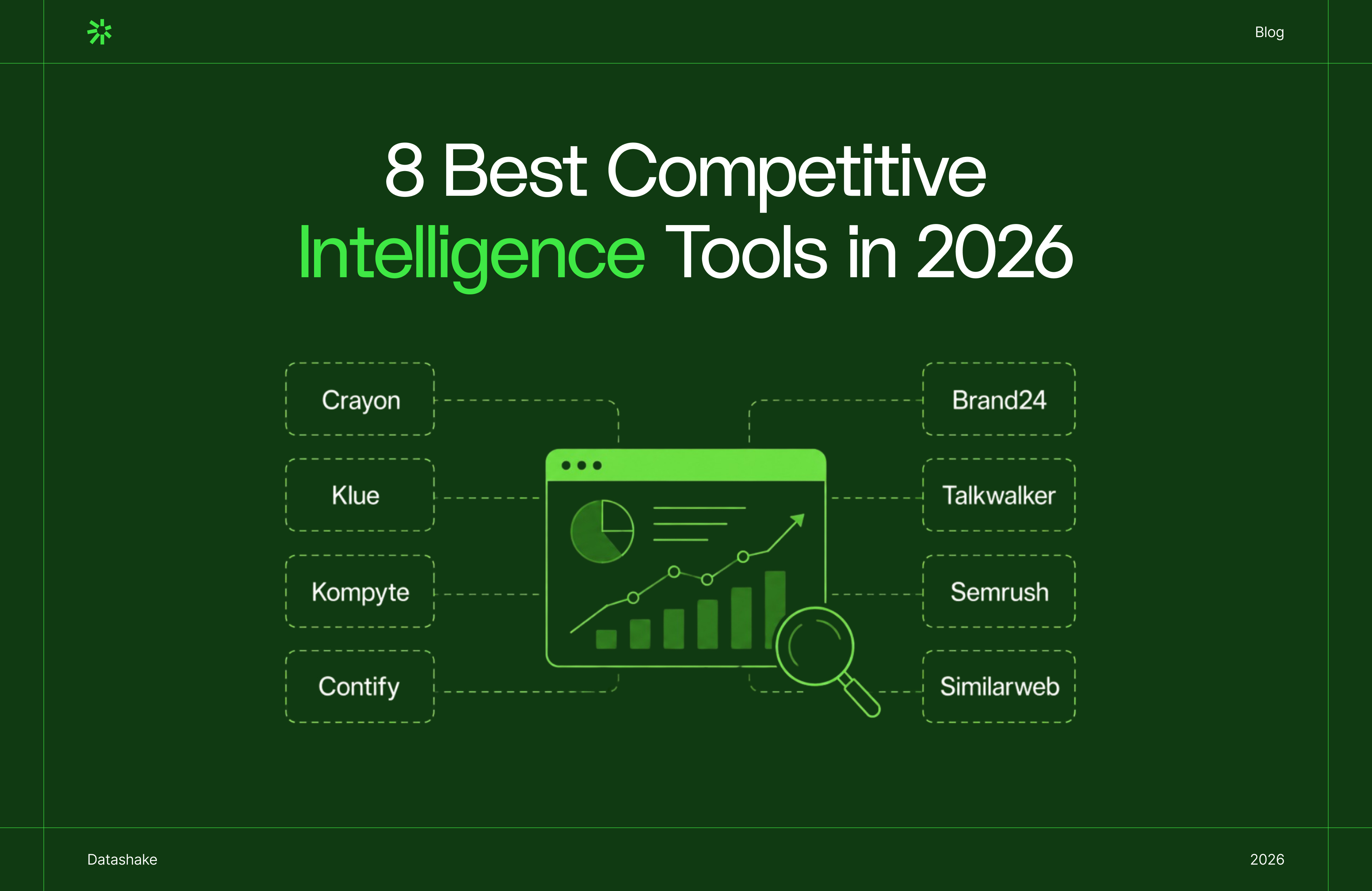
We tested eight of the most widely used competitive intelligence tools in 2026: Crayon, Klue, Kompyte, Contify, Brand24, Talkwalker, Semrush, and Similarweb.
The short version: some are awesome tools, and between them they cover most of what a serious CI programme needs. But they share one pretty deep blind spot.
Here’s everything we found ⬇️
- Crayon – best for monitoring breadth
- Klue – best for deal-based competitive intelligence
- Kompyte – best budget competitive intelligence tool
- Contify – best for market and regulatory intelligence
- Brand24 – best-value social and mention monitoring
- Talkwalker – best review site coverage
- Semrush – best for digital and AI search intelligence
- Similarweb – best for web traffic benchmarking
What are competitive intelligence tools?
Competitive intelligence tools are platforms that automatically collect, organise, and distribute information about competitors; including pricing changes, product launches, job postings, news coverage, and customer reviews. The aim is for sales, marketing, and strategy teams to be able to act on findings without manual research.
- Dedicated CI platforms (Crayon, Klue, Kompyte): battlecards, win/loss, competitor alerts; built for sales and product marketing teams
- Market and digital intelligence (Semrush, Ahrefs, Similarweb): traffic, SEO, ad spend, keyword share
- Social and media listening (Brand24, Talkwalker): public mentions, brand sentiment, share of voice
- Financial and market intelligence (AlphaSense): earnings transcripts, SEC filings, broker research, expert calls
- Website change monitoring (Visualping): change detection on pricing pages, product pages, and job postings
What does the standard CI stack monitor?
- Competitor websites and pricing pages
- Job postings and hiring signals
- Press releases and news
- Social media activity
- SEO, keyword, and ad spend data
- Web traffic estimates
- Sales call recordings
That's a solid base. It tells you what competitors are publishing, where they're spending, how they're positioning themselves publicly, and how they show up in your own pipeline.
The standard CI stack tells you what competitors say about themselves. What it largely ignores is what their customers say about them: on the review platforms, app stores, and employer sites where buyers write without a PR filter. That's a completely different dataset, but often a more useful dataset. ⚠️
How do competitive intelligence tools compare on review data coverage?
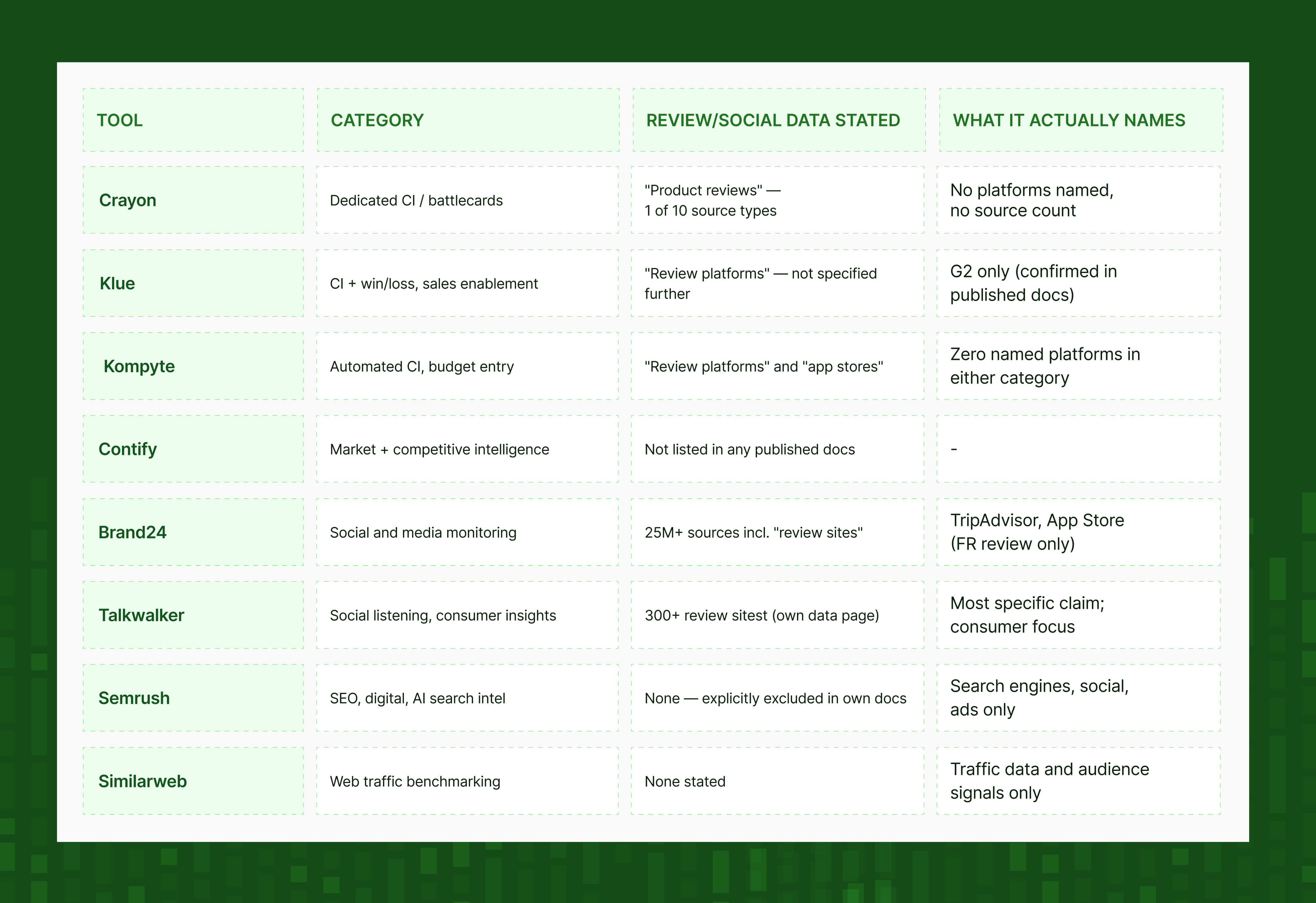
Here's what each tool says about its review and social data coverage:
Competitive intelligence tools compared: ratings, pricing, and free trials
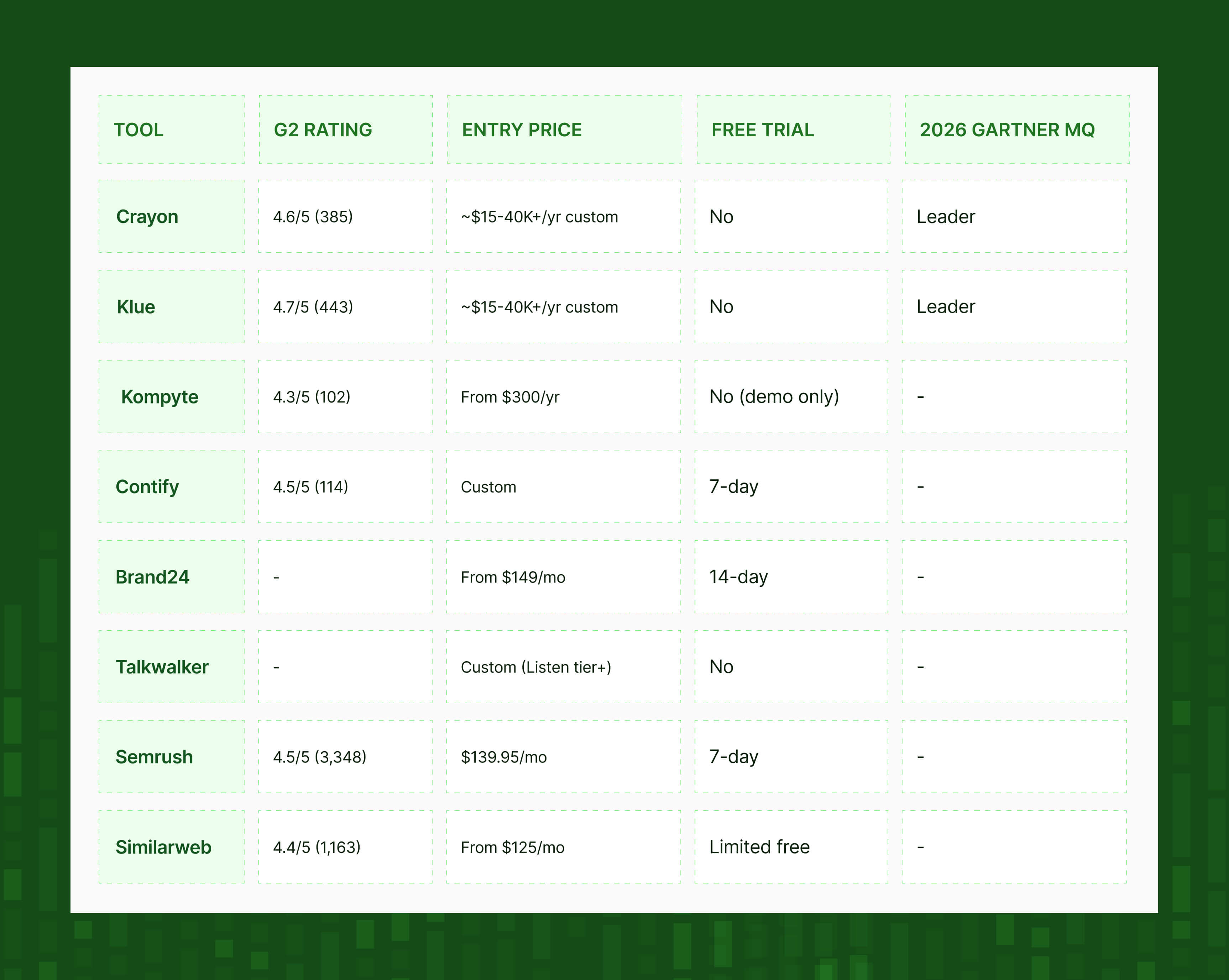
Pricing is indicative. Enterprise pricing varies, confirm directly with each vendor.
The full breakdown: what each competitive intelligence tool monitors
1. Crayon – best for monitoring breadth
G2: 4.6/5 (385 reviews) · Pricing: ~$15,000–40,000+/year custom · No free trial
Best for: Mid-market and enterprise teams that need to catch every competitor signal across the widest digital surface.
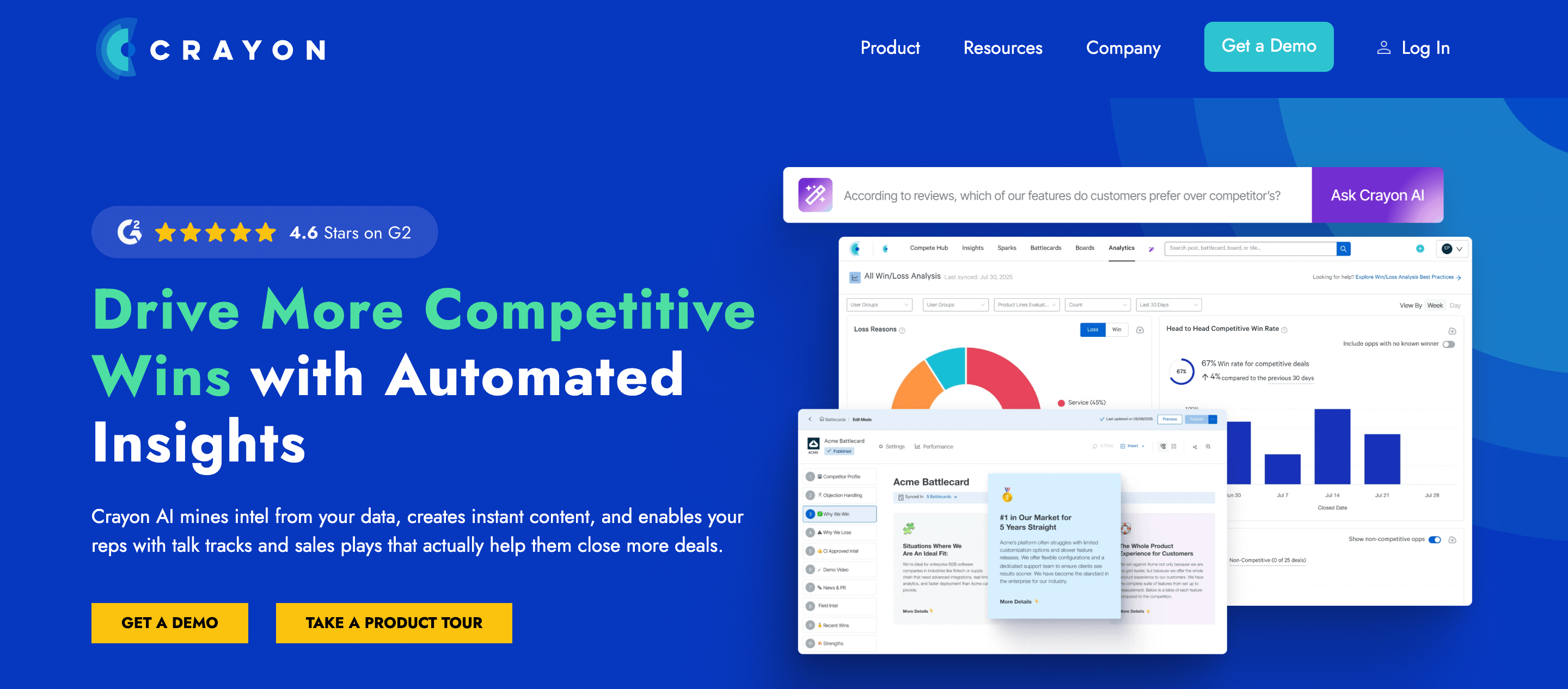
Crayon is the signal-coverage leader in dedicated CI. Its AI importance-scoring engine filters what surfaces to teams from 100+ monitored data types: website and pricing changes, news, social, job postings, press releases, and review sites.
SoftwareOne acquired Crayon for $1.4 billion in July 2025, expanding its distribution to 70 countries. Both Crayon and Klue were named Leaders in the 2026 Gartner Magic Quadrant for Competitive and Market Intelligence Platforms.
What Crayon does well
✅ Widest monitoring breadth in dedicated CI with 100+ data types
✅ AI Sparks agent auto-generates competitor summaries and refreshed battlecards
✅ MCP server feeds competitive intel into ChatGPT, Glean, and Microsoft Copilot
✅ Crayon Answers: conversational competitive Q&A inside Slack
Which platforms can you monitor with Crayon?
Crayon monitors competitor websites, pricing pages, job postings, news, social media activity, press releases, support documentation, and customer reviews.
On the review side, "customer reviews" appears as one line in its list of ten monitored source types; no specific platforms are named, and Crayon links to source URLs rather than ingesting or normalising review data itself.
In practice, review coverage is incidental to the core product, which is built around website and content monitoring.
What Crayon covers well: anything a competitor publishes or changes on their own properties. Pricing page updates, new product pages, job posting volume shifts, LinkedIn posts, press releases – Crayon catches it faster and more comprehensively than a lot of other dedicated CI platforms.
What it doesn't systematically cover: what those competitors' customers are saying on the platforms those customers use.
What reviewers say
👎 Signal-to-noise: broad monitoring generates a lot of low-value alerts. Gartner Peer Insights surfaces a recurring theme that Crayon's AI can "feel outdated vs LLM tools": the monitoring engine predates the current AI wave, and the AI layer feels additive.
2. Klue – best for deal-based competitive intelligence
G2: 4.7/5 (443 reviews) · Pricing: ~$15,000–40,000+/year custom · No free trial
Best for: Sales-led organisations where the battlecard is the centre of the competitive motion, with native win/loss analysis in the same platform.
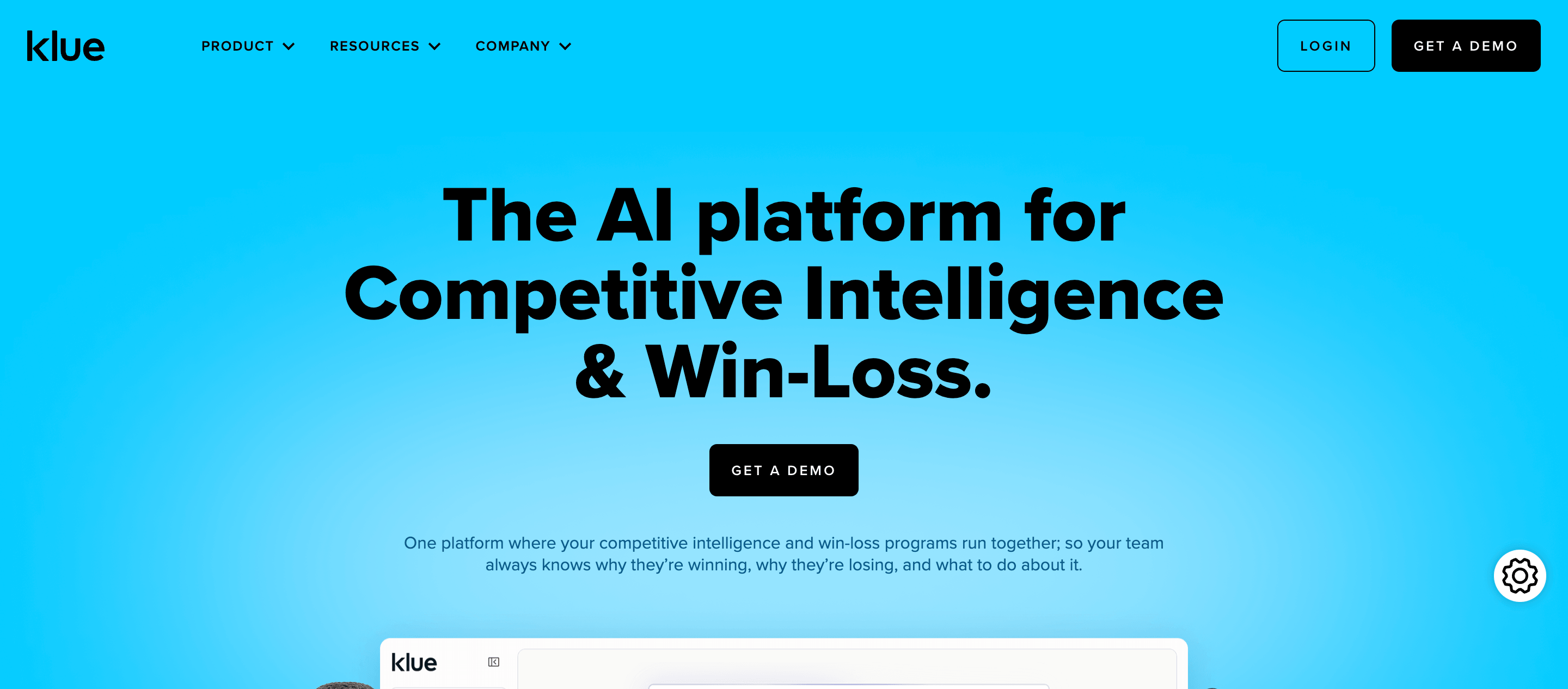
Klue is organised around the deal rather than the signal. Where Crayon catches competitor moves, Klue routes them to sellers at the moment a competitor appears in a live opportunity. It acquired Ignition in September 2025 and has 250,000+ users.
What Klue does well
✅ Compete Agent delivers deal-specific intel to sellers in active opportunities
✅ Ask Klue: natural-language competitive Q&A inside Slack, Teams, and Salesforce
✅ Native win/loss via DoubleCheck Research acquisition: AI interviewer, analyst-led interviews, imported transcripts
✅ Battlecard quality is its most-praised G2 feature – drag-and-drop editor, multi-type cards, in-workflow CRM delivery
Which platforms can you monitor with Klue?
Klue monitors competitor websites, social media activity, news, job postings, press releases, and review platforms.
Of those, G2 is the only review platform explicitly named in its published data sources.
Klue's strength is in what your own team knows, not in broad external coverage. Win/loss interviews, CRM data, call recordings, and employee-submitted intel feed back into battlecards directly.
That internal signal is truly valuable. But for review coverage beyond G2 (app stores, employer review sites, specialist review communities) Klue's coverage is unspecified.
What reviewers say
👍 Battlecard quality and in-workflow delivery
👎 setup complexity and a steep admin learning curve. Klue effectively requires a dedicated curator – without someone maintaining the content, battlecards go stale and adoption drops.
3. Kompyte – best budget competitive intelligence tool
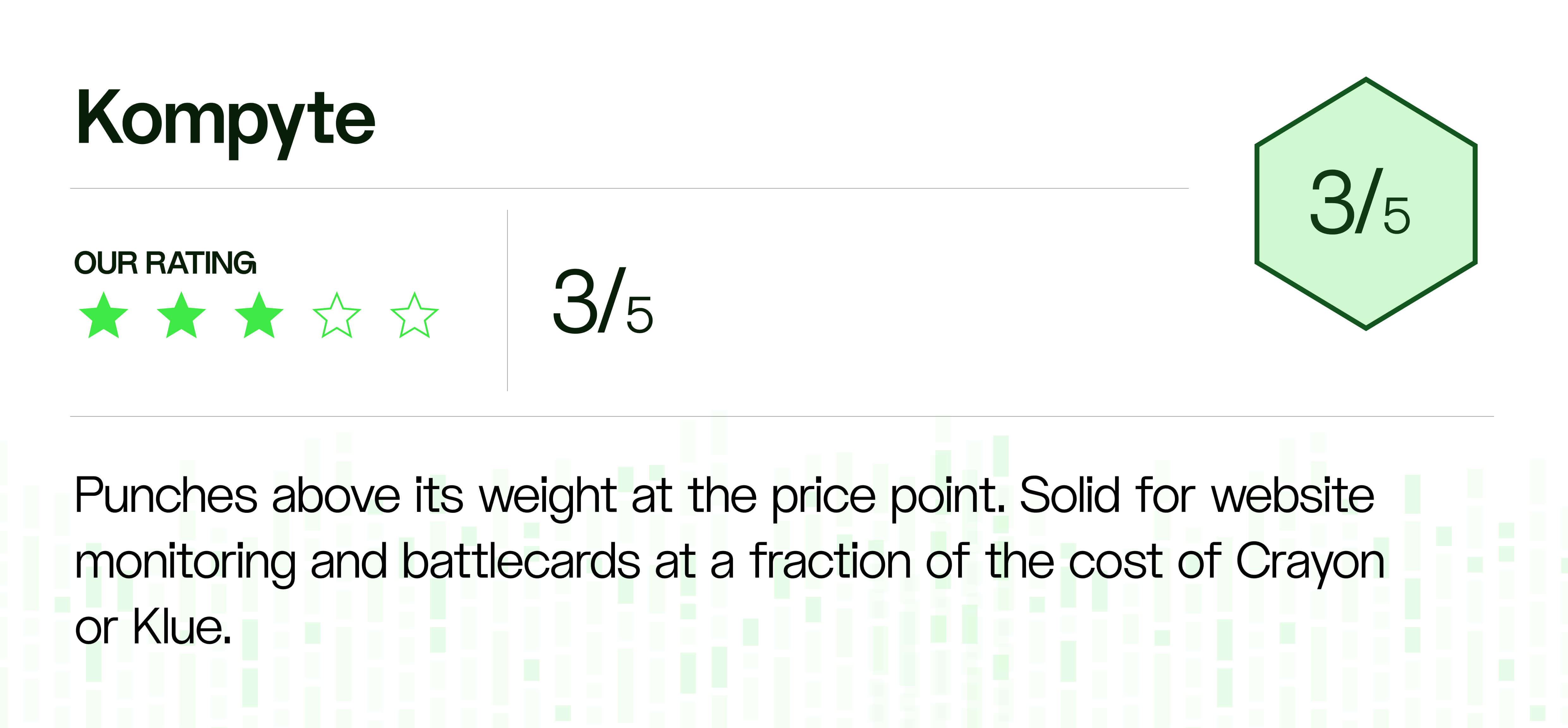
G2: 4.3/5 (102 reviews) · Pricing: from $300/year Essentials; Professional and Unlimited custom
Best for: Teams tracking a handful of competitors without a dedicated CI function, who need automated tracking and battlecards at startup-friendly pricing.
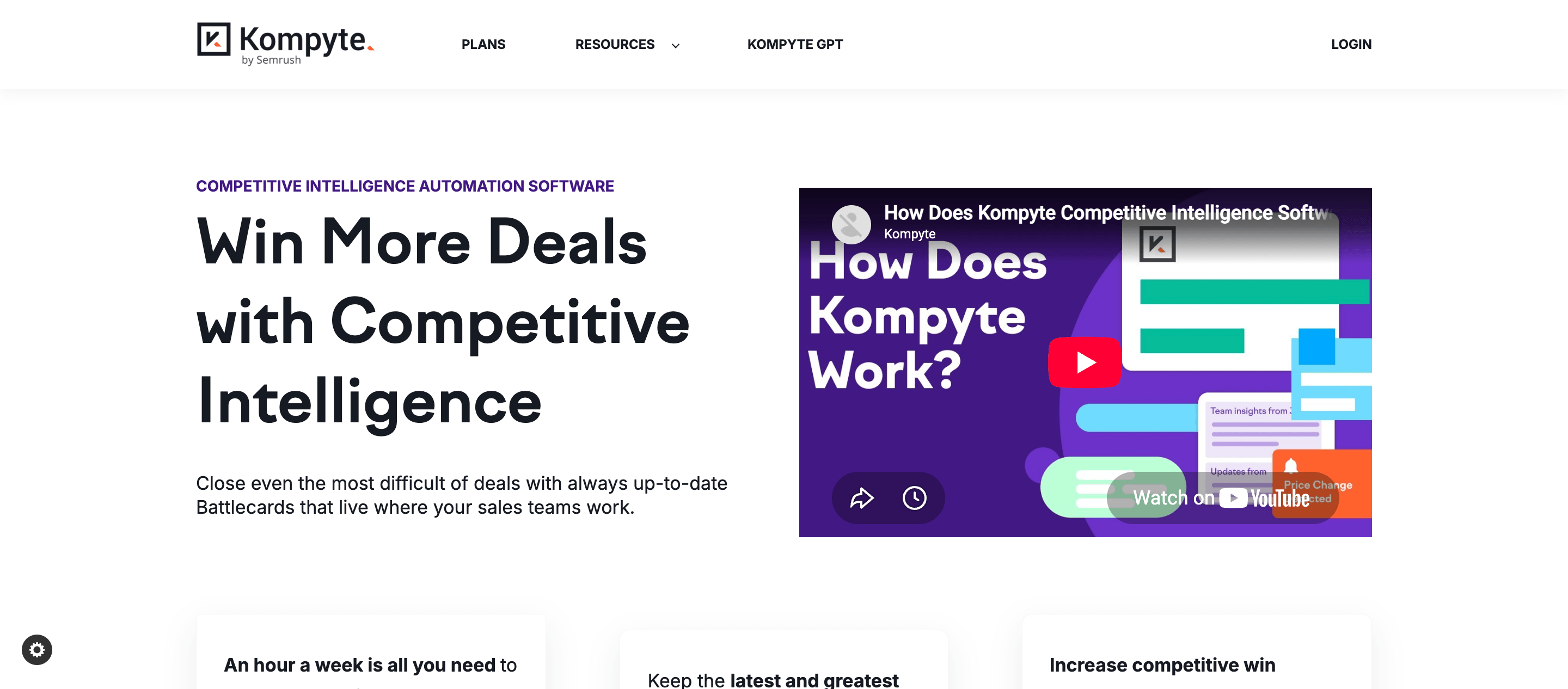
Kompyte (a Semrush subsidiary, acquired 2022) starts from $300/year which is a lot cheaper than Crayon or Klue. Its AI agent visits competitor websites daily, classifies changes, and generates unlimited battlecards via Kompyte GPT.
What Kompyte does well
✅ Most accessible dedicated CI price point: Essentials from $300/year
✅ AI agent automates daily competitor website monitoring and change classification
✅ Unlimited battlecards with no charge for changing tracked competitors
✅ Highest ease-of-use in the dedicated CI category: 8.7/10 on Gartner Peer Insights
✅ Deep CRM integration: Salesforce, HubSpot, Slack, Teams
Which platforms can you monitor with Kompyte?
Kompyte's published source list includes websites, social media, ads, job postings, RSS feeds, industry publications, review platforms, app stores, and search marketing data.
Both "review platforms" and "app stores" appear, but neither category names a specific platform. The headline claim of "over 500 million data sources" describes a page and document count, not distinct source types.
In practice, Kompyte's core monitoring is website-centric: it visits competitor URLs daily, classifies changes, and flags what's new. Review and app store monitoring is listed as a source category but without published specifics on platform coverage, frequency, or methodology.
What reviewers say
👎 AI outputs that are occasionally irrelevant or noisy, and outdated information: downstream effects of source coverage depth rather than the platform interface itself.
4. Contify – best for market and regulatory intelligence
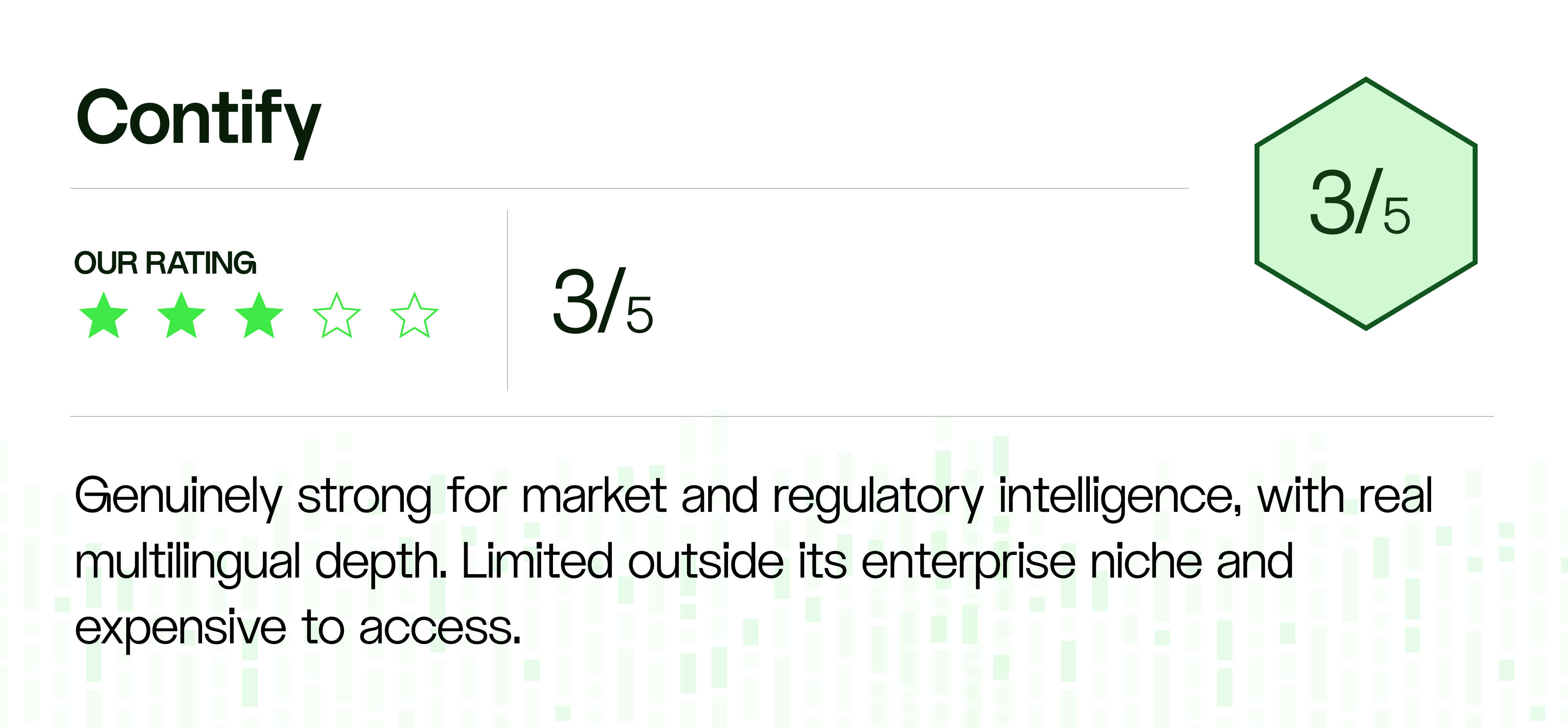
G2: 4.5/5 (114 reviews) · Pricing: custom · 7-day free trial available
Best for: Strategy, MI/CI, and product teams in financial services, pharma, IT, and consulting that need broad market intelligence alongside competitive data.
Contify is built for strategy and research functions where the intelligence requirement extends to regulatory filings, M&A activity, and multilingual sector news.
What Contify does well
✅ 1 million+ vetted external sources across news, company websites, SEC filings, social, and regulatory portals
✅ Athena AI: extracts business facts, answers ad-hoc questions, auto-updates dashboards and battlecards
✅ 117+ languages, the strongest multilingual coverage in this list
✅ Custom source configuration: clients can add their own sources on top of pre-configured library
✅ Analyst support bundled at higher tiers for secondary research and custom reporting
Which platforms can you monitor with Contify?
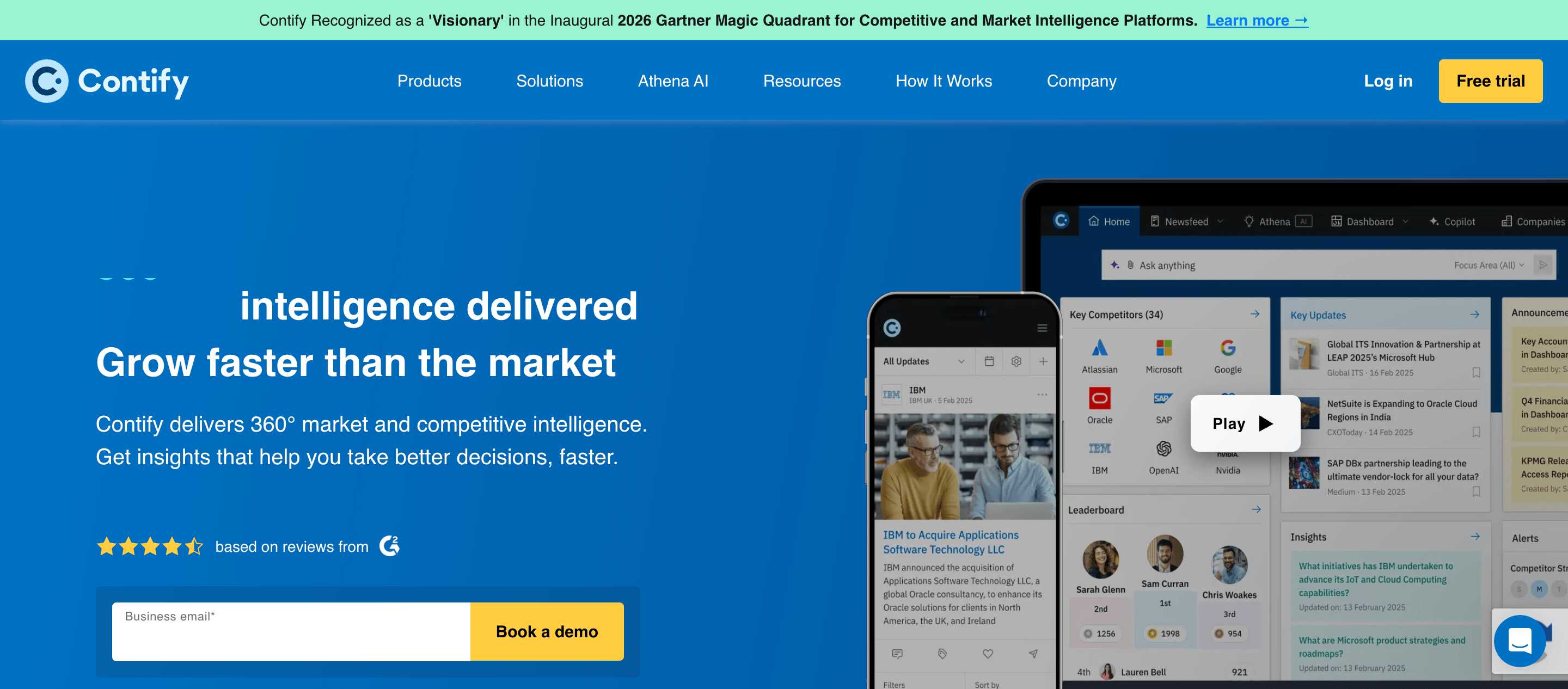
Contify monitors news sources, company websites, SEC filings and regulatory filings, social media, job portals, and government portals – across 1 million+ vetted sources in 117+ languages. Its coverage is very broad for market and regulatory intelligence.
What's missing: review platforms. Review sites don't appear in Contify's published source categories, and an independent ColdIQ review confirms the same source list with no mention of review platforms.
Contify is suitable for strategic intelligence — what's happening in the market, in regulation, in M&A — not for the product-level question of what customers are saying about competitors on consumer review platforms.
What reviewers say
👍 Real-time alerts, market intelligence depth, and Athena AI's responsiveness
👎 Cost-prohibitive pricing and a steep learning curve
5. Brand24 – most source-transparent tool
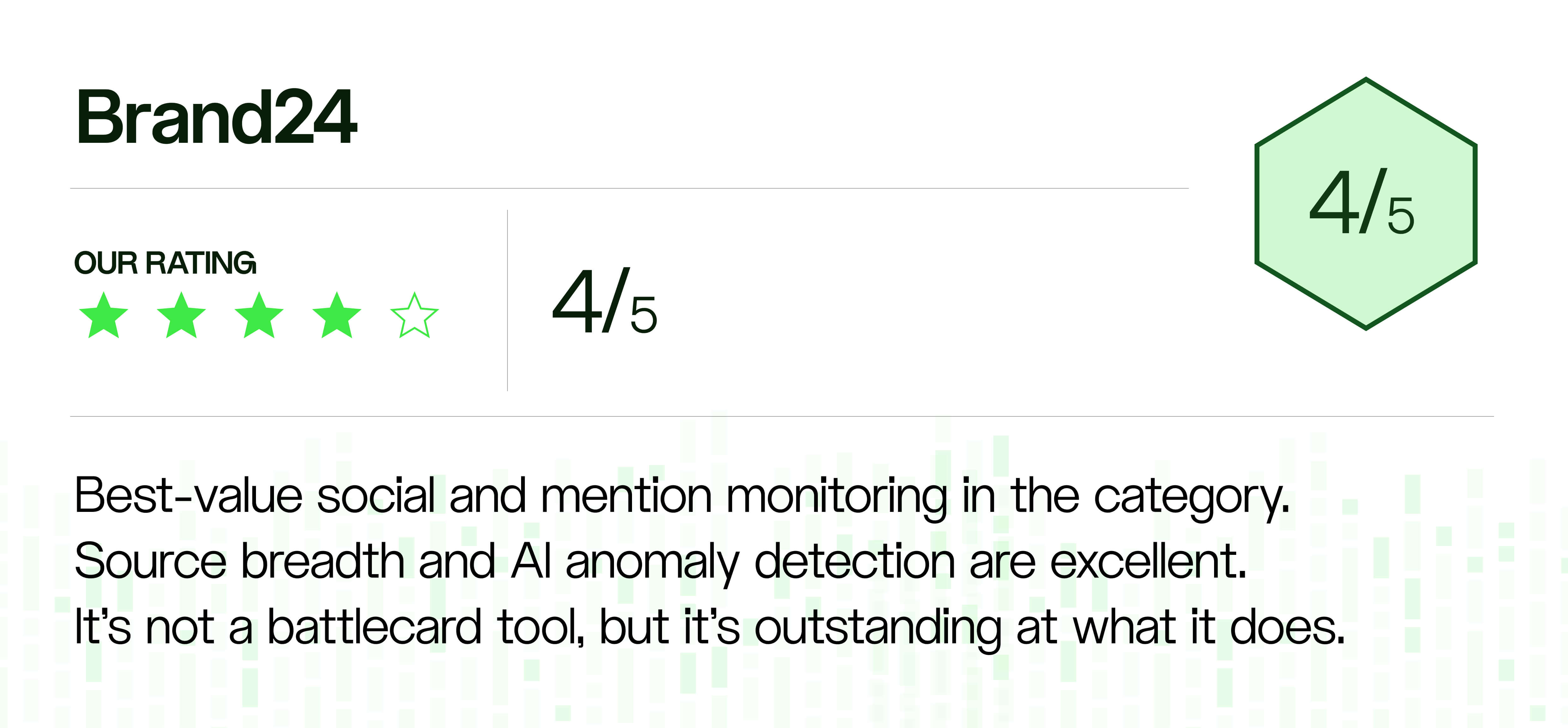
Pricing: $149–399/month · 14-day free trial · 4,000+ brand customers
Best for: Teams that need real-time mention alerts across social media, forums, podcasts, and review sites at an accessible price point.
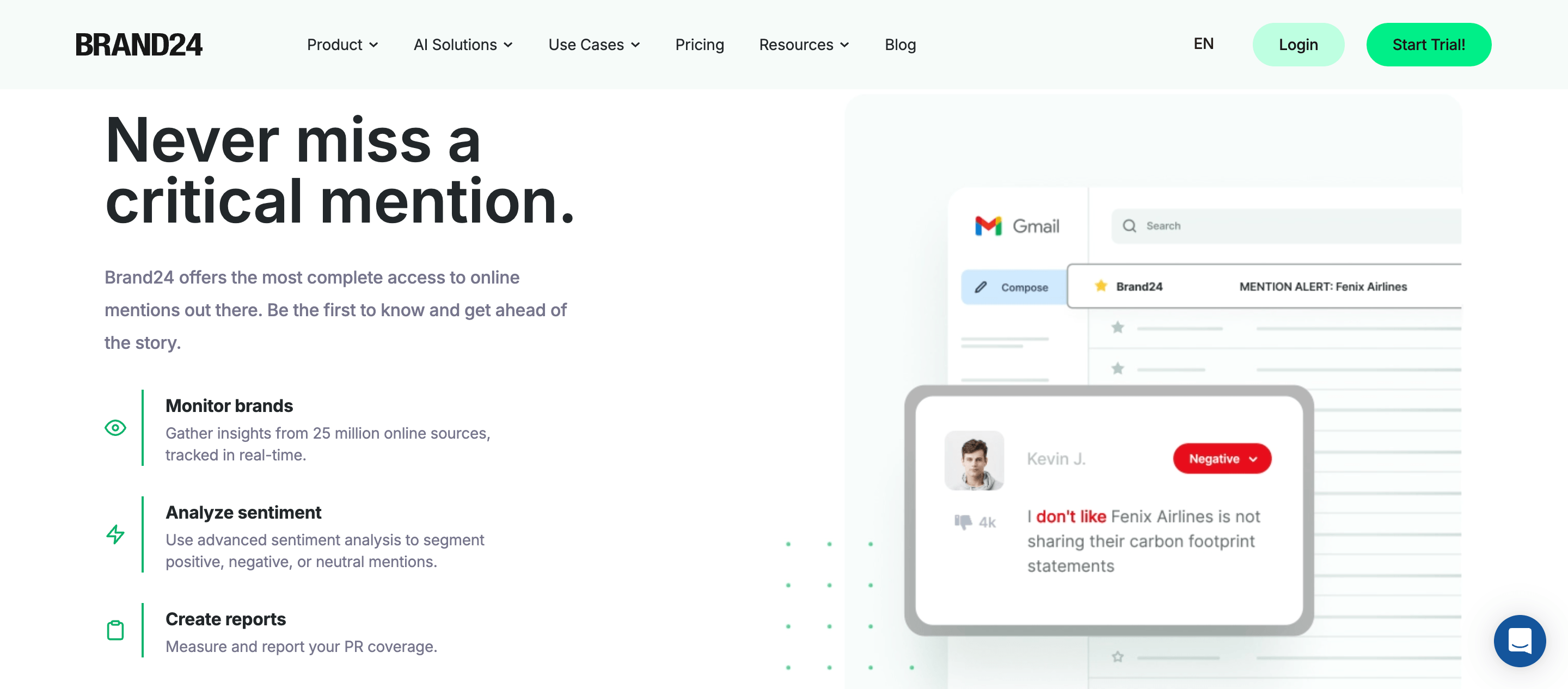
Of all the tools in this audit, Brand24 is the most upfront about what it monitors. Its published coverage spans 25 million+ online sources.
What Brand24 does well
✅ AI Anomaly Detector: identifies unusual mention spikes and crawls for the most probable root cause
✅ 2026 sentiment model: 95% accuracy across 90+ languages with emotion detection (joy, fear, anger, trust)
✅ LLM Listening (2026): tracks brand and competitor mentions across ChatGPT, Gemini, Claude, Perplexity, and Grok
✅ Context Search filters mentions by intent, not just keyword match
✅ Most accessible price point for real-time social and mention monitoring
Which platforms can you monitor with Brand24?
Brand24 monitors 25 million+ online sources. Beyond social, it covers blogs, forums, podcasts, newsletters, and review sites.
On review coverage specifically: Brand24 includes review sites in its source pool but doesn't publish a list of which platforms.
What reviewers say
👍 Source breadth, the AI Anomaly Detector, and ease of setup
6. Talkwalker (Lumen by Talkwalker) – most review sites named
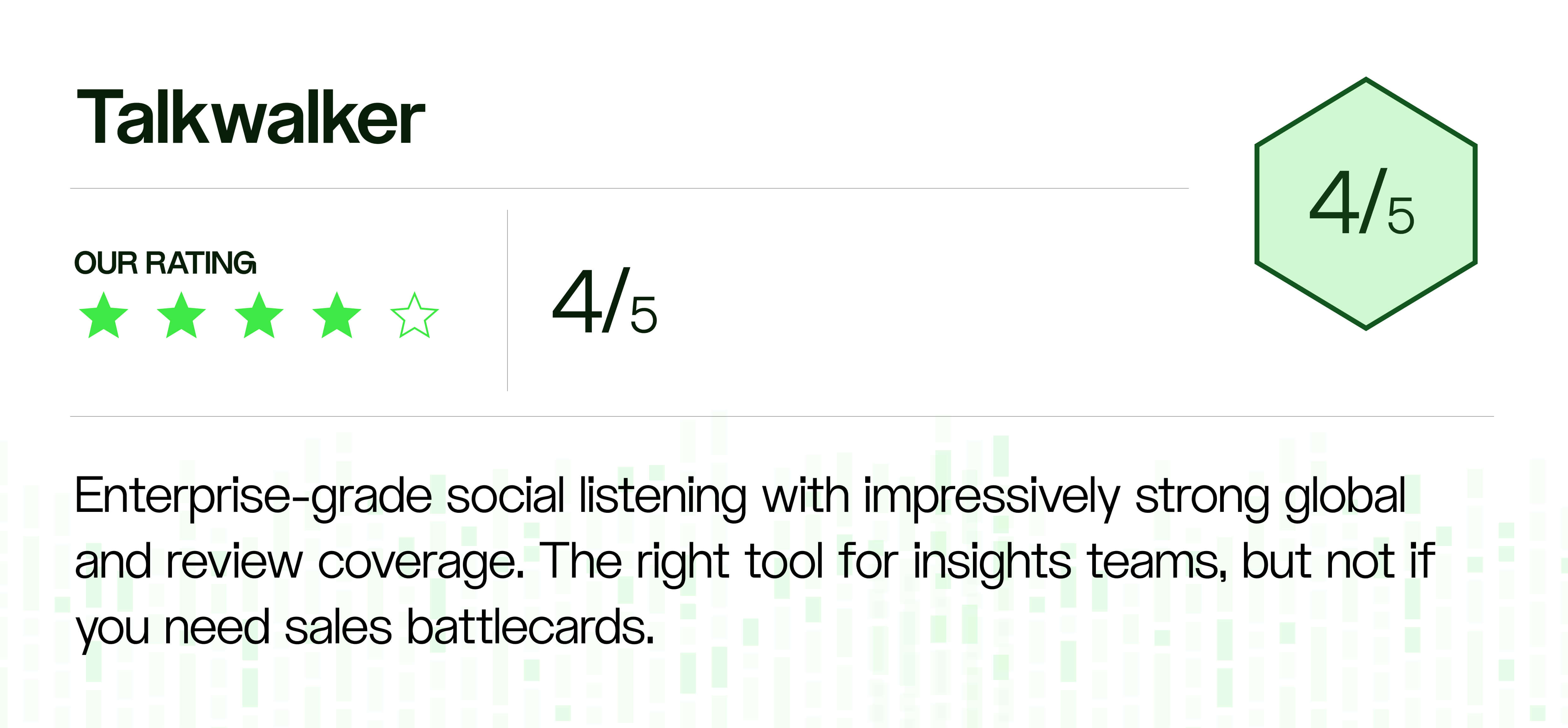
Pricing: custom (Listen tier and above) · Most commonly used by: marketing, PR, consumer insights teams
Best for: Marketing, PR, and consumer insights teams that need deep social listening, brand monitoring, and consumer sentiment analysis.
Talkwalker (acquired by Hootsuite in 2024, now Lumen by Talkwalker) claims 300+ review sites. The caveat is context. Talkwalker is a consumer insights and social listening platform, not a competitive intelligence battlecard tool. That review coverage exists to serve brand perception and sentiment analysis, not to populate sales enablement content or alert sellers in active deals.
What Talkwalker does well
✅ 300+ review sites
✅ BlueSilk GPT: AI-powered sentiment analysis and trend synthesis
✅ 239 countries and 187 languages
✅ Enterprise infrastructure: 5,000 servers, 3.5 TB processed daily
✅ 100+ workflow integrations
Which platforms can you monitor with Talkwalker?
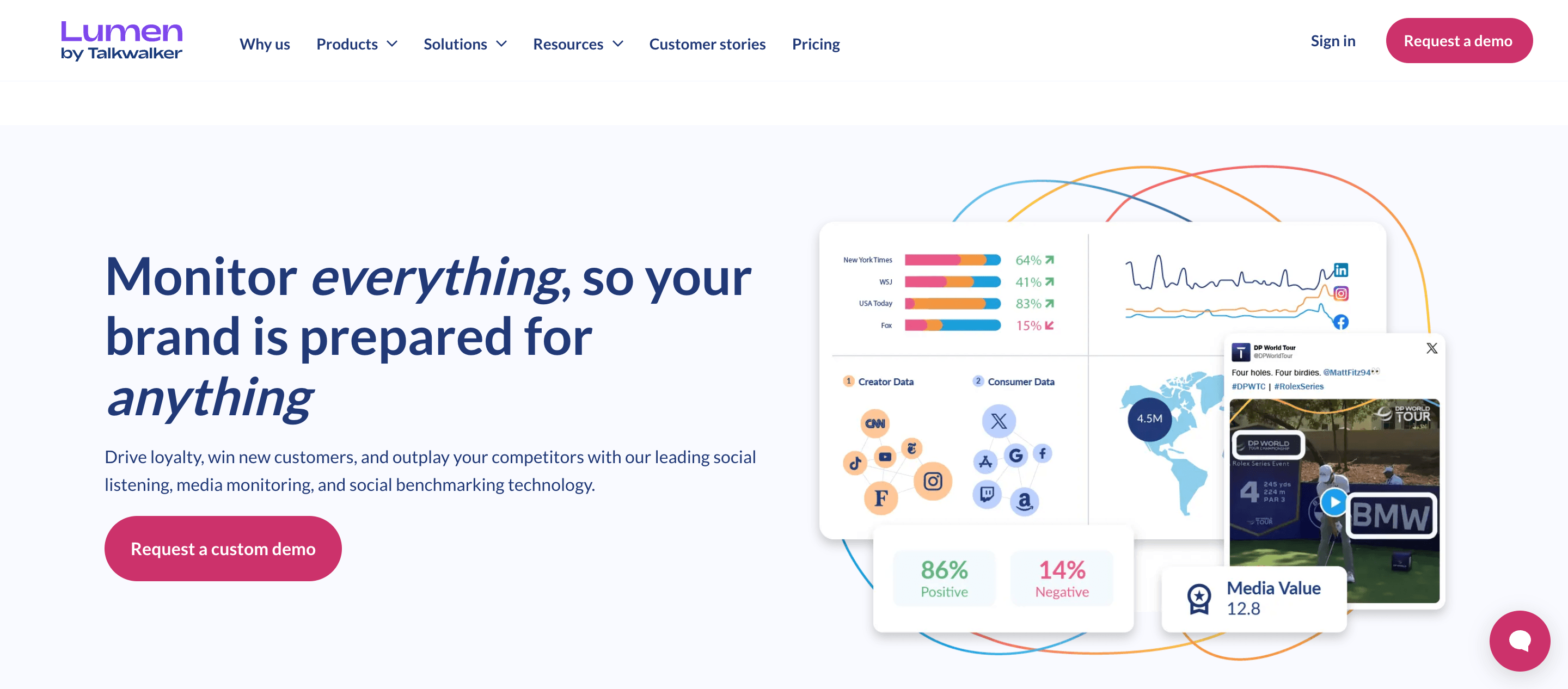
Talkwalker’s data coverage page lists 300+ review sites, alongside 30+ social networks and 150 million+ websites across 239 countries.
The important context: that 300+ review site coverage is built for consumer insights — brand perception, sentiment analysis, consumer research — not for competitive battlecards or sales enablement.
Talkwalker will tell you how consumers feel about a competitor's brand across a broad review landscape. It won't route that data into your CRM or generate a battlecard from it.
What reviewers say
👍 Social listening depth and alert speed
👎 Most commonly used by marketing and PR teams rather than CI functions: the recurring criticism is that competitor data stays surface-level, because only social and digital platforms are monitored.
7. Semrush – best for digital and AI search competitive intelligence
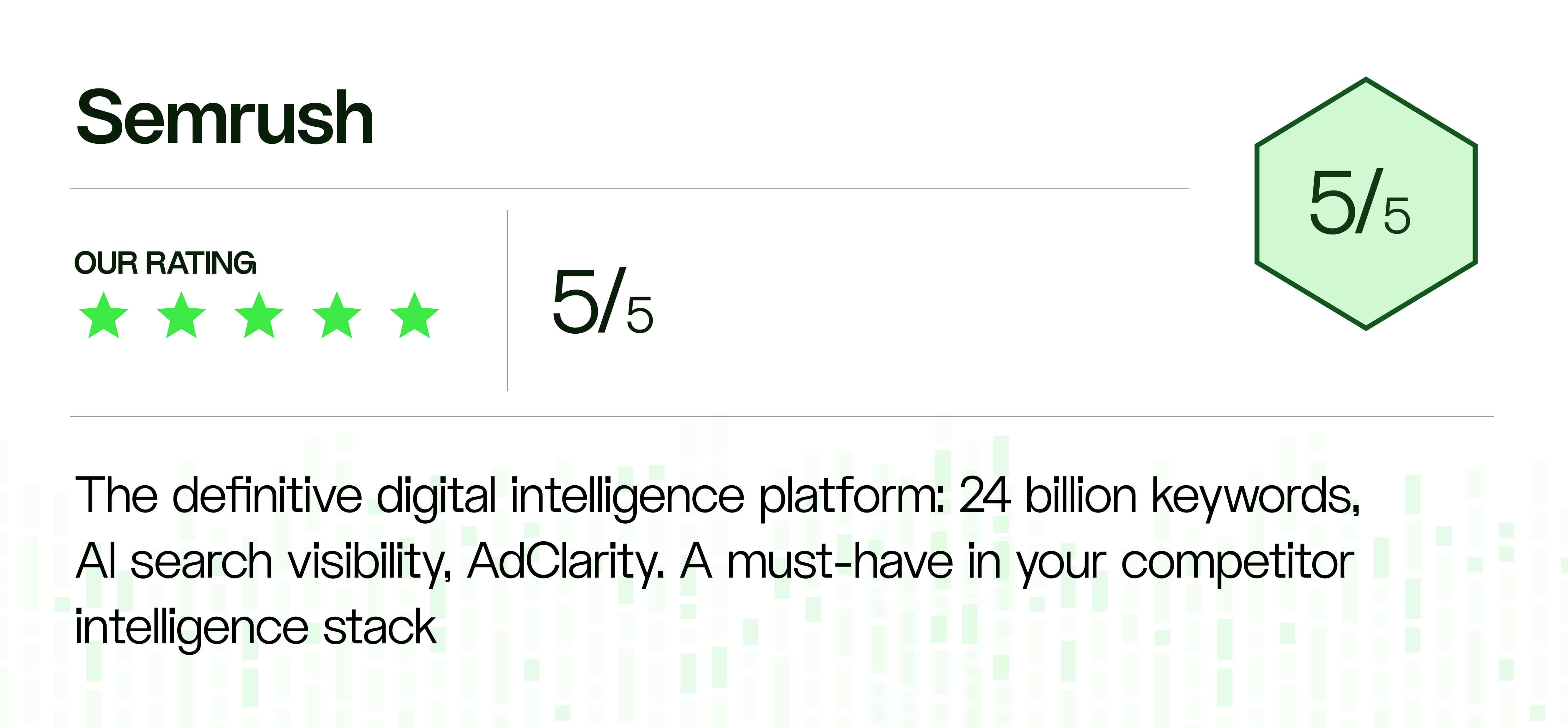
G2: 4.5/5 (3,348 reviews) · Pricing: $139.95–499.95/month · 7-day free trial
Best for: Marketing and SEO teams tracking competitor keyword rankings, ad spend, content strategy, and AI search visibility.
Semrush is the digital intelligence layer, the tool that tells you what competitors are doing in search, advertising, and since October 2025, in AI-generated results. Semrush One added AI visibility monitoring across AI Overviews, Perplexity, and other LLM-driven surfaces, plus AI brand sentiment tracking across ChatGPT, Gemini, Claude, and others.
What Semrush does well
✅ 24 billion keywords and 808 million domain profiles – the largest SEO and digital intelligence database in the category
✅ AdClarity: reveals competitor ad creative, placements, and estimated spend
✅ AI visibility monitoring: how competitors appear in LLM-generated results
✅ AI brand sentiment: how LLMs describe your brand versus competitors' brands
✅ 55+ tools from keyword research through to technical site audit and content optimisation
Which platforms can you monitor with Semrush?
Semrush monitors search engine results pages (Google, Bing), advertising networks, and digital marketing data. It does not monitor review platforms.
What you can track with Semrush: how competitor content ranks in organic search, what keywords they're bidding on, what ad creative they're running, how much estimated traffic they're generating, and since Semrush One (October 2025), how they appear in AI-generated search results. What you cannot track: anything customers say about them: no review platforms, no forums, no app stores.
What reviewers say
👍 Breadth of digital coverage and keyword research
👎 Cost escalating quickly with add-ons and a learning curve given the volume of tools
8. Similarweb – best for web traffic competitor benchmarking
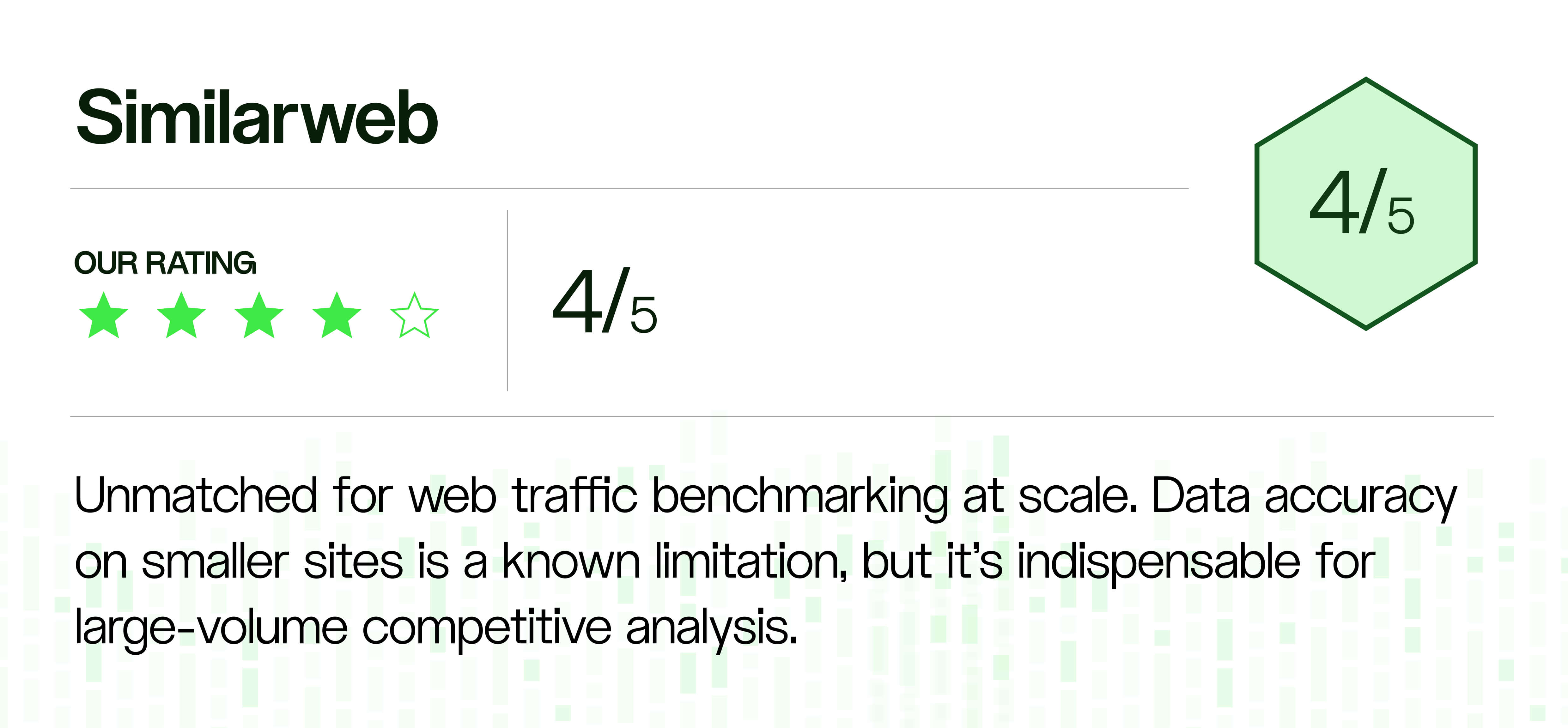
G2: 4.4/5 (1,163 reviews) · Pricing: from $125/month individual; from $14,000/year teams; enterprise custom
Best for: Teams that need to benchmark competitor web performance, traffic trends, and audience demographics for strategy or sales conversations.
Similarweb covers 100 million+ websites, 4 million+ apps, and 10 years of historical data. It's publicly traded on the NYSE (SMWB) and used by brands including Google, Walmart, The Economist, and Adidas.
What Similarweb does well
✅ Traffic estimation across 100M+ websites with 10 years of historical data
✅ Channel mix breakdown: direct, organic, paid, referral, social, email
✅ Audience demographics and interest categories for competitor sites
✅ GenAI visibility tracking for AI search surfaces (added 2025–2026)
✅ BI integrations: Looker Studio, Tableau, Power BI, HubSpot, Salesforce, Snowflake, Databricks
Which platforms can you monitor with Similarweb?
Similarweb monitors websites – 100 million+ of them, across traffic sources, audience behaviour, keyword data, and channel mix. It also tracks app performance across 4 million+ mobile apps.
What it does not monitor: anything people say on those websites or apps. No review platforms, no social listening, no sentiment.
The Similarweb use case for CI is benchmarking and traffic intelligence: is a competitor growing? Which channels are driving their traffic? Are they investing more in paid search? How does their audience compare to yours?
What reviewers say
👎 Data accuracy for smaller sites: traffic estimates are modelled rather than measured, and flagged as inconsistent for lower-volume domains.
Why you don’t want to miss review data in your competitive intelligence stack
Does your CI program have a blind you don’t know about? ⬇️
- A competitor ships an update
- Their website changes
- Crayon catches it within hours and fires an alert
- Your sales team is briefed. So far, so good.
⚠️ But the update introduced a problem. Maybe performance degraded. Maybe a key feature broke for a subset of users. Within days, those users start writing about it: one-star app store reviews, a Reddit thread, a complaint cluster on a specialist forum, a wave of Glassdoor posts from engineers flagging a culture shift.
❌ None of it appears in a Crayon alert. None of it populates a Klue battlecard. None of it triggers a Kompyte update.
Because those tools monitor what competitors publish: press releases, blog posts, pricing page edits, job postings. Review platforms are where competitors' customers publish. That's often largely outside the standard CI stack.
💡 Datashake aggregates review and social data across 150+ source types through a single API for teams that need the signal the standard CI stack doesn't collect. Talk to us
Is AI making competitive intelligence tools better?
Lately, every major CI platform launched or expanded AI features.
- Crayon's Sparks generates competitor summaries automatically
- Klue's Compete Agent delivers deal-specific intelligence mid-deal
- Semrush One tracks competitor presence in LLM search results
- Brand24's Anomaly Detector crawls for root causes behind mention spikes.
The analysis layer is becoming a commodity.
But if the underlying sources haven't changed – if "customer reviews" still means G2 and an unspecified handful of others — then a more sophisticated AI layer applied to that same narrow input produces the same blind spots. It summarises them more quickly. It routes them to sellers more efficiently. It doesn't fill them.
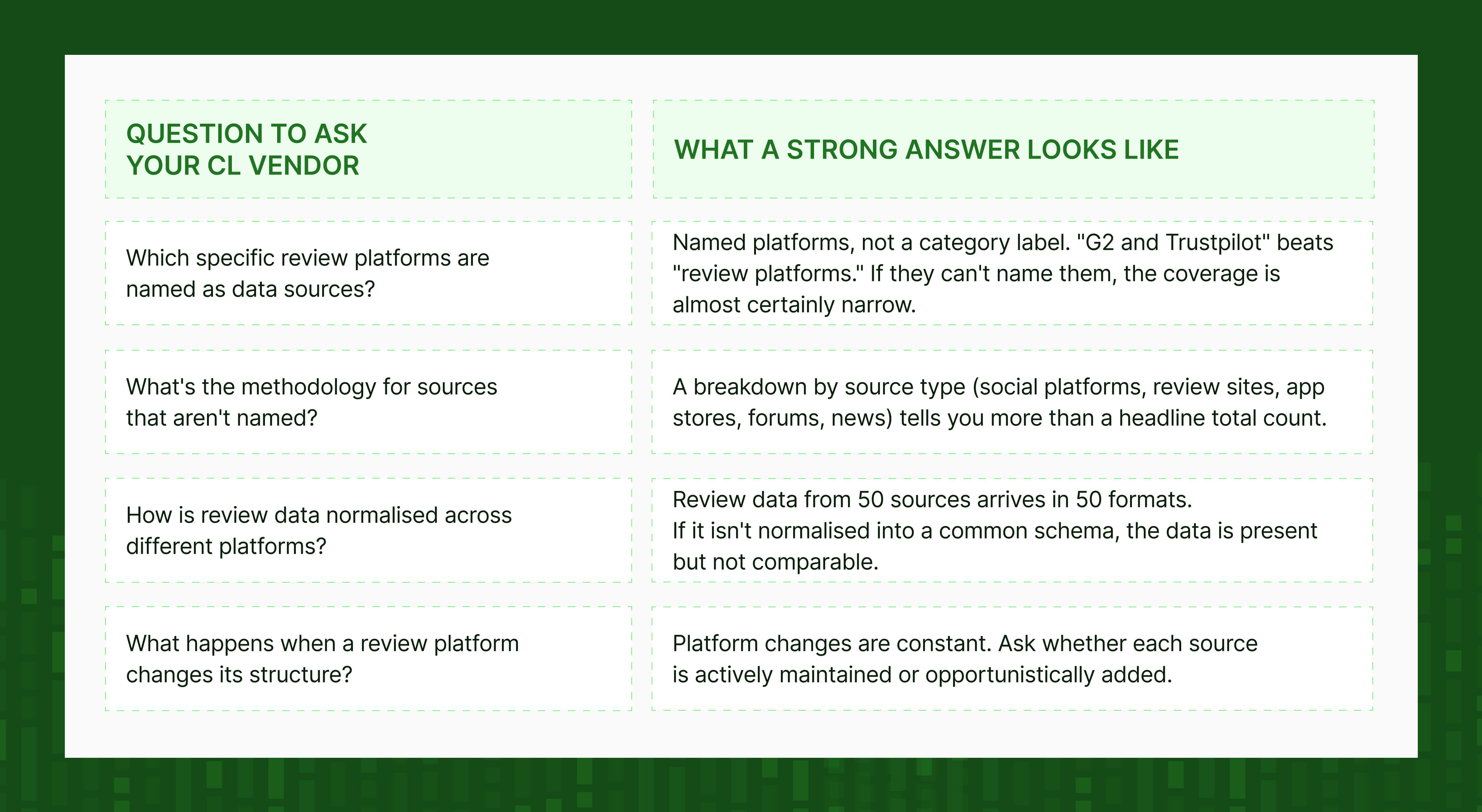
What questions should you ask a competitive intelligence tool about its review data?
Whether you're evaluating CI tools for your own programme or building a product that incorporates competitive data, these four questions cut through the category marketing:
Use the right tool for the right job
There are some very strong competitive intelligence tools out there:
- Crayon monitors more competitor signals than anything else in the dedicated CI space
- Klue has built a complete deal-level intelligence workflow
- Semrush is the definitive tool for digital and search competitive analysis
- Similarweb for traffic benchmarking
- Brand24 for social and mention monitoring
- Talkwalker for enterprise-grade social listening
Use the right tool for the right job and you'll cover a lot of ground.
What you won't cover though, with any tool, in any combination, is a systematic read on what competitors' customers are saying about them across the full landscape of platforms where that signal actually lives.
➡️ App stores. Employer review sites. E-commerce platforms. Hospitality directories. Health communities. Local review sources.
The places where people write honestly, without a PR filter, specifically to help other people make decisions.
❌ That signal is largely absent from every CI stack we've audited because building and maintaining clean, normalised review data across 150+ source types is hard infrastructure work.
It's expensive to build, expensive to maintain, and it degrades every time a platform changes its structure.
CI platforms invest that engineering capacity elsewhere: in battlecard workflows, AI summarisation, win/loss analysis, CRM integrations.
💡 Fill the gap
Datashake provides social and review data infrastructure across 150+ source types through a single API. If you're building a social intelligence, reputation management, or customer experience product and want to understand what's possible with broader source coverage, get in touch.
Frequently asked questions
What is the best competitive intelligence tool in 2026?
It depends on what you're trying to do. For monitoring the widest range of competitor signals – website changes, pricing, job postings, news – Crayon leads the category. For sales teams that need competitive intel routed directly into live deals, Klue is the strongest option. If budget is the constraint, Kompyte delivers solid automated monitoring and battlecards from $300/year. For social listening and brand monitoring, Brand24 and Talkwalker are the category leaders. For SEO and digital competitive analysis, Semrush is the definitive tool. For web traffic benchmarking, Similarweb.
Do competitive intelligence tools monitor review sites?
Klue names G2 as its review source, but it’s the only platform. Crayon lists "customer reviews" as one of ten monitored source types without naming any platforms. Kompyte mentions "review platforms" and "app stores" without specifying which. Talkwalker mentions 300+ review sites on its data coverage page. Brand24 includes review sites in its 25M+ source pool. Semrush and Similarweb don't cover review data at all.
What types of review data are most commonly missing from CI tools?
The review types that are most commonly missing from CI tools include: app store reviews (Apple App Store, Google Play), employer reviews (Glassdoor, Indeed, Comparably), e-commerce product reviews (Amazon, retailer platforms), hospitality and location reviews (TripAdvisor, Booking.com, Google Maps, Yelp), health and patient community reviews, and local or regional review sites. These sources often contain the most honest, unfiltered customer sentiment about competitors.
What is the difference between Crayon and Klue?
Both are dedicated competitive intelligence platforms and both were named Leaders in the 2026 Gartner Magic Quadrant. The difference is in what they're built around.
Crayon is organised around the signal – it monitors the broadest range of competitor sources and is best for teams that need comprehensive coverage across website changes, news, social, job postings, and more. Klue is organised around the deal – it routes competitive intelligence to sellers at the moment a competitor appears in a live opportunity, with native win/loss analysis built in via its DoubleCheck Research acquisition.
In practice: Crayon catches more. Klue converts more of what it catches into sales outcomes. Both are enterprise-priced at roughly $15,000–40,000+/year and both effectively require a dedicated CI owner to get full value: without someone curating the content, battlecards go stale and adoption drops regardless of which platform you're on.
Is Semrush a competitive intelligence tool?
Semrush is a digital marketing and SEO platform with strong competitive intelligence features, but specifically for the digital and search layer. It covers 24 billion keywords, 808 million domain profiles, competitor ad creative and spend via AdClarity, and since Semrush One launched in October 2025, AI search visibility across Overviews, Perplexity, and other LLM-driven surfaces.
What it doesn't cover: customer reviews, financial data, win/loss intelligence, or the kind of broad competitor monitoring that Crayon or Klue provide. Semrush's documentation states it "only sources data from search engines, social media, and advertising platforms."
How much do competitive intelligence tools cost?
There's a wide range. At the accessible end: Brand24 from $149/month, Semrush from $139.95/month, Similarweb from $125/month, and Kompyte from $300/year for Essentials. At the enterprise end: Crayon, Klue, and Contify are all custom-quoted, typically landing in the $15,000–40,000+/year range depending on team size, number of tracked competitors, and feature tier. Talkwalker is also custom-quoted with no published entry price.
.png)



More insights you might like
%20thumbnail.jpg)