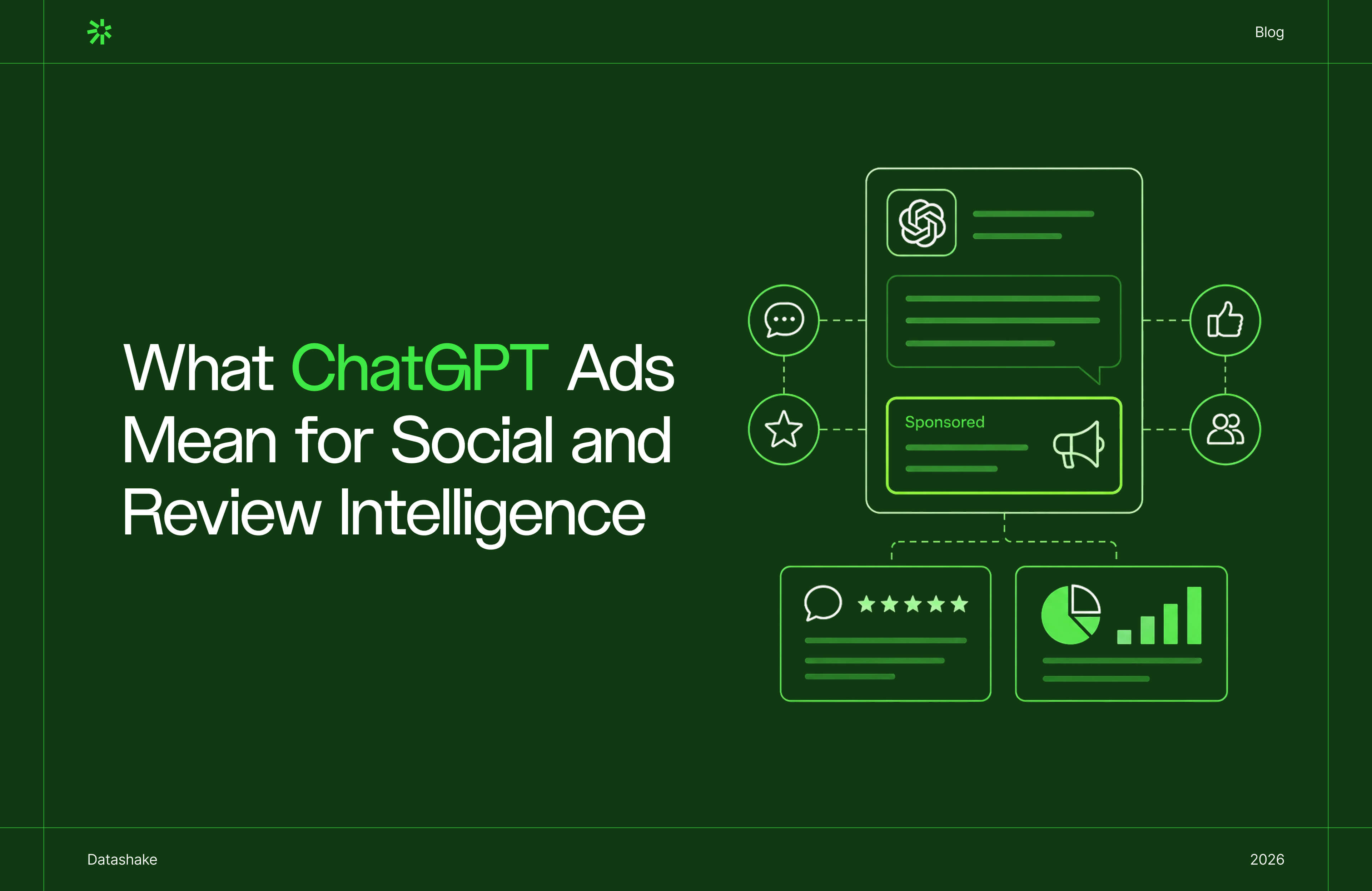
What ChatGPT Ads Mean for Social and Review Intelligence
Quick answer: ChatGPT ads, live since February 2026, let advertisers appear beside AI answers; but hand them only aggregated views and clicks, not the conversation or the review signal behind each recommendation. That leaves independent social and review data as the only way to see, and measure, how a brand actually shows up inside AI.
TL;DR
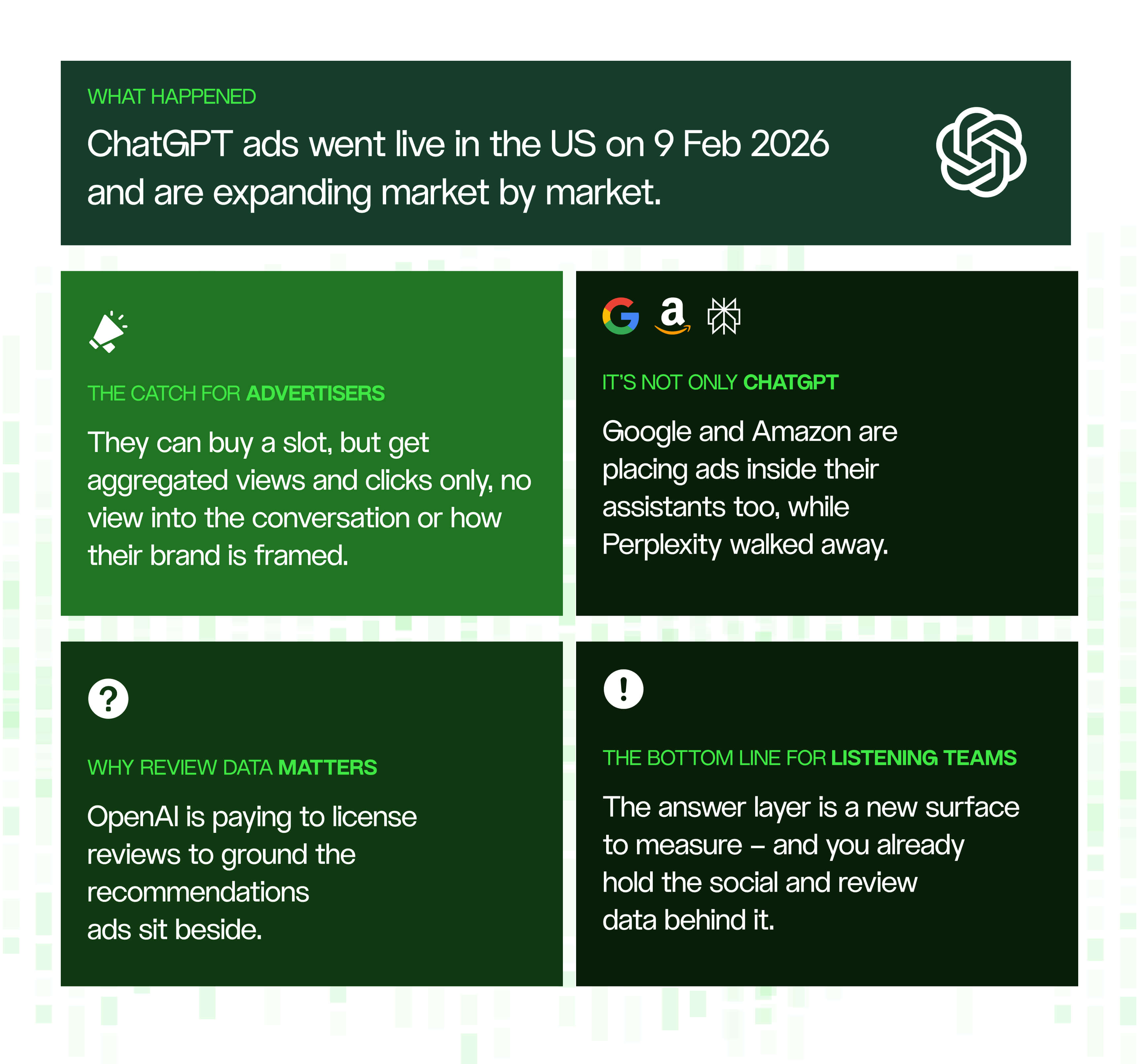
- ChatGPT ads went live in the US on 9 Feb 2026 and are expanding market by market.
- Advertisers can buy a slot, but get aggregated views and clicks only, no view into the conversation or how their brand is framed.
- It's not only ChatGPT, Google and Amazon are placing ads inside their assistants too, while Perplexity walked away.
- OpenAI is paying to license reviews to ground the recommendations ads sit beside.
- The bottom line for listening teams: the answer layer is a new surface to measure – and you already hold the social and review data behind it.
What are ChatGPT ads?
ChatGPT ads are sponsored placements that appear below an answer in ChatGPT, clearly labelled and kept separate from the response.
They show only to logged-in adults on the free and low-cost "Go" tiers in tested markets, and each ad is matched to the topic of your conversation rather than to a profile OpenAI sells on.
How do ChatGPT ads work?
ChatGPT ads work by matching sponsored content to the conversation, then ranking it by relevance and bid:
- You ask ChatGPT something with commercial intent: a product, a place, a tool.
- The ad system reads the topic and intent of your current chat to find relevant sponsored placements.
- If ad personalisation is on, past chats and memory can refine the match.
- Eligible ads are ranked on relevance and the advertiser's bid.
- One or more labelled ads appear below the answer, kept separate from it.
What advertisers can and can't see
The model is deliberately walled off. Advertisers buy proximity to a relevant moment, not the data behind it.
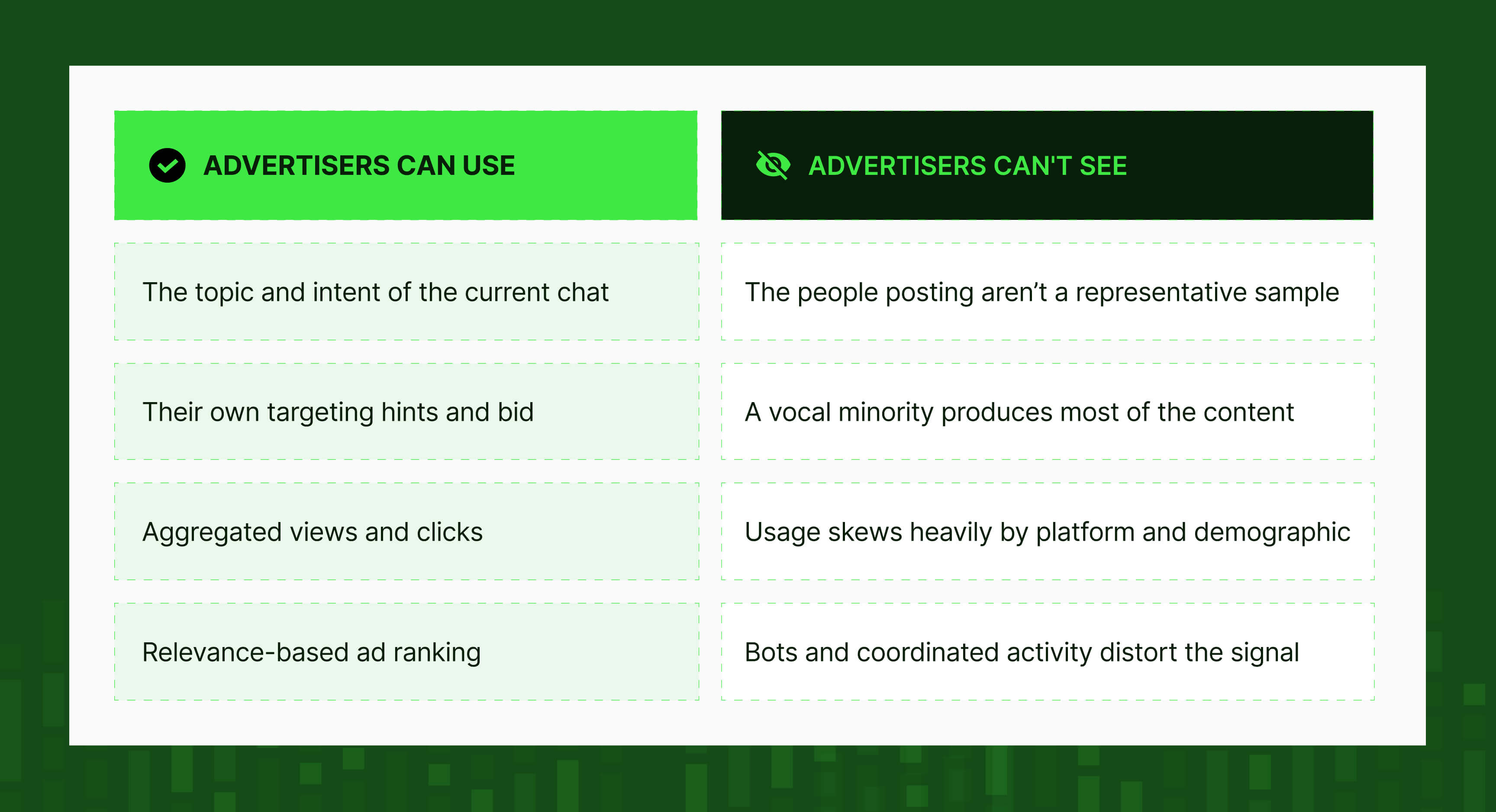
Ads sit below the response and are always labelled; no ads run near personal health, mental health, or politics; and none show to users predicted to be under 18.
Where are ChatGPT ads available?
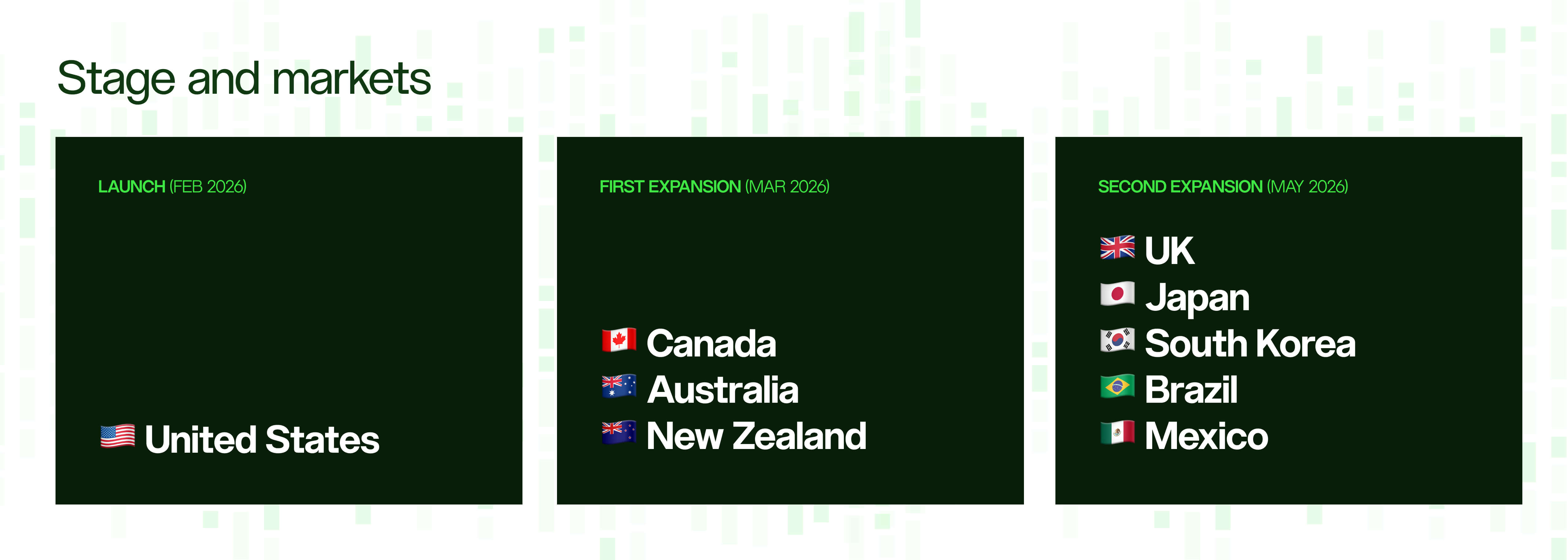
ChatGPT ads started in the US in February 2026 and have expanded across three stages, according to OpenAI:
What data do ChatGPT ads give advertisers?
Very little. Advertisers get aggregated views and clicks: how many people saw the ad and how many tapped it.
Those numbers tell you an ad ran. They don't tell you:
- Why the answer went the way it did
- How your brand was described in the response your ad sat beside
- Whether the assistant recommended you or a competitor
- Or what the wider conversation about you sounds like.
In a feed you can at least see the post next to your ad. In a conversation, that context is invisible: the assistant reads it, the advertiser doesn't.
When a platform keeps advertisers away from the underlying signal, the only way to read it is from the outside. That's what social data and review data are for: they reconstruct the context the ad platform won't hand over (the sentiment, the framing, the share of the conversation) so you can see what the metrics leave out.
Review data is now AI infrastructure
In July 2026, Yelp licensed around 330 million reviews and 8 million business listings to OpenAI so ChatGPT can use them for local recommendations. Yelp's stock jumped on the news.
Yep, OpenAI paid for structured, at-scale review data. Because grounded, attributable reviews are what make a recommendation trustworthy enough to show a user.
Do reviews affect what ChatGPT recommends?
Yes, reviews are increasingly the signal an assistant checks before it recommends anything. Which coffee shop, which SaaS tool, which contractor: the review data behind each option is doing much of the deciding.
An advertiser can buy the slot beside a recommendation. They can't buy their way into it. That part is earned through the review signal, and it stays independent of the ad auction.
So for review intelligence, the question remains "how is our review data shaping what an AI says about us, and how do we compare in the answer."
Where Datashake fits in
All of this rests on having access to a solid foundation: clean, structured review and social data, pulled from across the sources that shape AI answers and delivered somewhere you can build on.
That's what we do here at Datashake as an API and data layer. A few of the use-cases we help power:
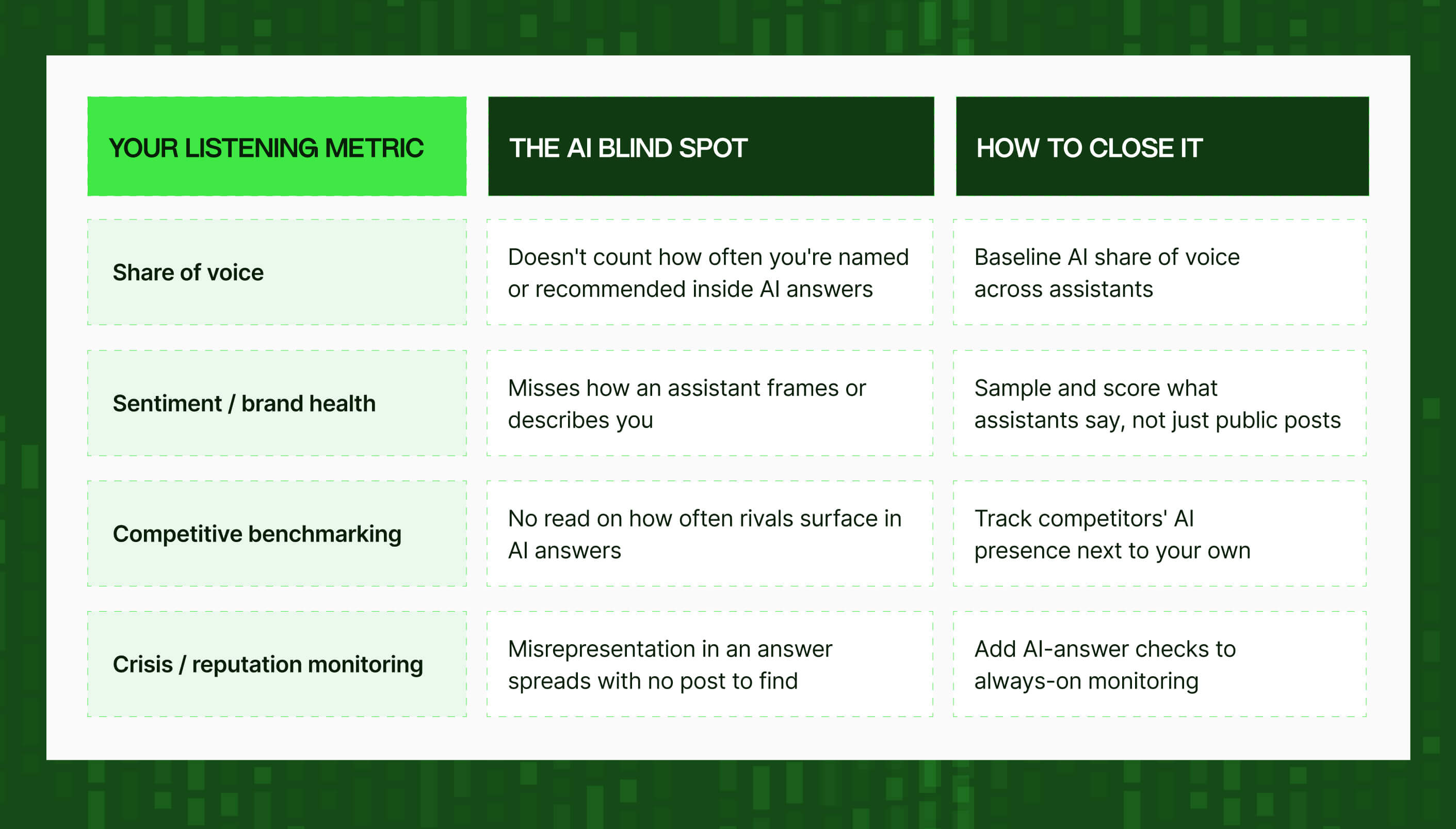
- AI share-of-voice tracking. Feed structured review and social data into your own models to baseline how often you're named or recommended across assistants, and how you're described when you are.
- Competitor benchmarking. Pull the same signal for rivals from review, social, and e-commerce sources, so your share of voice means something in relation to someone else.
- Reputation ground-truthing. Use your real review and social data as the reference to check an assistant's version of you against, and catch a misrepresentation early.
- Manipulation and anomaly detection. Work from raw, deduplicated review and social streams to spot coordinated activity or sudden sentiment swings before they skew what an AI recommends.
Because it arrives as clean JSON or CSV via API, it slots into the stack you already run: without scrapers to maintain, or platforms to wait on. It's the difference between building the data pipeline yourself and buying one that's managed for you.
What ChatGPT ads change for social listening
Every headline social listening metric assumes one thing: that the conversation is findable.
➡️ A public post, a permalink, a timeline you can track. Share of voice, net sentiment, brand health: they're all counts of things people said in the open.
An AI answer breaks that assumption. It has no permalink, it's assembled on the spot, and it can differ from one user and phrasing to the next. The assistant reads the conversation; nobody else gets to see it.
So a fast-growing share of brand impressions now happens somewhere your dashboards don't reach.
And that share is growing fast: shopping-related generative-AI use rose 35% in under a year.
As more discovery runs through answers you can't see, share of voice measured on social alone describes a shrinking slice of the picture.
💡 Go deeper: How to Use Social Data to Stress-Test Survey Findings for Market Research
So the listening surface widens:
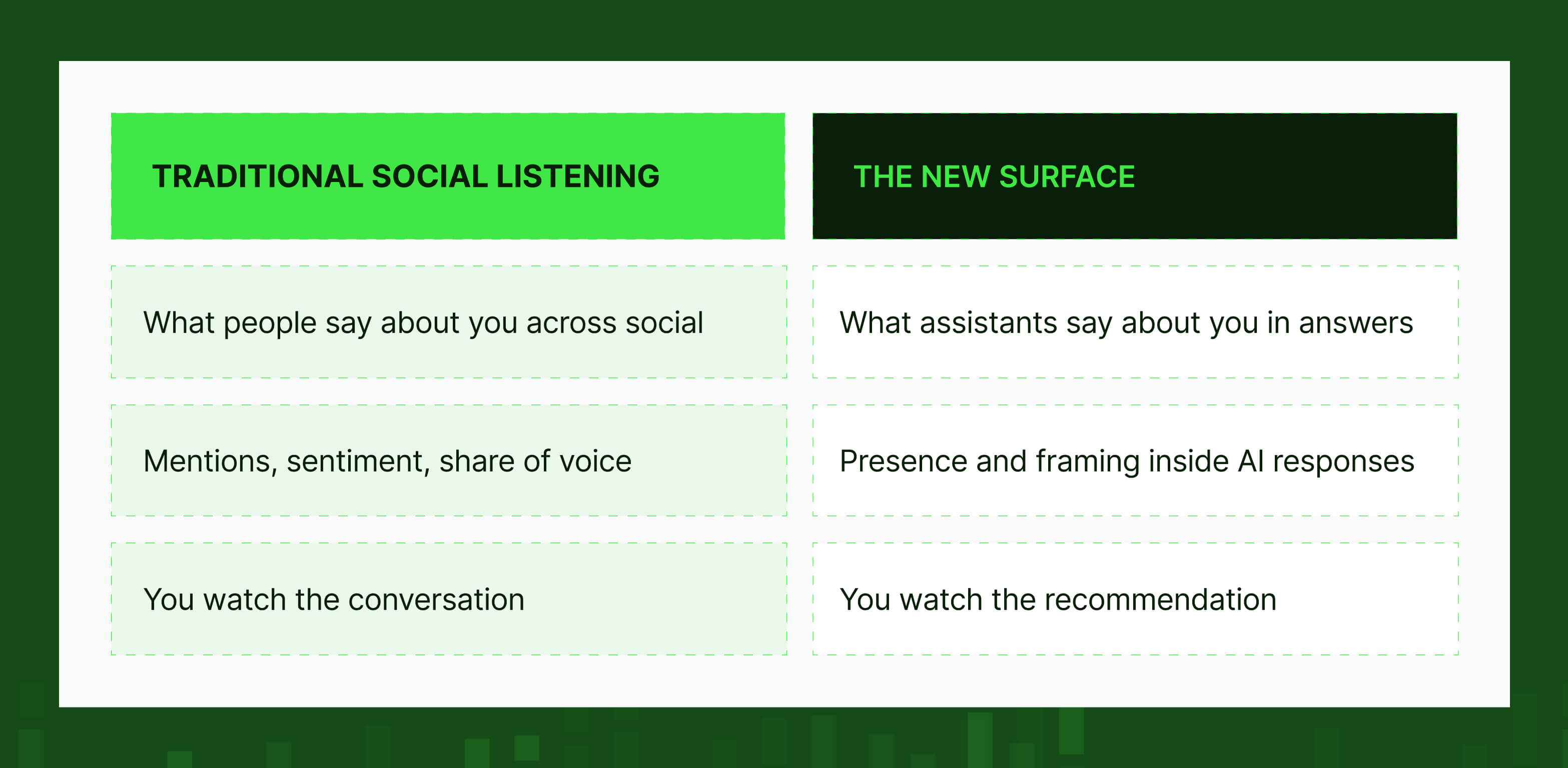
The inputs to those answers are exactly what you already track. An AI recommendation is a synthesis of social conversation and reviews, the signal listening teams have watched for years. You hold the upstream data. What's missing is a read on the downstream output: what the assistant says back.
So because those conversations are private, you can't see the questions people ask an assistant about your category directly. The social and review signal feeding those answers is the closest proxy you have for that hidden demand.
Where your listening metrics now have a blind spot
Should you license your social data to AI?
Social data has become a licensable asset: Reddit reportedly earns around $60 million a year from its Google deal and licenses to OpenAI too.
But those platforms have started asking an uncomfortable question: whether feeding the AI answer layer undercuts the value of their own advertising.
Sell your signal to the assistant, and you may be sharpening the thing that competes with you.
➡️ Social signal is now valuable enough that everyone is arguing over who gets to use it. When your inputs are being fought over, they're worth investing in. 👏
Which AI assistants are showing ads?
ChatGPT isn't acting alone. Paid placements are arriving across the assistants people now ask for recommendations.
AI assistant
Where ads stand
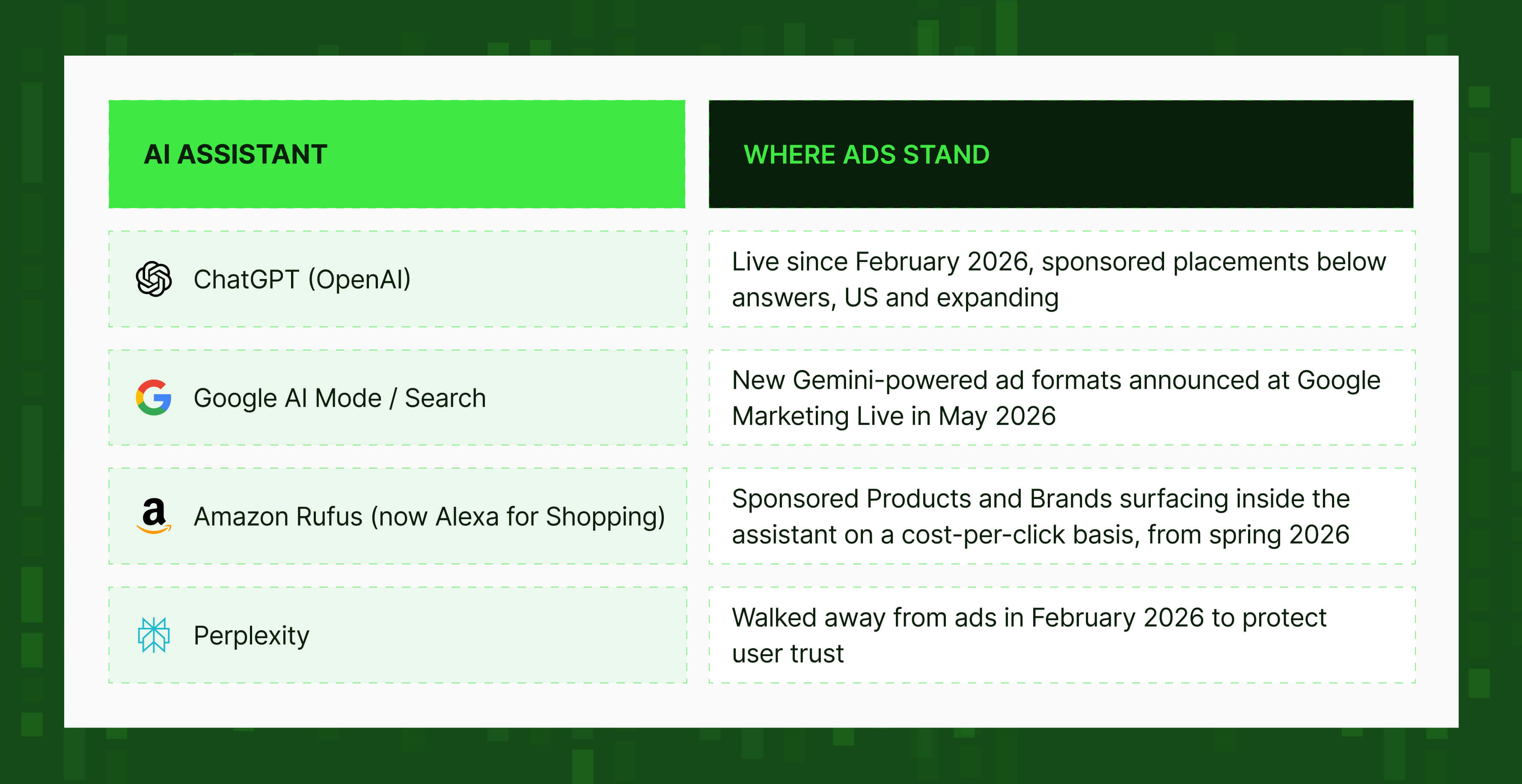
- ChatGPT: Ads have run since February 2026, appearing as labelled placements below an answer, starting in the US and widening market by market through the year.
- Google: At Google Marketing Live in May 2026 it introduced new Gemini-powered ad formats built for AI Mode and Search, ads designed to sit inside a conversational answer rather than above a list of blue links.
- Amazon: Its shopping assistant Rufus, now rebranded Alexa for Shopping, has Sponsored Products and Sponsored Brands surfacing inside the chat on a cost-per-click basis, with existing campaigns rolled in from spring 2026.
- Perplexity: After testing sponsored questions from 2024, it publicly walked away from advertising in February 2026, arguing that ads would erode the user trust its product depends on.
The direction of travel is clear: the assistants that dominate discovery are turning into ad channels.
But not everyone agrees it's worth it, Perplexity's retreat is a reminder that trust is the real constraint, and it's the same worry that keeps the players who are running ads labelling them and boxing them off from answers.
What is AI share of voice?
AI share of voice measures how often, and how favourably, your brand appears inside AI-generated answers.
It's the AI-era counterpart to share of voice across social and search, measured across every assistant that answers, not just one.
And it's the metric brands are starting to baseline, sometimes filed under answer engine optimisation (AEO) or generative engine optimisation (GEO).
Are ChatGPT ads worth the hype?
OpenAI has reportedly projected roughly $2.5 billion in ad revenue this year, climbing toward $100 billion by 2030.
But analysts aren't convinced: eMarketer estimates the company will fall about 90% short of that 2030 figure, pegging the entire US chatbot ad market at a small fraction of OpenAI's target.
Either way, it strengthens the case for independent data.
If in-platform measurement stays thin and the numbers stay contested, the neutral read from review and social data is what brands can actually trust to tell them whether any of it works.
What social and review intelligence teams should do now
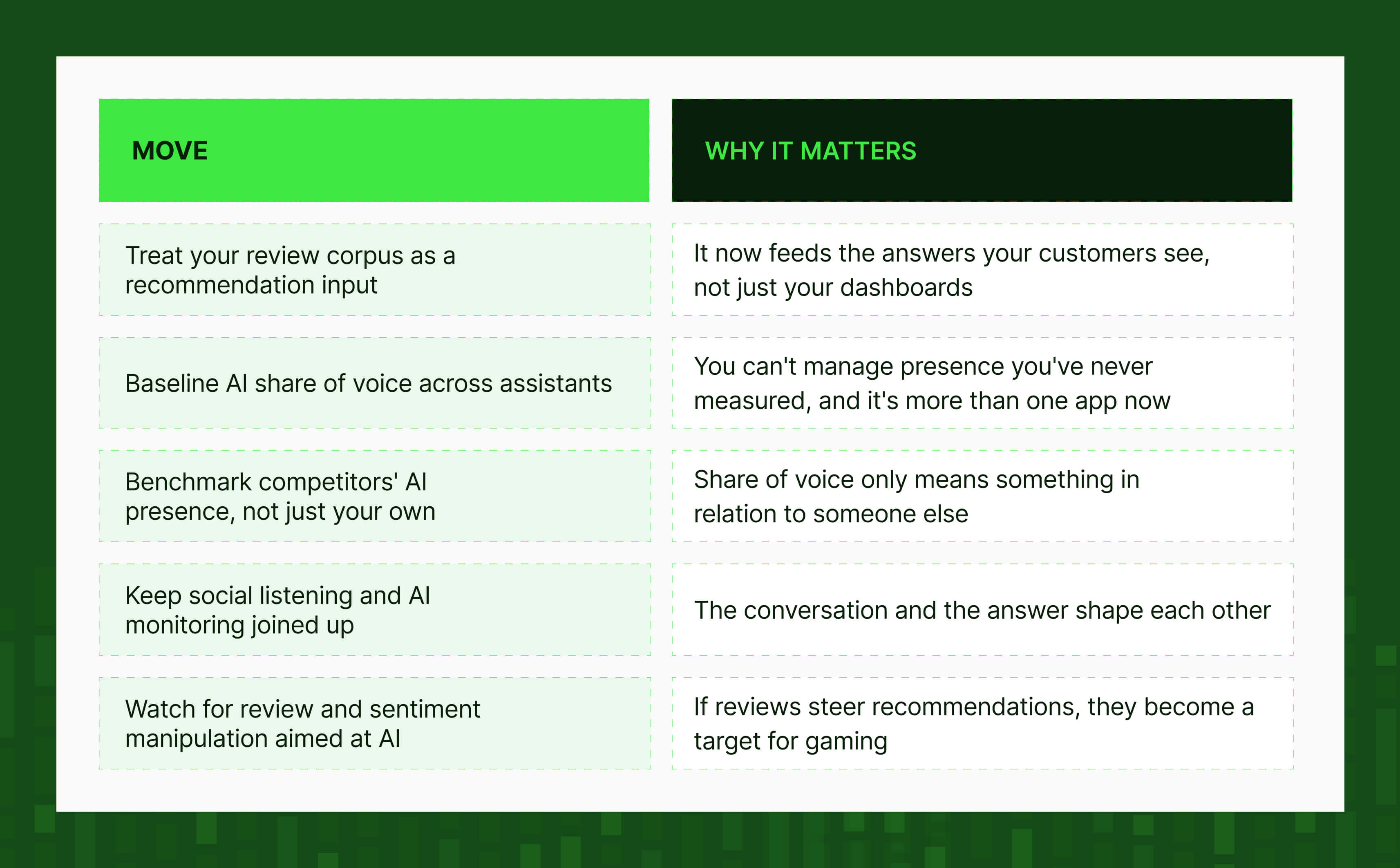
None of this needs a reorganisation or a new budget line this quarter. It's more a shift in how you treat data you already work with.
Treat your review corpus as a recommendation input
Reviews used to be something you analysed after the fact: sentiment for a dashboard, themes for a quarterly deck.
Now the same data helps decide whether an assistant recommends you at all.
That changes what "good" looks like: freshness, volume, and breadth across sources start to matter as much as the average star rating, because those are the signals an AI leans on when it vouches for a business.
Baseline your AI share of voice across assistants
You can't improve a presence you've never measured, and there's no longer a single place to measure it.
Weight your effort toward the assistants that matter for your category: a retailer cares most about the shopping assistants, a B2B or local brand about ChatGPT and Google's AI answers.
Pick the questions your customers ask, run them across those assistants, and record how often you appear, in what light, and against which competitors. Even a rough first baseline tells you where you stand and gives you something to move.
Benchmark competitors' AI presence, not just your own
Share of voice only means something in relation to someone else.
Tracking how often rivals surface in AI answers – and how they're described when they do – is the same competitive read listening teams already run across social, moved to the surface where buyers now build their shortlists.
See also: 8 Best Competitive Intelligence Tools in 2026
Keep social listening and AI monitoring joined up
These aren't two separate jobs. What people say across social feeds into what the assistants say back, and the assistants' answers shape the next round of opinion.
Watching one without the other gives you half a picture, and usually the wrong half, since the conversation is the leading indicator of the answer.
Watch for review and sentiment manipulation aimed at AI
If reviews now steer what assistants recommend, they become a target for gaming.
Spotting coordinated or fake review activity, and sudden sentiment swings, is already a listening-team responsibility, it just matters more when that data feeds AI recommendations.
➡️ Structured, comparable, historical review and social data is the layer that makes all of this legible. It's the part assistants keep private and advertisers can't see.
Related: Why messy data breaks your analysis — Social Data Deduplication: What It Is and How it Works
💡 Your listening tools can't see inside AI answers. Datashake can help you get there.
A growing share of brand perception now forms inside AI answers your dashboards don't reach. Datashake gives you the structured review and social data to extend what you already do: track your AI share of voice, benchmark competitors, and catch a misrepresentation before it spreads. Explore Datashake
FAQ
When did ChatGPT ads launch?
OpenAI began testing ads in ChatGPT in the US on 9 February 2026, for logged-in adults on the free and Go tiers, and has been expanding to more countries through the year.
How do ChatGPT ads work?
They match sponsored placements to the topic and intent of your current conversation, rank them by relevance and the advertiser's bid, and show them below the answer as clearly labelled ads
How much do ChatGPT ads cost?
OpenAI hasn't published fixed rates. Pricing runs on an auction, so cost depends on relevance and competing advertiser bids, and access is currently through a sign-up on OpenAI's advertiser page rather than open self-serve.
Which AI assistants show ads?
As of 2026, ChatGPT, Google's AI Mode, and Amazon's Rufus / Alexa for Shopping all carry ads, while Perplexity stepped away from advertising to protect user trust.
Do ChatGPT ads use my social or review data?
Ad targeting uses your conversation (and your ChatGPT history if personalisation is on), not third-party review data. Review data enters differently: OpenAI licenses reviews to ground the organic recommendations ads appear beside.
Can advertisers see my ChatGPT conversations?
No. Per OpenAI, advertisers get only aggregated performance data such as total views and clicks – not your chats, history, memories, or personal details.
Do reviews affect what ChatGPT recommends?
Yes. Reviews increasingly act as a trust signal an assistant weighs before recommending a business, product, or service – which is why AI platforms are now paying to license review data at scale.
💡 Related: Reviews often flag trouble before your dashboard does – How to Spot Customer Churn Signals in Reviews
What is AI share of voice?
It's a measure of how often, and how favourably, a brand appears inside AI-generated answers, across the assistants people use — the AI-era counterpart to share of voice across social and search.




More insights you might like
.png)