Sentiment Alone Is Not a Strategy: How to Use Social Data in Strategic Decision-Making
Commission a qualitative research study. Budget somewhere between £8,000 and £50,000. Wait six to eight weeks. Get a report describing opinions that may already have shifted. That is the research instrument too many strategic decisions about products, pricing, and positioning are still built on.
Now contrast that with this: millions of people, right now, talking to each other unprompted in communities they chose – about products, problems, and decisions. Neither a moderator nor recruitment fee in sight. Without observer effect or wait time.
Most organisations are treating that conversation as a marketing metric. This post is about why that's a strategic mistake, and what the organisations getting real value from social data are doing differently.
Let’s dive right in ⬇️
Who this is for:
- Strategy, insights, and research leaders who suspect their social data is being under-used – and want to understand what "using it properly" actually looks like
- VPs of Marketing, Product, and Customer Success who are being asked to make faster decisions with better evidence
- Data and analytics leads evaluating social intelligence as an input to business reporting, not just campaign measurement
- Anyone who has sat in a strategy meeting where the answer was "let's commission some research" and wondered whether there was a faster, cheaper, more honest way to get there
What you'll learn:
- Why sentiment scores are a flag, not an insight, and what the investigation that follows actually looks like
- How social data compares structurally to traditional research methods, and why the economics are increasingly asymmetric
- Why the survey (the instrument most strategic decisions are still built on) is becoming less reliable, and what's replacing it
- Where social data creates genuine strategic value outside of marketing
- Why the biggest barrier isn't the tool or the data – it's organisational design and C-suite buy-in, and what the organisations doing this well have figured out
- What a social intelligence programme built around business questions looks like, and how to start designing one
Why social data has a positioning problem
Social data has only been sold, packaged, and delivered as a social media tool so far. Social listening. Brand monitoring. Sentiment tracking. The language is reactive, the outputs are tactical, and the dashboards sit inside the marketing or comms team.
So when a VP of Strategy or CFO hears "we need to invest in social intelligence," what they hear is: the marketing team wants a better dashboard to track their social media posts. And they're not wrong, because that's almost always what they've been shown and what they have received.
Social data gets relegated to dashboards
One reason social data gets relegated to dashboards is that most organisations treat it as a quantitative instrument. They count mentions, score sentiment, and measure volume. And then the outputs don't inform decisions.
Qualitative research is where the why lives. Surveys tell you what percentage of people hold a view. Qualitative research tells you why they hold it, what language they use to describe it, what emotional register accompanies it, and what other concerns cluster around it. That is the kind of intelligence that changes positioning briefs, product directions, and brand messaging.
Where you sit shapes what you answer
The Social Intelligence Lab's 2025 State of Social Listening report confirms this. Only 10% of in-house brand professionals believe social listening is considered in every strategic decision, versus 30% of agency professionals. The difference is where the function sits and what questions it's asked to answer.
When social intelligence lives inside marketing, it answers marketing questions. When it sits inside research and insights (as it does in the organisations getting real strategic value from it) it answers business questions.
The organisations extracting the most value treat it as a company-wide input:
- R&D uses it to validate product direction before development begins
- Sales uses it to find prospects already asking questions the product answers
- Customer success uses it to detect churn signals in the communities where dissatisfied customers talk to each other long before they talk to you.
➡️ The biggest single barrier to social intelligence being used strategically isn't data quality, budget, or tooling. It's a lack of knowledge and buy-in at manager and C-suite level. The function can't answer business questions if leadership doesn't know to ask them – or doesn't yet see social data as the kind of instrument that belongs in that conversation.
This is a governance problem, not a technology problem. And it explains a pattern that shows up consistently: organisations that have elevated social intelligence out of the marketing function (giving it a seat in research, strategy, or product) tend to use it more strategically, get more leadership engagement, and derive measurably more value from the same underlying data. 👏
The fix isn't a better tool. It's a better question, asked at a higher level, by someone with the authority to act on the answer. And that starts with understanding what social data actually is. ⬇️
Before redesigning the question, it's worth checking whether the data underneath it is actually representative. → Why Your Social Media Data is Incomplete

Sentiment is not a strategy
Let's be precise about what sentiment analysis can tell you.
Positive, negative, neutral at the post level tells you that a mention has a certain valence. It doesn't tell you:
- Whether the negative mention is about pricing, a product defect, or a customer service failure
- Whether someone is venting or about to churn
- Whether the problem is new or systemic, isolated or accelerating
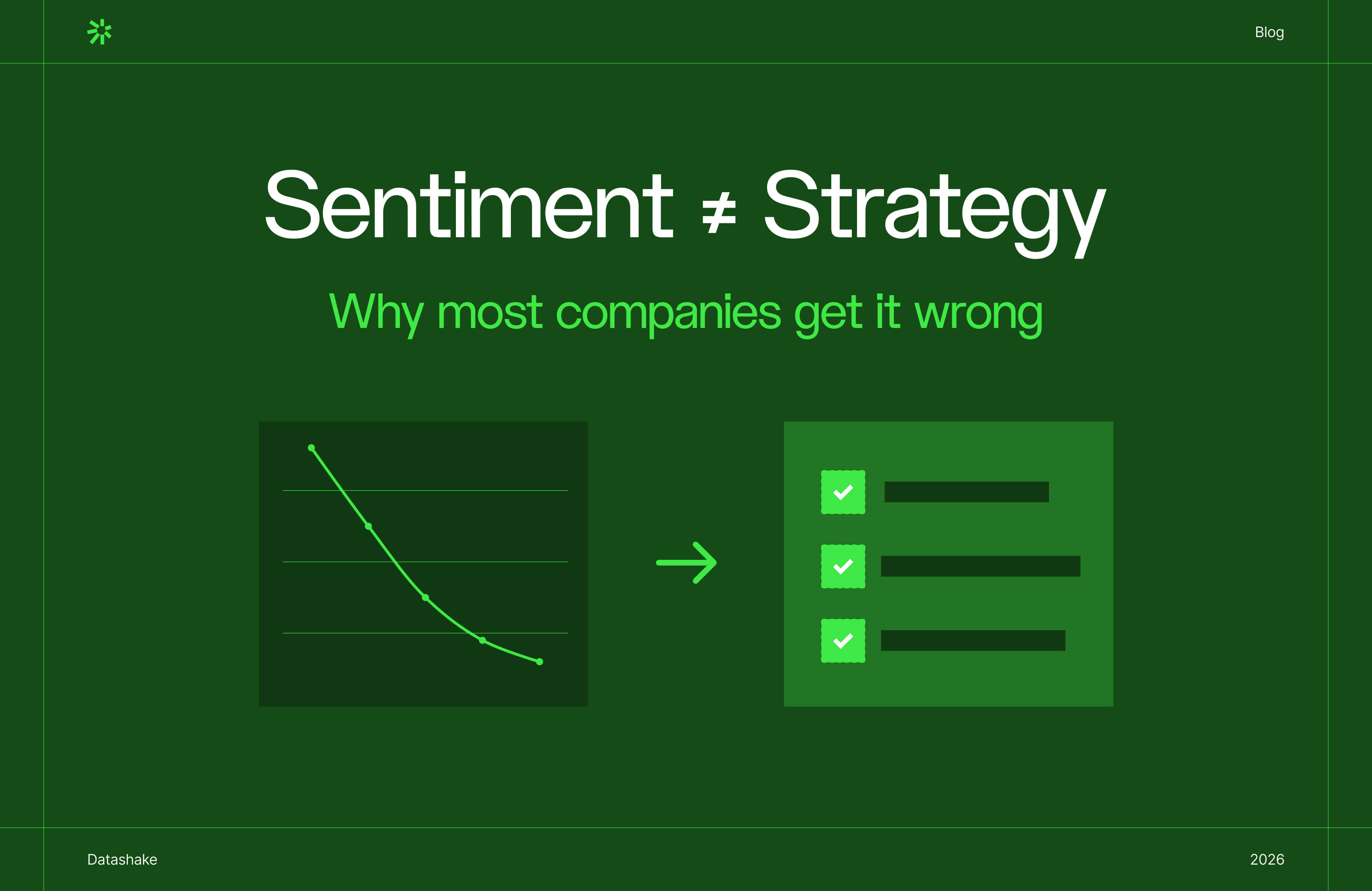
A declining sentiment score isn't an insight. It's a flag that says: there's something here worth investigating. The investigation – what it is, who's saying it, in which communities, at what volume, and with what trajectory – that's the strategy.
Platforms like Converseon go well beyond positive/negative/neutral – analysing posts for specific emotional attributes including frustration, anticipation, surprise, and satisfaction.
That level of granularity changes what you can do with the data.
❌ Knowing that sentiment is declining tells you something is wrong
✅ Knowing that frustration is spiking while surprise is also elevated (in a specific community, around a specific product feature) tells you what the problem is, who it's affecting, and how urgently it needs a response.
That's the difference between a metric that flags and an instrument that informs.
The same data, two completely different values
Consider two versions of the same underlying data:
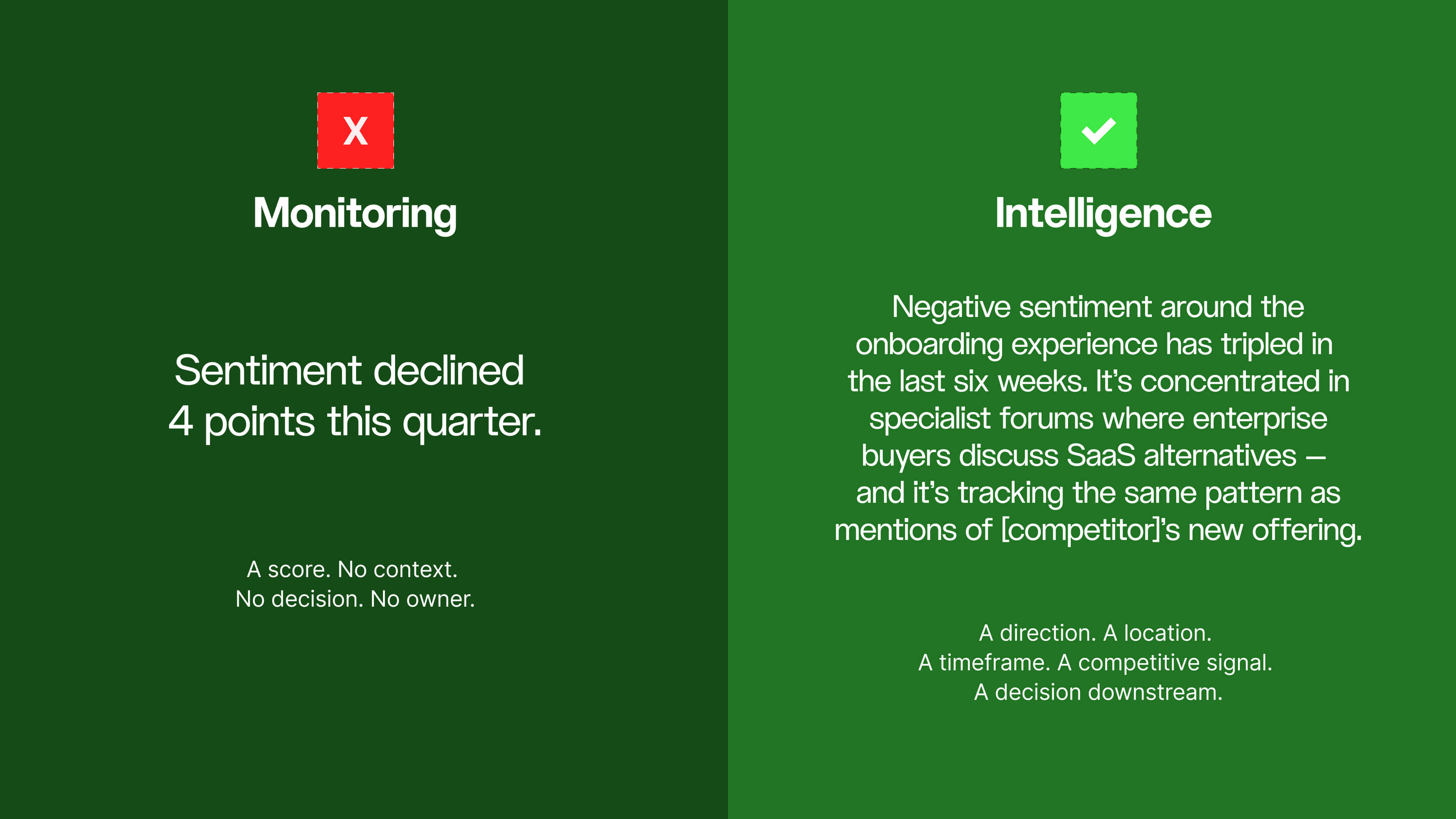
❌ Version 1: "Sentiment declined 4 points this quarter."
✅ Version 2: "Negative sentiment around the onboarding experience has tripled in the last six weeks. It's concentrated in specialist forums where enterprise buyers discuss SaaS alternatives, and it's tracking the same pattern as mentions of competitor X's new offering."
It’s the same data source, but with completely different strategic value. The difference is the question that was designed before the data was collected. Version 1 is monitoring. Version 2 is intelligence.
What social data actually is
Social data isn't a social media tool. It's a real-time, continuous, community-level market research instrument. And compared to traditional research, it has structural advantages that are difficult to overstate.
The problem with the observer effect
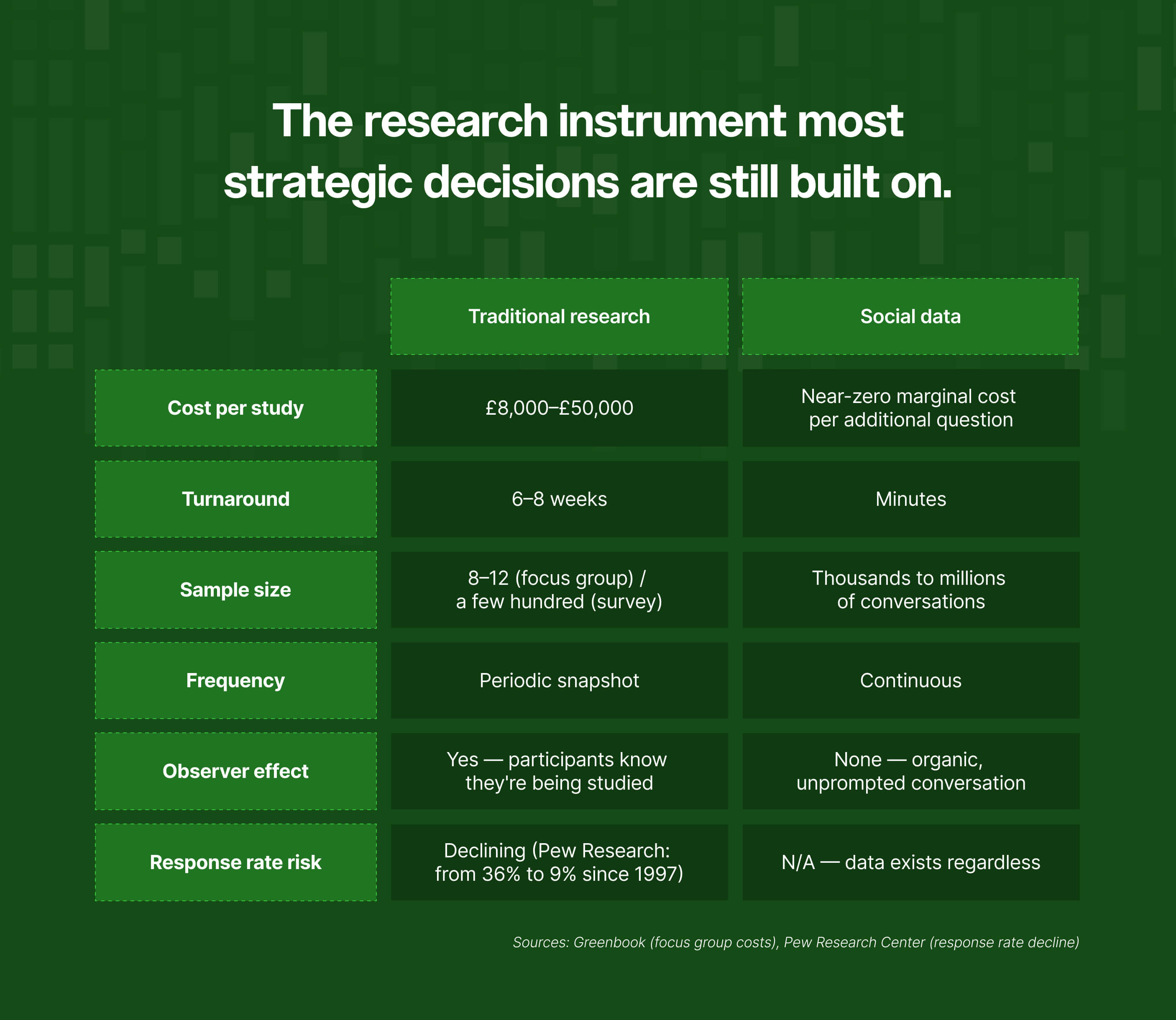
Focus groups and surveys have a well-documented observer effect. Research on focus group methodology shows that when people know they're being studied, they perform – they give answers that align with the group, that seem rational to a moderator, or that they think the researcher wants to hear. Quieter participants may agree with more vocal ones even when they disagree.
Social data has no observer effect. The person posting in a forum thread about a product failure isn't talking to a researcher. They're talking to a community. They're not trying to look good or be helpful to your brand, they're just being honest.
As Scott Cook, co-founder of Intuit, put it: "A brand is no longer what we tell the consumer it is – it is what consumers tell each other it is." Social data is the live feed of those conversations. Everything else is reading what brands want to say about themselves.
Scale and statistical confidence
A focus group gives you 8–12 people. A well-designed social data query gives you thousands of conversations, from communities across demographics, geographies, and contexts. The statistical confidence is categorically different. You're not extrapolating from a handful of responses. You're reading the population directly.
And the economics reflect this: a well-run focus group costs £4,000–£12,000 per project – a snapshot in time. Social data infrastructure, once established, runs continuously at near-zero marginal cost per additional question.
The trust dynamic
There's a reason peer conversations carry disproportionate weight in buying decisions.
➡️ 92% of consumers trust recommendations from people they know over any form of advertising.
The conversations happening in communities are the ground truth of brand perception, far closer to what actually shapes buying decisions than any commissioned research. Social data reads those conversations at scale.
One important nuance on data quality

⚠️ None of this holds if the data isn't representative.
If 80% of your social data comes from a single platform, you're hearing the opinion of that platform's demographic. No single source should account for more than half your data, or you're systematically skewing insights toward one community's profile.
MIT Sloan Management Review researchers found in one client case that just 10% of posts provided by a social data vendor had actually been written by a real consumer. The rest came from brand marketing agencies, e-commerce sellers, and bots.
You can have perfect platform distribution and still be basing strategic decisions on data that no genuine customer wrote. This is why your infrastructure (where your data actually come from, and how is it collected) matters as much as coverage breadth. A sentiment score generated from 90% non-consumer content is effectively structured noise dressed up as market research.
The point is that data quality cannot be assumed. It has to be verified at the source level, before the query is ever run.
If you're not sure your data passes this test, we've built a practical framework for evaluating social data coverage before you build strategy on top of it. → Is Your Social Data Representative?
Why the instrument your strategy is built on might be breaking

Pew Research Center's data shows that the response rate to a typical telephone survey dropped from 36% in 1997 to just 9% by 2012, and continued declining from there. Those are the people doing it properly, a well-funded research institution with rigorous methodology. For the average company sending a post-purchase feedback email, rates are significantly lower.
Survey volumes have jumped 71% since 2020, while response rates have crashed for many organisations, dropping from 30% to just 18% in some cases in a six-month window. About 70% of people quit surveys midway through due to exhaustion.
According to Fortune's February 2026 investigation into the survey crisis, NYU marketing professor Priya Raghubir put it plainly: "You're getting a very biased view, simply because there's survey overload." Surveys now over-index for people at the emotional extremes (the very angry and the very satisfied) while the large middle, where most market intelligence actually lives, goes unheard.
Social data does not have survey fatigue. Nobody opts out of being in a community. Nobody receives a notification asking if they would like to share their views on a product this time. They are simply there, already talking. The insight infrastructure is built from conversations that happened regardless of whether you were listening, and it scales continuously, at zero marginal cost per additional question.
Where social data creates strategic value
Social data creates genuine strategic value in at least four areas that have nothing to do with campaign measurement. ⬇️
1. As a leading indicator – seeing what's coming before the numbers confirm it

Every conventional business metric is a lagging indicator. Revenue, churn, NPS, CAC – by the time you see them move, the window for intervention has often closed. The quarter is over. The customer has already left. The trap most organisations fall into is treating lagging indicators as their primary management tool.
Social data operates upstream of these metrics. At the macro level, it is one of the fastest and most cost-effective ways to track shifts in industry dynamics and consumer behaviour – how priorities are changing, what new concerns are emerging, which categories are gaining or losing cultural relevance. At the micro level, it surfaces the specific signals that precede business outcomes: the forum thread where frustration accumulates, the community discussion where alternatives are being compared, the specialist space where product limitations are being documented. Both matter strategically. Macro trends indicate where purchase intentions are forming and shifting. Micro signals tell you when a specific account, segment, or product is at risk – weeks or months before the churn event, not after.
This is why social data is increasingly the basis for anticipating demand, not just measuring it. It tells you not just what people think right now, but what they are moving towards. And that directional quality is what distinguishes a leading indicator from a reporting tool.
It is also precisely why 65% of hedge funds now use alternative data, with social sentiment among the most widely used signals. If the most analytically rigorous organisations in the world (institutions that can be ruined by bad information) have made social data a standard input to their decision-making, the question of whether it's credible is already settled. 👀
2. As a competitive intelligence instrument
Your competitors' unhappy customers are writing their evaluation criteria in public. They're describing exactly what they needed and didn't get. Social media is effectively a window into your competitors' focus groups: customers publicly share pain points and feature requests that organisations can use to differentiate. If customers are complaining en masse about a rival's missing feature, you can prioritise it before they make the connection.
Building materials company James Hardie® uses social listening for competitive research, combining audience analysis, product sentiment research, and competitor comparisons.
In their words: "Not only is it good from a brand health and marketing angle – it's also important information we can pass on to our sales teams and product teams."
And here's a term for what happens when you don't read these signals in time. ⬇️
MIT Sloan Management Review researchers coined it: a strategy hijack. It describes the moment when groups of dissatisfied customers overtake control of an organisation's strategy, forcing reactive pivots instead of proactive decisions.
Sonos, Adidas, Coca-Cola, H&M, and Lego have all experienced versions of this. The researchers' conclusion: strategy hijacks can be predicted and avoided. Social intelligence is the primary early warning mechanism.
Apple's 2024 iPad Pro 'Crush!' showed a hydraulic press destroying creative tools (instruments, books, cameras, a piano) to reveal the new iPad. The backlash was immediate and severe. Apple's VP of marketing communications apologised publicly: "We missed the mark with this video, and we're sorry." The company pulled the ad from television entirely.
Apple's in-house team is among the most sophisticated in consumer tech. But they experienced an intelligence gap. A Wharton marketing professor who analysed the response put it plainly: the ad reflected "a misunderstanding of the fear that consumers have of tech and generative AI kind of destroying humanity." That anxiety – tech erasing human creativity – had been building visibly in creative professional communities for months before the campaign launched. It was there in the forums, the threads, the comment sections where Apple's core audience processed what AI was doing to their industry.
3. As a real-time trend instrument, not just for finance
Social data is the only intelligence source that detects shifts in consumer language as they happen. Language changes before behaviour does. Research from the Corporate Foresight Initiative shows that companies with formal "weak signal" scanning processes (the ability to detect early, faint indicators before they become mainstream trends) are 33% more likely to achieve above-average financial performance.
Social data is one of the richest sources of weak signals available. When the way people talk about a category starts shifting – new vocabulary emerges, different concerns surface, certain communities start engaging with a topic that was previously quiet – that's a directional signal. It gives you the ability to act before competitors know what's forming.
For a full picture of where social data is creating measurable strategic value right now, this is worth reading alongside this post. → The Most Impactful Use Cases for Social Data in 2026
This isn't exclusive to finance. McKinsey recommends it explicitly for consumer and retail leadership teams: "Consumer sentiment is no longer neatly aligned with consumer spending, and simple methods for predicting consumer behaviour are insufficient. Companies need to build a 360-degree view of their consumers that enables proactive decision-making. This means leveraging new capabilities, such as AI-powered social-listening tools."
4. As community-level targeting for research
Traditional research segments by demographic – age, gender, geography. Social data lets you query by community: the specialist forums, professional communities, and practitioner spaces where your buyers actually talk to each other.
For a B2B organisation, that might mean listening to the communities where enterprise buyers discuss SaaS alternatives before they've raised their hand as a prospect. You're not waiting for them to come to you, you're understanding the conversation that shapes their decision before any discovery call happens.
That conversation is happening before people make purchasing decisions. Someone asking "Has anyone tried Brand X's new feature?" in a specialist community weeks before they buy is a signal most organisations aren't capturing. That is community intelligence, and it gets you closer to how decisions are actually made.
5. As a product development instrument – before the brief, not after the launch
MIT Sloan Management Review documented a skincare manufacturer that doubled its product success rate after replacing survey-based research with social listening as a primary input – halving its development costs by building fewer products that didn't find a market.
Instead of asking curated groups structured questions in a controlled setting, the team read what real consumers were saying to each other about packaging, formulation, and experience. Not ❌ "what would you like this product to do?" but ✅ "what are you actually complaining about, right now, to people you trust?"
That is a structural rethink of where product insight comes from, and when in the development cycle you seek it.
The use cases above require a different kind of data infrastructure – one that feeds product, research, and strategy rather than a marketing dashboard. This is what that looks like in practice. → What is Headless Social Listening?
The same research makes a point worth sitting with: new-product development cycles often last months, if not years. A concept that fits the market at the brief stage may be misaligned by the time it reaches launch. Social data is the only source that lets you track how the audience's language, concerns, and priorities are shifting across that entire window, not just at the beginning.
The shift from monitoring to intelligence
There are three distinct levels at which organisations use social data:
- Monitoring – what's being said? Volume, mentions, sentiment scores. This is the dashboard. Most organisations have this. It isn't useless, but it isn't strategy.
- Listening – why is it being said? Contextual analysis, community identification, trend detection. This is where most analysts want to be working, and most aren't.
- Intelligence – what should we do, and when? Strategic insight tied to a specific decision, with ownership and a decision downstream. This is where real value sits.
The 2025 State of Social Listening report puts this tension in clear terms: "Technology is great for measuring – competitive benchmarking, crisis detection, brand health tracking. Where it struggles is finding meaning in the data. That requires critical thinking by humans. And the richer insights that result from this are where the strategic impact lies."
The question is the instrument
A social intelligence programme starts with the strategic question, not the sentiment dashboard. For example:
- What are the fastest-emerging frustrations among the buyer segment we're targeting next quarter?
- What language is our category using that our current messaging doesn't reflect?
- Where is negative sentiment concentrating, and is it in the communities where enterprise buyers make decisions?
Here's what the difference between monitoring and intelligence looks like when you reduce it to the query itself. ⬇️
❌ A monitoring query asks: [brand name] + sentiment, last 30 days.
✅A strategic query asks: What are the most frequently cited reasons enterprise buyers in [target sector] give for switching away from [product category] – and in which communities is that conversation most concentrated right now?
The first produces a score. The second produces a decision, or at least a decision-shaped input. That requires a different starting point, a business question that exists before the data is collected, not a dashboard that generates outputs for someone to interpret later.
If you're thinking about what it takes to build a social intelligence program that operates at this level, the build vs buy question is where most organisations start. → Should You Build vs Buy Your Social Media Data Pipeline?
And social data maps the language, not just the sentiment
There is a dimension of social data that almost no organisation is using systematically, and it may be the most commercially valuable of all: language.
Your audience is constantly telling you how they think about your category, your product, and your competitors. Not just what they think – how they describe it. The specific words., the phrases that carry emotional weight. The vocabulary they use when they're frustrated, and the vocabulary they use when they're satisfied. That language is in social conversations. And it is wholly different from the language your organisation is probably using in its positioning.
Social listening captures consumers' unprompted conversations in their natural habitat, using their own language – which often yields more honest sentiment. This contrasts with surveys or focus groups where questions can lead or constrain answers, and participants may give more guarded or artificial responses.
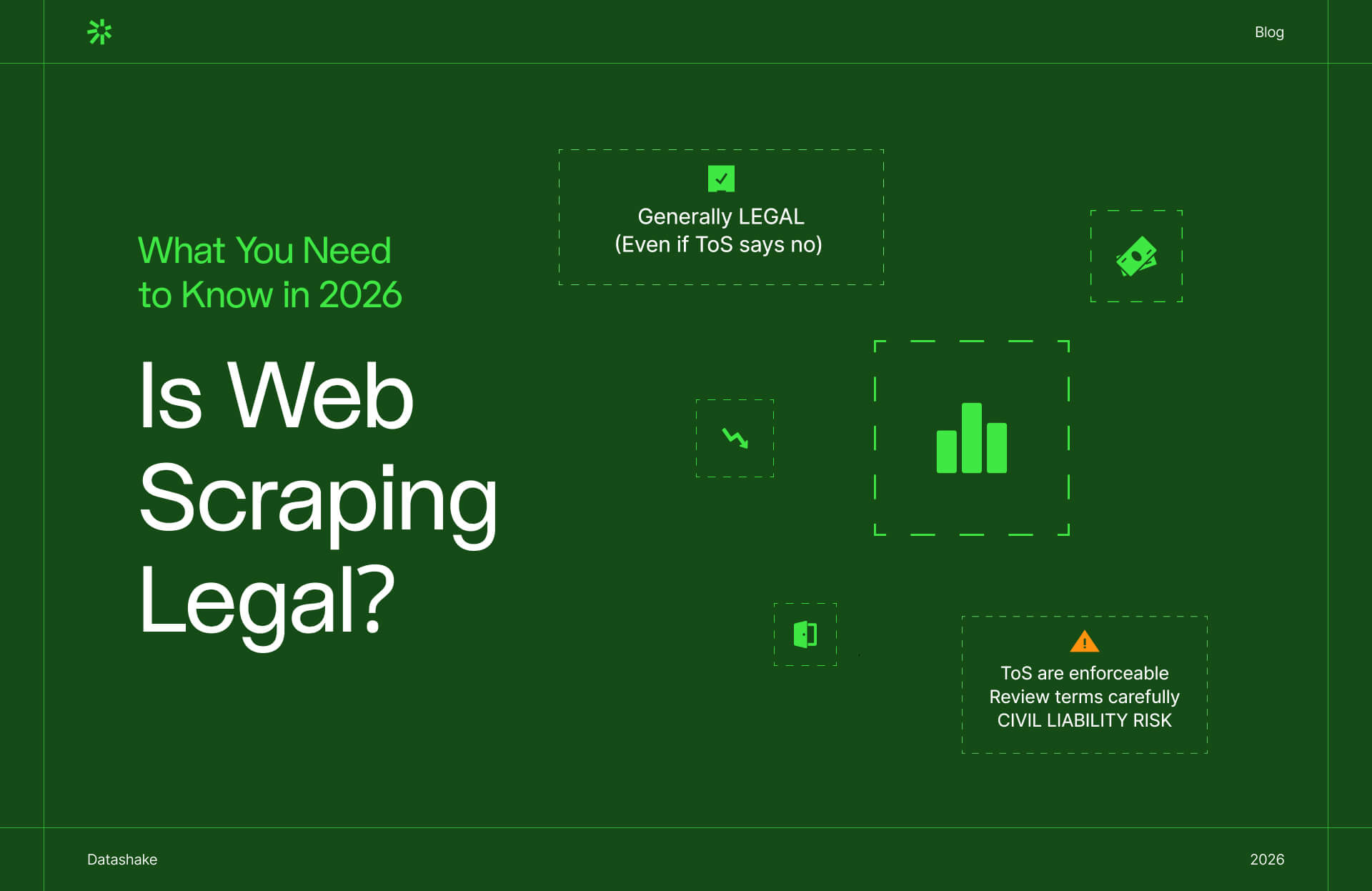
Before you build a program on top of social data, it's worth understanding where the legal lines are. → Is Web Scraping Legal?
Why the appetite at leadership level is already there
According to Sprout Social's research, 95% of execbutives agree that companies will rely more heavily on social data to identify business opportunities outside of marketing. More than half believe it will become the number one most important resource for data and insights that inform key business decisions.
The appetite is there. What's missing is the bridge – someone who knows how to design a social intelligence programme around business questions, and translate its outputs into decisions rather than reports.
McKinsey shows what this governance looks like: embedding analysts across the organisation in functions ranging from strategic planning and product development to customer service and M&A planning. The insight doesn't stay in one department, it flows to where decisions are made.
The conversation is already happening
There's a live conversation happening right now about your product, your category, your competitors, and the problems your market is trying to solve. Millions of people are participating in it. They have no idea they're providing you with some of the most candid market intelligence you'll ever access. They're just talking to each other.
Is your organisation treating it as intelligence or ignoring it as noise?
Sentiment is not a strategy. But the data that generates it – understood correctly, queried deliberately, and connected to a decision – can be.
Want to see what a social intelligence programme built around real business questions looks like? Book a call with the Datashake team.




More insights you might like
.png)