Introducing The Datashake Free Trial: Sign Up and Pull Your First Data in Minutes
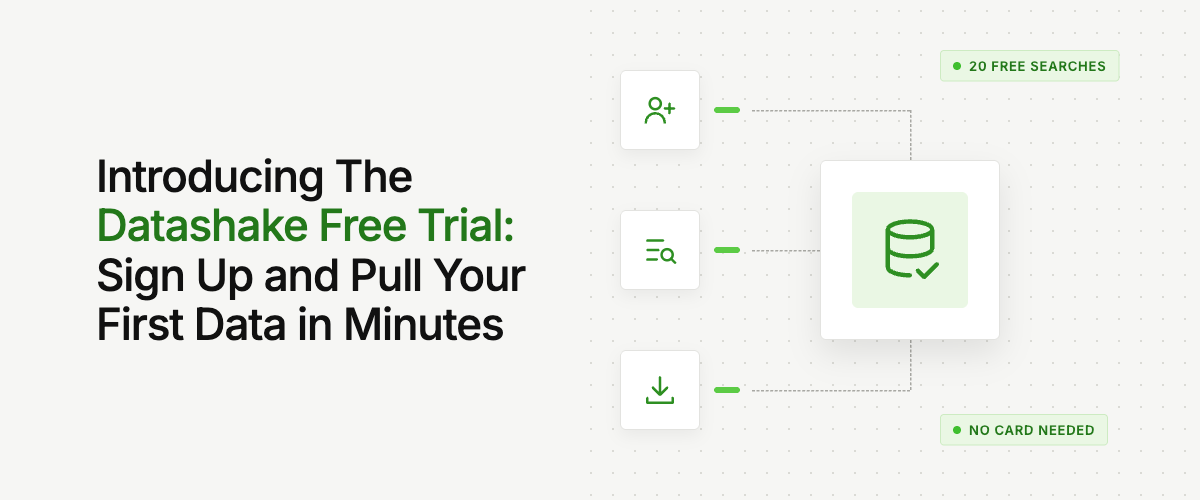
With self-serve, you can create an account, search across 160+ review and social sources and send clean, structured data straight into your stack, all on your own. There's no demo to book, no contract to sign and no card needed to start.
The backstory
Since I started Datashake in 2020, the way in has been to talk to us first. Every dataset was scoped by hand, which made sense when every project was custom.
But the people who find us have changed. Most are now engineers deciding whether to build or buy, usually in the middle of a sprint. They want to see the data, check it fits and make the call, and a sales call just sits between them and the answer.
Until now, that meant waiting for a meeting. With self-serve, you can test Datashake against your own use case today, on your own schedule.
How it works
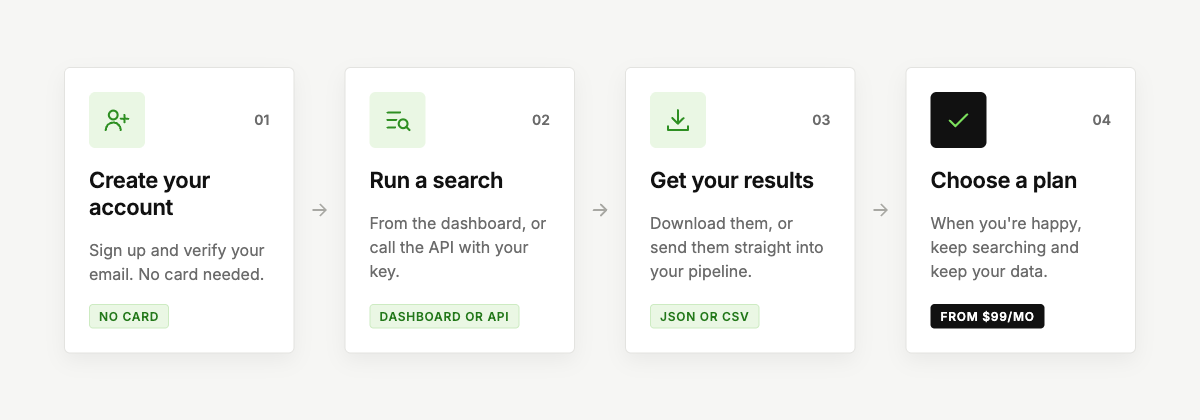
1. Create your account. Sign up and verify your email. No card needed.
2. Run your first search. Pick a source and a query in the dashboard, or call the API with your key.
3. Get your results. Download them as JSON or CSV, or send them straight into your pipeline.
4. Keep going. When you're happy, choose a plan to keep searching and keep your data.
Want to see the data structure before you sign up? Our API docs are public.
What you get with your free trial of Datashake
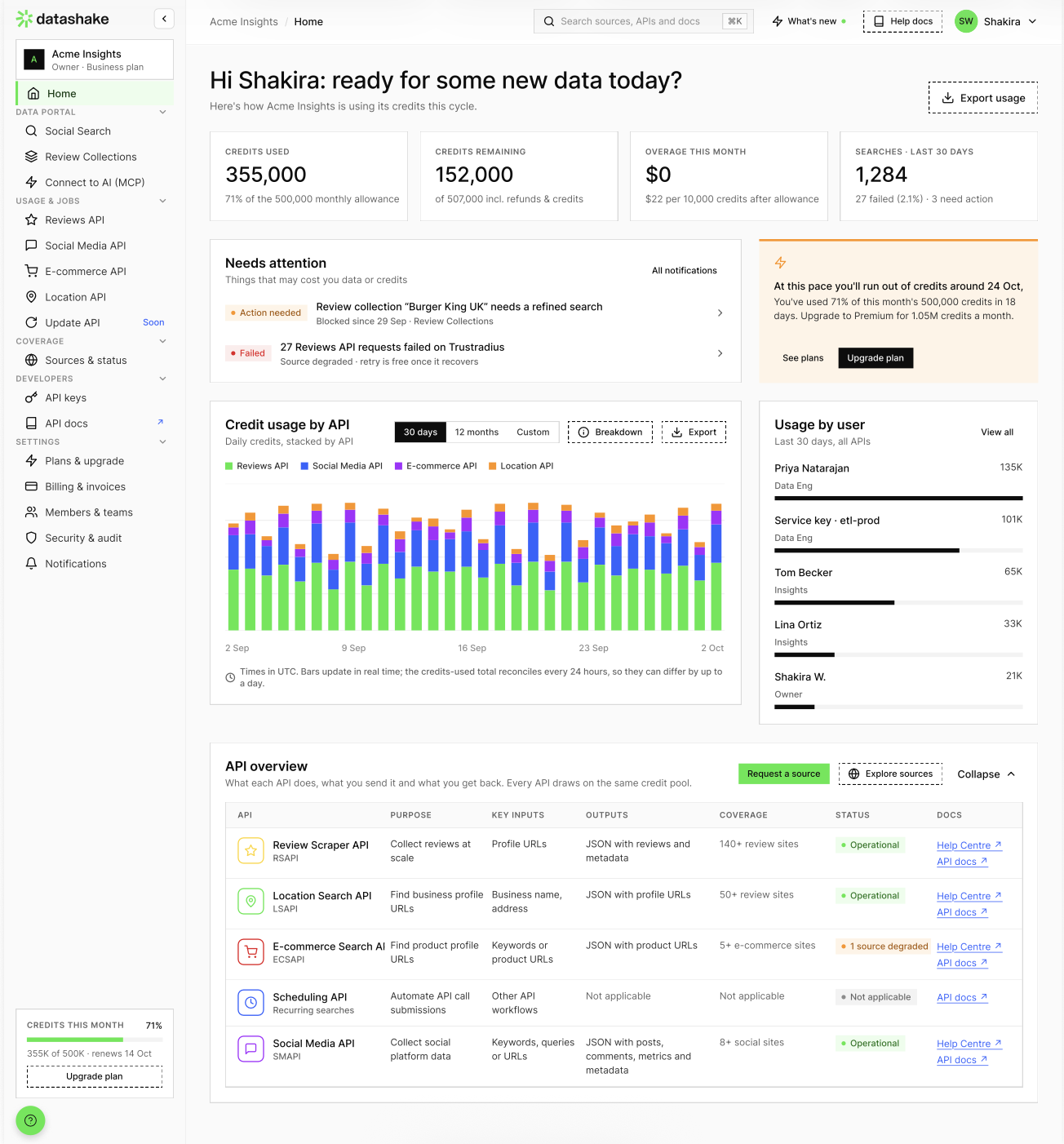
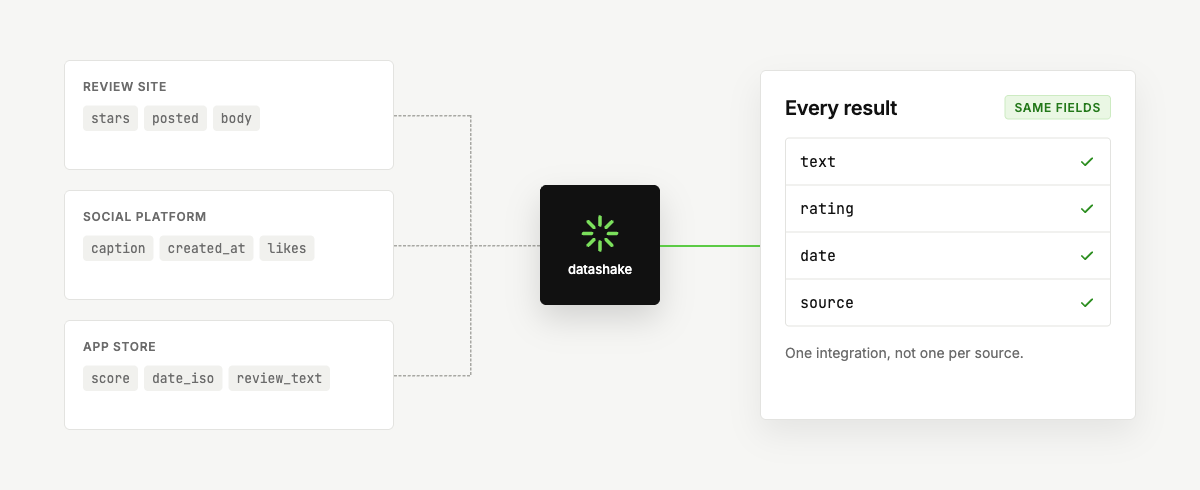
Whichever source a review or post comes from, it arrives in the same structure, with the same fields. You write one integration, not one per source.
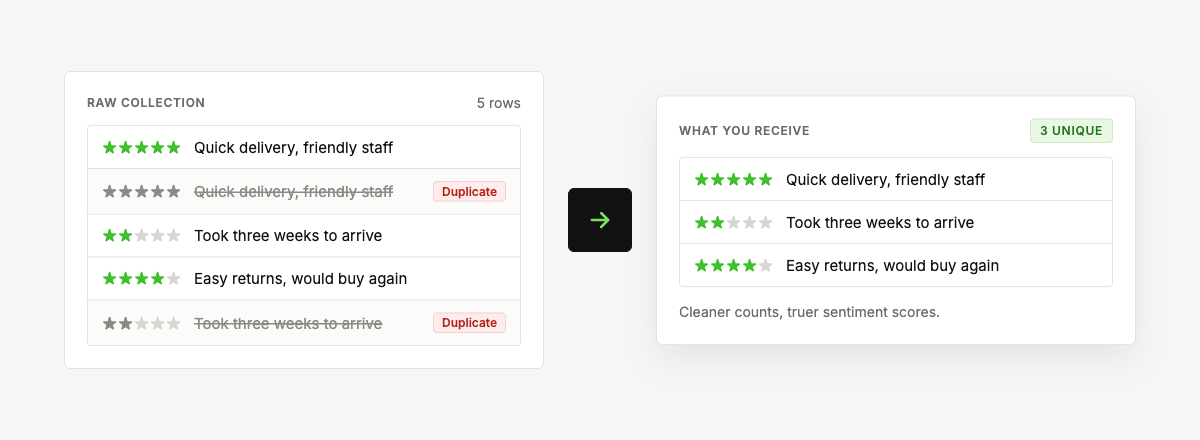
We also remove duplicates before the data reaches you. The same review often turns up on several pages of one site, and if your sentiment scores have ever looked slightly off, duplicates are a likely culprit.
And there are no scrapers to maintain. Sources change their layouts, limits and rules, often without warning, and the worst failures are the quiet ones: the job still runs, the fields come back empty, and nobody notices for weeks. If one engineer spends half a day a week keeping that going, it's around 26 working days a year spent standing still. With Datashake, that work is ours.
Your trial and pricing
- 14 days or 20 searches, whichever comes first.
- No card to start. You only add one when you choose a plan, and we won't charge you anything before then.
- Plans start at $99 a month and scale with your volume. Choose one and your trial data stays in your account.
- Need more? For higher volume, custom sources or help with a security review, talk to the team. We’re always here to help.
- Already a customer? Nothing changes for you. Your plan and your data stay exactly as they are.
What teams use it for
1. Spotting churn early
Product and CX teams pull reviews and social mentions to catch the complaints that come before customers leave.
2. Bringing the voice of the customer together
Research teams combine public feedback with their surveys and support tickets, so no single channel tells the whole story.
3. Watching reviews across every location
Clinics, salons, gyms and other multi-site businesses track every branch in one place, even though each one lives on different review sites.
4. Filling gaps in social intelligence
Agencies and insight teams use Datashake for the sources their listening tools don't cover well.
5. Feeding your own models
Data teams use clean, structured text to train and test their own analysis, without spending a sprint on cleaning first.
What to try first
If I were starting today, here's how I'd spend my 20 searches.
- Search for something you already know well. Your own brand or product is ideal. You'll see straight away whether the data matches what you know of the real world.
- Then search for something you don't. A market you're entering, a category you're researching, a brand you keep an eye on. This is where you find out what the data can tell you.
- Pull one result through your own pipeline. Grab your API key and run it end to end. The question isn't only "is the data good?" but "does it slot into what we've already built?"
We can't wait to see what you build with it, and we'd love to hear what you'd change.




More insights you might like