The 24 Best Brand Monitoring Tools in 2026
We ran the same brand search through seven of the leading brand monitoring tools. One pulled 92% of its results from a single platform, and presented it to us the big picture.
Yep, when it comes to brand monitoring tools, you can shortlist a selection on price, features and star ratings and still end up with the wrong one.
What decides whether you’re making the right call is whether the tool can see the conversations that matter to you in the first place. And spoiler alert: plenty of them see far less than you’d need for any sound brand monitoring strategy.
Join us for an exploration of what brand monitoring is, our selection of every tool worth knowing, and the coverage problems to decide whether any of them tell you the truth about your market.
Key takeaways
- Brand monitoring tools track mentions of your brand across social, reviews, news, forums and AI answers.
- Prices run from free (Google Alerts, F5Bot) to $29–$199/month self-serve, up to $26k–$127k/year for enterprise platforms.
- The biggest differentiator is coverage. Our test found some tools pull 75–92% of their mentions from a single platform.
- Match the tool to the job: enterprise, mid-market, reviews, AI visibility, or free.
- If no single tool covers enough, that's the moment to consider owning the data layer instead of buying another dashboard.
What is brand monitoring?
Brand monitoring is the practice of tracking where and how your brand is mentioned across the open web: through social platforms, forums, review sites, news, blogs, podcasts and AI answers.
It allows you to measure sentiment, catch issues early, and respond while it still makes a difference.
Brand monitoring is different from just watching your social notifications in two ways. ⬇️
The majority of people who talk about you will never tag you, so brand monitoring exists to surface those untagged, unlinked conversations.
And it spans channels you don't own – a Reddit thread, a Trustpilot review, a journalist's article; not just the accounts you post from.
Brand monitoring vs. social listening vs. media monitoring
In short: brand monitoring tracks individual mentions of your brand so you can respond to them, while social listening analyzes the patterns across those mentions (themes, sentiment and share of voice) to guide strategy.
Here's how the neighboring terms break down.
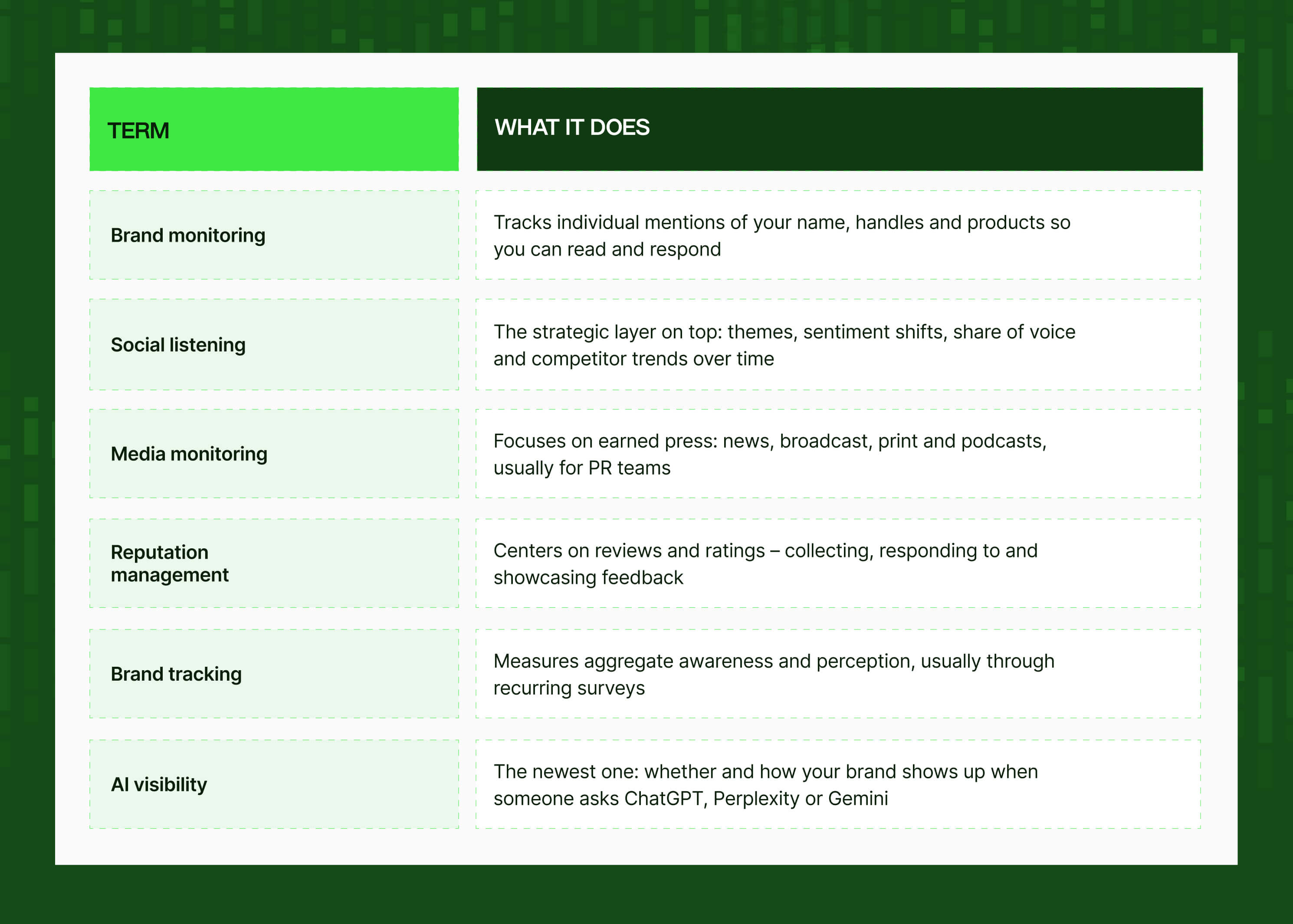
- Brand monitoring: Tracks individual mentions of your name, handles and products so you can read and respond
- Social listening: The strategic layer on top – themes, sentiment shifts, share of voice and competitor trends over time
- Media monitoring: Focuses on earned press: news, broadcast, print and podcasts, usually for PR teams
- Reputation management: Centers on reviews and ratings – collecting, responding to and showcasing feedback
- Brand tracking: Measures aggregate awareness and perception, usually through recurring surveys
- AI visibility: Whether and how your brand shows up when someone asks ChatGPT, Perplexity or Gemini
What makes or breaks your brand monitoring: coverage
Two tools can both promise "social listening" and "brand monitoring," show you near-identical dashboards, yet pull from completely different slices of the internet.
And if your brand monitoring tool is missing the forum thread, the TikTok video or the review where your conversation is happening, you’ve got a problem on your hands.
When the Social Intelligence Lab surveyed 241 social intelligence professionals, the top two challenges were both about access: "API restrictions and platform changes" (64.6%) and "lack of data access" (25.9%). Budget came third, at 23.3%.
Why does this happen? Well, over the past few years, the big platforms have been locking their data down: raising API prices, capping how much you can pull, or even closing access off altogether.
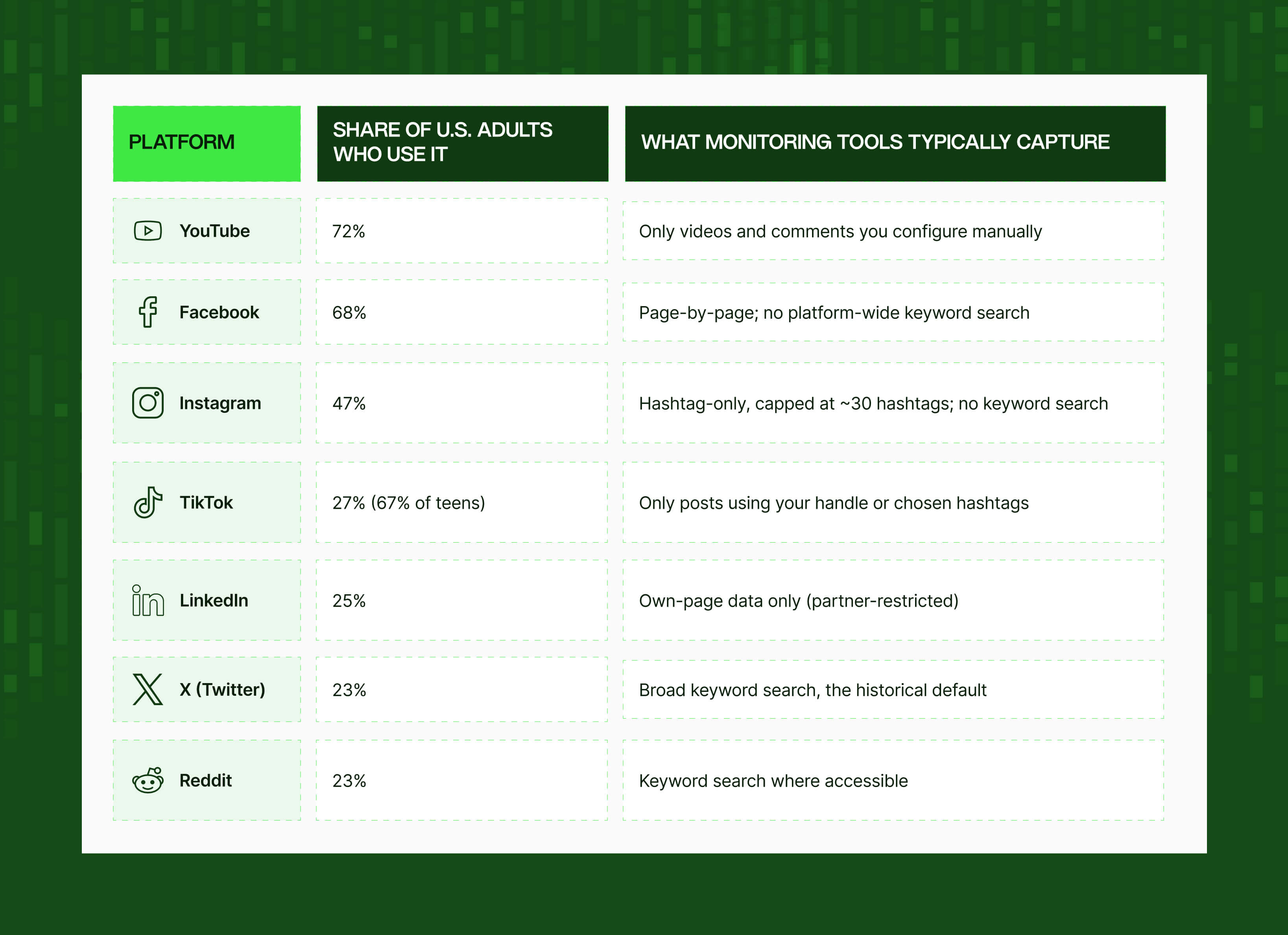
That's created an awkward mismatch where the platforms that host the most users are now the hardest for monitoring tools to see into. Meanwhile the platform nearly every tool leans on by default, X, reaches less than a quarter of U.S. adults.
- YouTube: 72% of U.S. adults
- Facebook: 68% of U.S. adults
- Instagram: 47% of U.S. adults
- TikTok: 27% of U.S. adults (67% of teens)
- LinkedIn: 25% of U.S. adults
- X (Twitter): 25% of U.S. adults
- Reddit: 25% of U.S. adults
Usage and access figures from our 2026 Social Data Coverage Report.
So the tools lean hardest on one of the least-used platforms, because it was historically the easiest to access. We unpack that in why your social media data is incomplete.
TikTok, Instagram and Facebook: what brand monitoring tools really cover
When a tool lists TikTok, Instagram or Facebook as supported, it’s not quite as straightforward. Out of the box, here's what those connections capture:
- TikTok: ⚠️only posts mentioning your specific handle or selected hashtags. Someone posting "this changed my life" without tagging you is invisible, yet that would be something you’d want to know about.
- Instagram: ⚠️requires a Business account and tracks up to 30 hashtags. There's no keyword search, so a complaint without your hashtag never surfaces.
- Facebook: ⚠️page-by-page tracking only, no platform-wide keyword monitoring.
- Threads: ⚠️up to 10 keywords, and you’ll have to re-authenticate periodically.
- YouTube: ⚠️only videos and comments from keywords you set up in advance.
Yep, all these are only scratching the surface of the data you need for a comprehensive brand monitoring strategy. This is why a dashboard can look busy and still miss the important mentions. High volume from an accessible platform hides low coverage everywhere else. (scroll down to read about our solution to this)
💡 We go deeper on two of the hardest channels to get data for in TikTok data coverage in 2026 and Facebook social data access in 2026.
How to audit your brand monitoring coverage
Run through these five questions about your current monitoring setup. Each "yes" points to a blind spot in what your tool can see:
- Does any single platform account for more than 50% of your data?
- Can your vendor show you where your mentions come from in under five minutes?
- Are TikTok or LinkedIn missing entirely?
- Are you relying on hashtag-only discovery for Instagram?
- Has anyone asked for coverage you couldn't provide?
If two or more of those are yes, you’ve got a data coverage problem on your hands, and no extra feature or slicker dashboard will fix it. ⚠️
How we compared these tools
We weighted five things, in order:
- coverage (does it see where your brand comes up?)
- Signal quality (can it filter noise and read sentiment, especially for common-word brand names?)
- Speed (how fast a mention becomes an alert)
- Data access (can you get mentions into Slack or your own systems?)
- And pricing (what you'll pay).
24 best brand monitoring tools in 2026 at a glance
The best brand monitoring tools in 2026 are:
- Datashake
- Brandwatch
- Sprinklr
- Meltwater
- Talkwalker
- Brand24
- Mention
- Awario
- Determ
- Mentionlytics
- BrandMentions
- Sprout Social
- Birdeye
- Yext
- Reputation
- Profound
- Peec
- Otterly
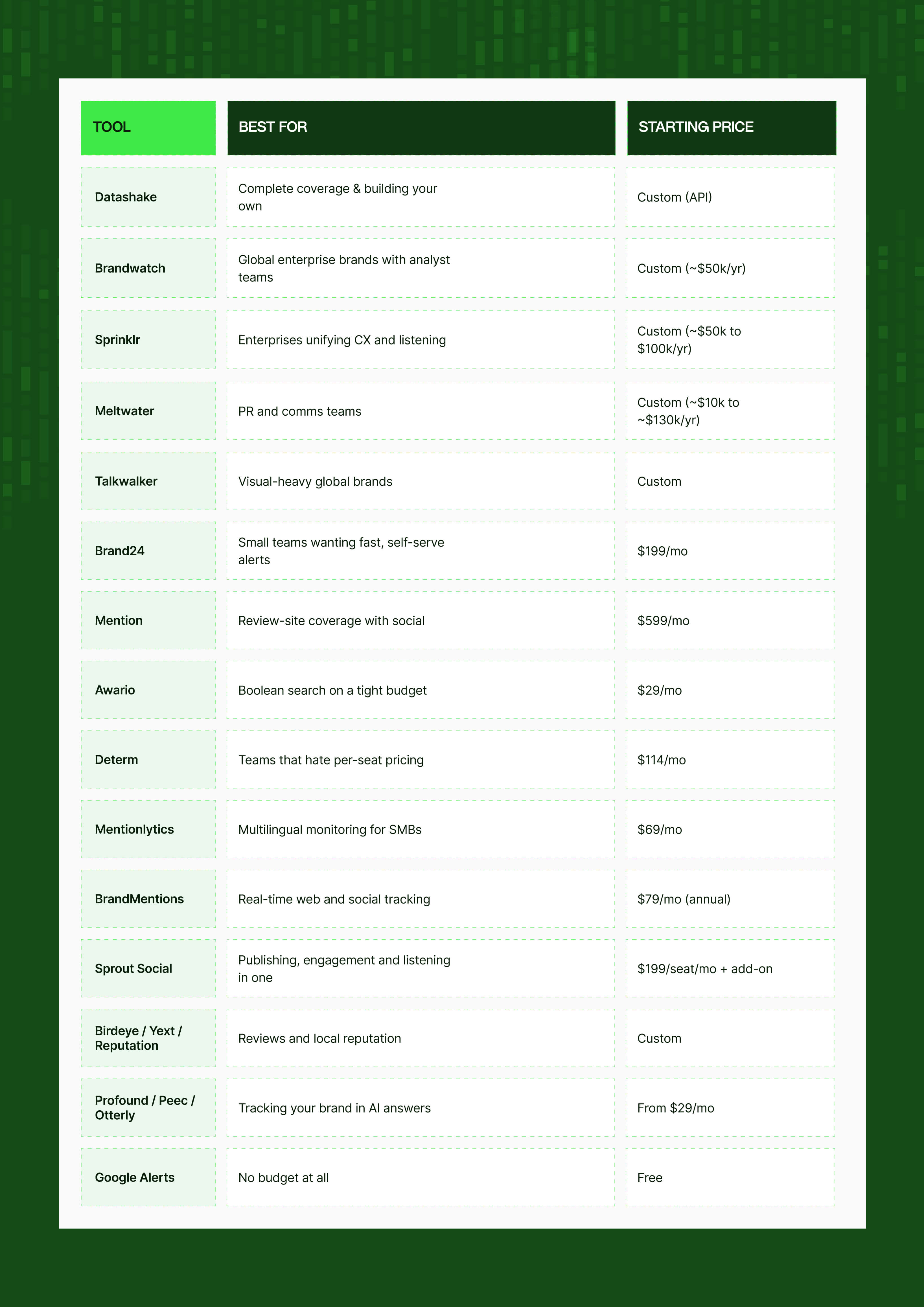
24 best brand monitoring tools
The tools below aren't all the same kind of thing, so the right pick depends on your size, budget and what you're trying to watch. They fall into a few groups:
- Datashake, the data layer to power your brand monitoring
- Enterprise platforms – Brandwatch, Sprinklr, Meltwater and Talkwalker: the most powerful and the most expensive, built for global brands with analyst teams and sold through a sales call.
- Mid-market listening tools – Brand24, Mention, Awario, Determ, Mentionlytics, BrandMentions and Sprout Social: self-serve, affordable, and where most growing teams land.
- Review and reputation platforms – Birdeye, Podium, Yext, Reputation, Trustpilot and ReviewTrackers: for businesses that live or die on reviews and local presence rather than the whole web.
- AI-visibility tools – Profound, Peec AI and Otterly: the newest group, tracking how your brand shows up in ChatGPT and other AI answers.
- Free tools – Google Alerts, F5Bot and ForumScout: enough to cover the basics until your volume justifies paying.
Datashake

Datashake delivers normalized social and review data straight into your warehouse, BI tools or product, through a single API.
Instead of a fixed dashboard, you get the raw material to power whatever you need: your own monitoring, competitive intelligence, model training or customer-experience workflows.
Why build on the data instead of buying a dashboard?
You avoid coverage gaps and platform bias
Off-the-shelf tools lean on whatever data is easiest to reach, which majorly skews what you see. Some of these tools pull 75–92% of their mentions from one single platform like Youtube for example.
Datashake collects across the full range of platforms and review sites, including the ones those tools thin out or skip, so the data you build on reflects your whole market rather than one platform's demographics.
Your coverage survives platform changes
Platform access shifts without warning: X (Twitter) killed its free API with about a week's notice in 2023, Reddit started charging for access soon after, and the tightening hasn't let up since.
When that happens, a tool that relied on one access route springs a hole in its data and you inherit it.
Datashake keeps coverage intact by adapting how it collects when a source changes, so the gap never reaches you. In other words, you get complete data for your brand monitoring no matter what changes a platform makes.
You own your data instead of renting a view of it
A brand monitoring tool keeps your data locked inside its interface, charges per seat to see it, and makes it hard to join with anything else.
Datashake delivers the structured data straight to you, so you can use it anywhere (your warehouse, your BI stack, your own models) combine it with your other data, and give the whole team access without paying per head. 👏
Key features
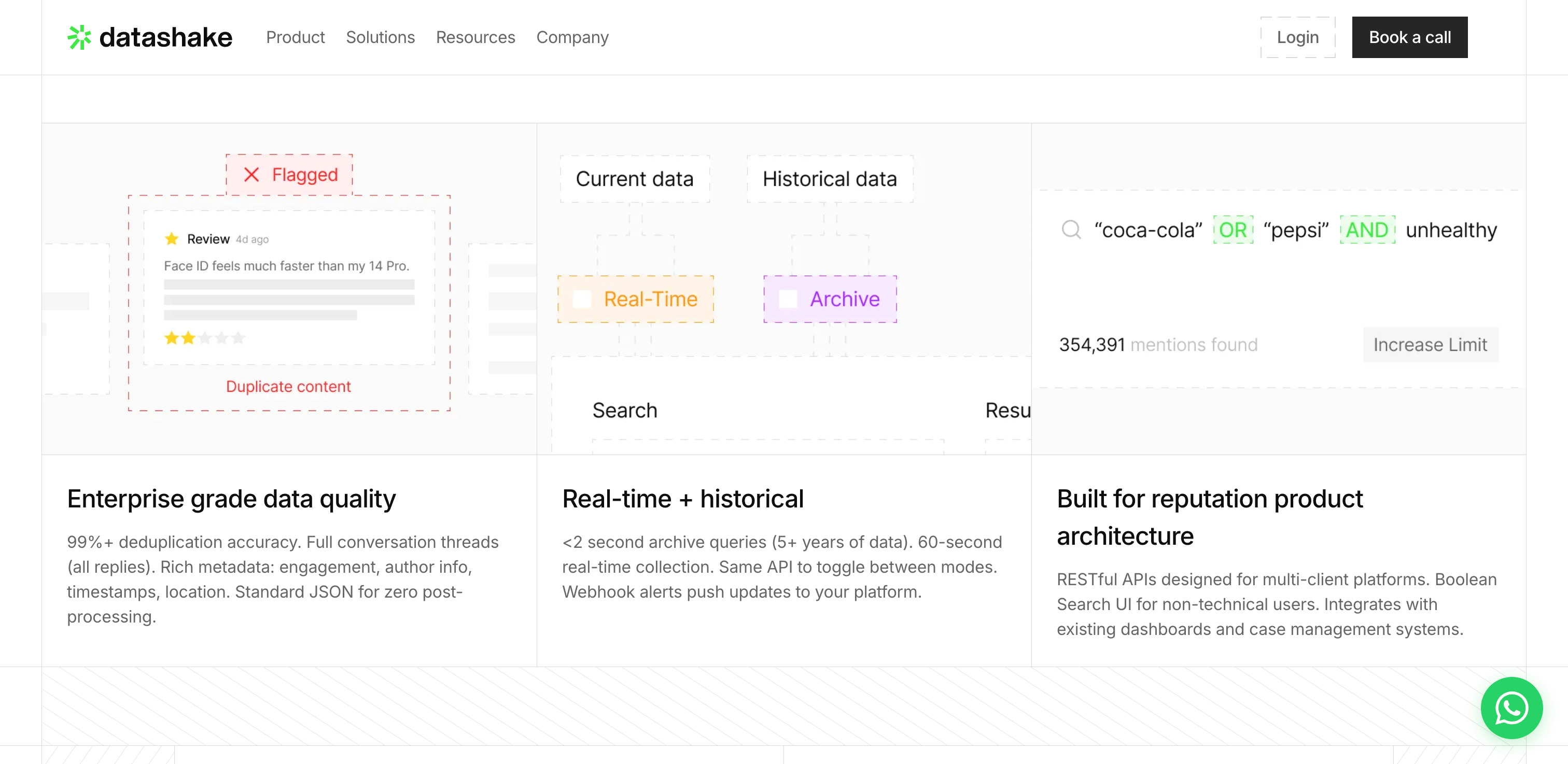
- Clean, normalized social and review data delivered through a single API, nothing to log into
- Collection across official APIs and compliant alternative sources, adapted whenever a platform changes access
- Full source transparency, with documented methodology and audit trails for compliance reviews
- Downloadable JSON and CSV samples, so you can check the data before you build on it
Data coverage
Social posts, community and forum discussion, and reviews across the major platforms and review sites, plus e-commerce data. It provides data breadth and representativeness rather than concentrating on whichever sources are cheapest to reach.
"We’ve been using Datashake for over six years, and it’s been a big part of our business growth during that time. It has really helped improve our operations by providing consistent, reliable data that we can easily plug into our workflows." – Tech Lead, Review Management Services
Brandwatch

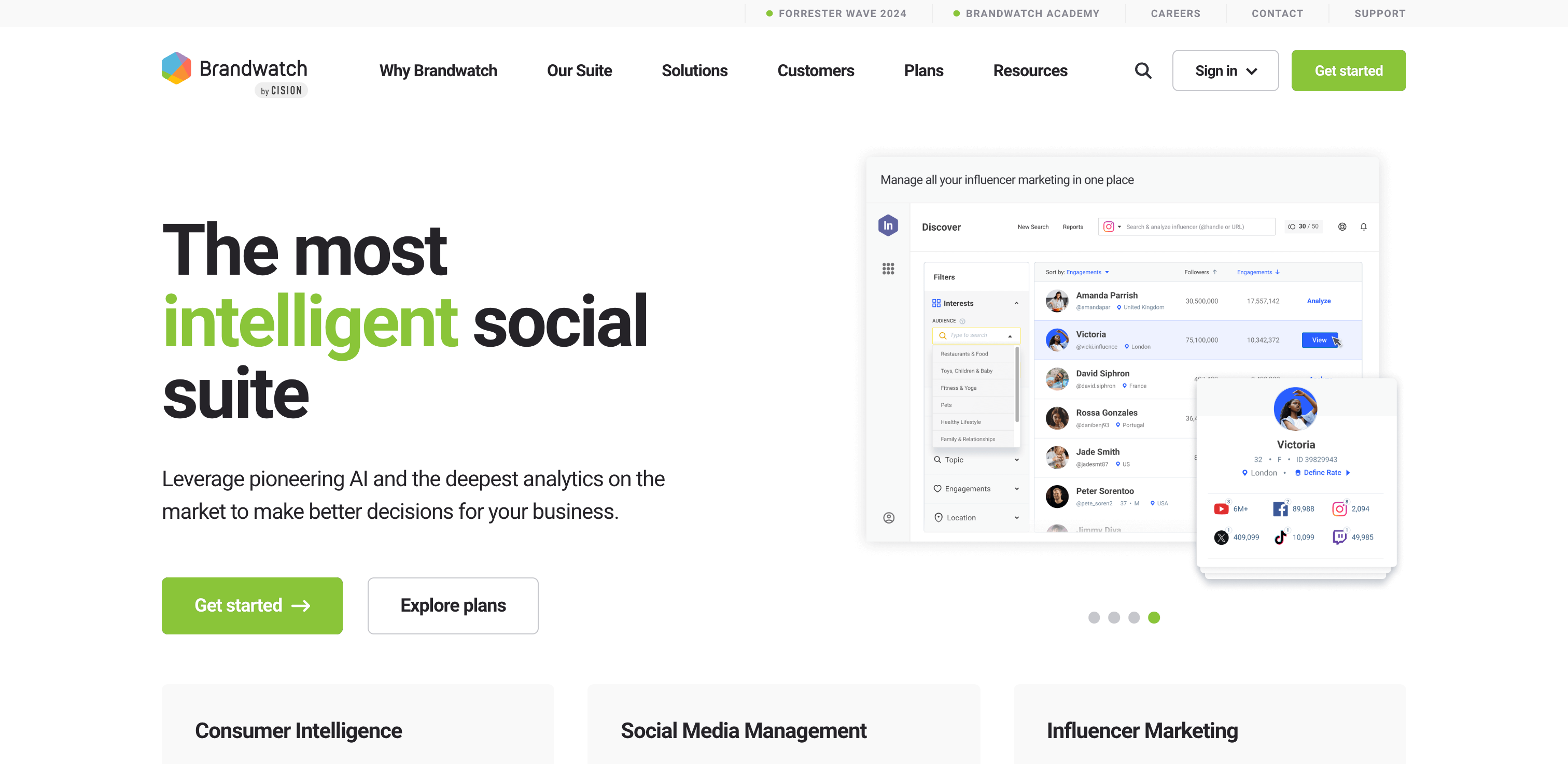
Brandwatch, founded in the UK in 2007 and now part of Cision, is a name well-known by enterprises worldwide.
It's used by around half the Forbes 100, and the platform's Iris AI layer runs across the whole suite: "Ask Iris" answers plain-language questions with instant charts and summaries, the AI Query Writer turns a description into a full Boolean query, and AI Dashboards write narrative summaries of what the numbers mean.
Key features
- Image analysis that reads objects, scenes, actions and logos, not just text
- Six-emotion sentiment across 44 languages, plus intent detection (it can separate "I hate this" from "I'm about to switch")
- Social Panels: listen to defined audience segments rather than just keywords
- Real-time anomaly alerts for crisis monitoring
Data coverage
100M+ sources with a historical archive reaching back to 2010; the company claims access to roughly 1.2 trillion public mentions. Late-2025 updates expanded coverage to include Threads, TikTok, LinkedIn, YouTube and 70,000+ podcasts with transcript analysis.
Pricing
Quote-only. Tracked contracts sit around a $50,000 annual median, with no self-serve entry.
Watch out for ⚠️
Multi-week onboarding and a steep learning curve. If you have a small team, it's almost certainly more platform than you need.
Sprinklr

Sprinklr's listening tool (Insights) is one module inside a five-product platform that also covers social publishing, customer care, marketing and advertising.
You can run your whole external-facing operation from one place, but you often end up pricing the bundle rather than listening alone.
Key features
- Unified dashboard spanning social, news, blogs, forums, podcasts, reviews and AI-model outputs
- Sentiment and trend analysis across 100+ languages
- Deep integration with Sprinklr's care and marketing modules for closed-loop response
Data coverage
25M+ sources across social and the wider web.
Pricing
Tracked contracts run to a median near $127,000 a year, with the largest tracked deal past $480,000.
If you're weighing it against Brandwatch or building your own, we compared all three in Brandwatch vs. Sprinklr vs. building your own data pipeline.
Watch out for ⚠️
Overkill and overspend if listening is all you actually need.
Meltwater

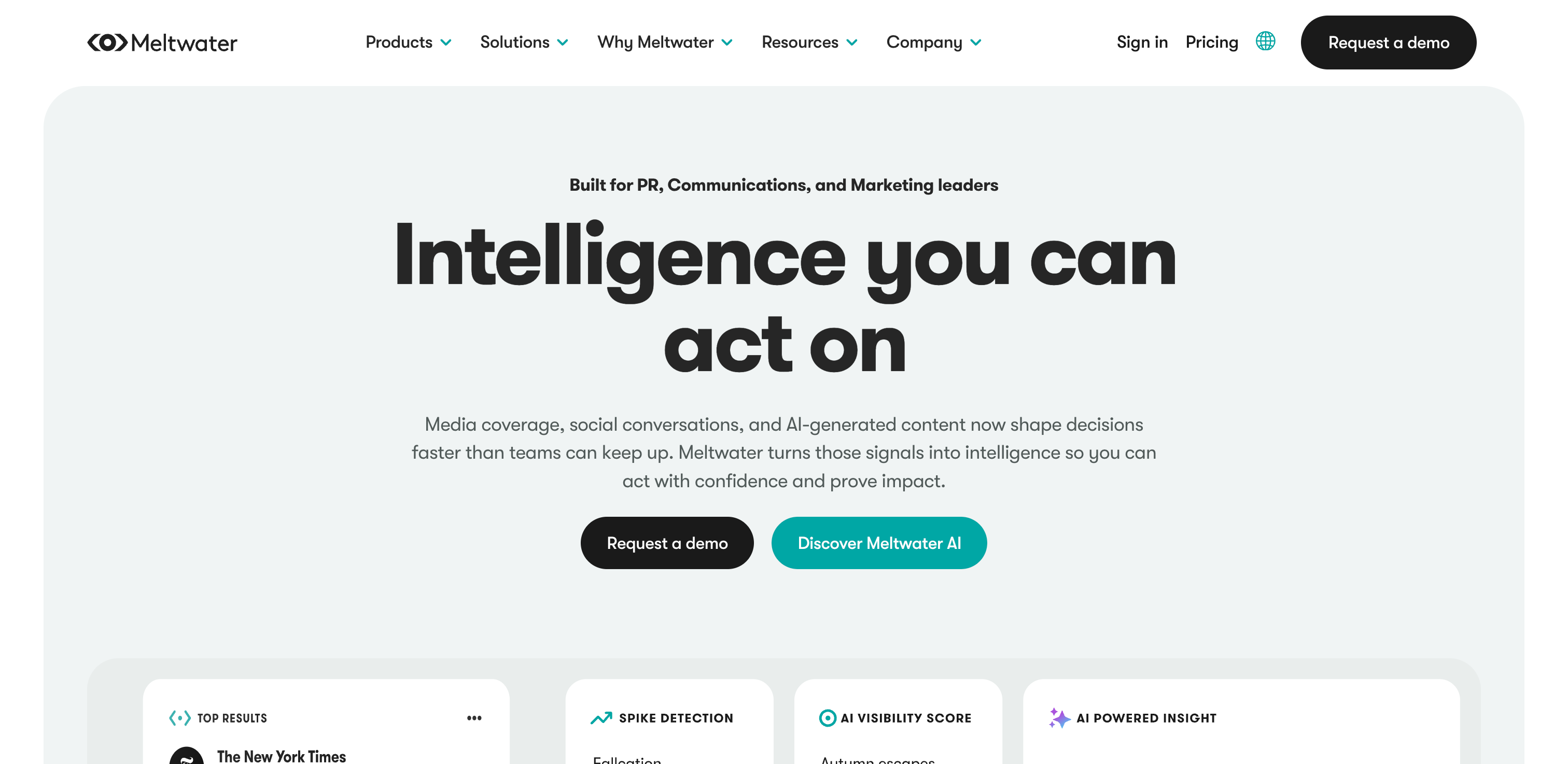
Meltwater is the media-intelligence heavyweight.
It monitors 270,000+ news sources alongside 15+ social channels, and its real strength is earned media (news, broadcast, print, podcasts, newsletters, Substack) paired with a journalist database and outreach tools that let PR teams go from spotting coverage to pitching without leaving the platform.
Key features
- Mira, an AI assistant that has handled more than 1.3 million prompts and answers with cited sources; now available in Slack, on mobile, and via API and MCP
- GenAI Lens: tracks how ChatGPT, Gemini, Claude, Perplexity and others describe your brand, one of the first LLM-visibility features to ship at scale
- Predictive analytics that forecast whether a mention spike will grow or fade
- Klear influencer discovery and management
Data coverage
News, print, broadcast, podcasts, newsletters and social, backed by a very large media archive; recent additions include YouTube channel-level data and speech-to-text for video.
Pricing
Quote-only, with a 12-month minimum. It's the cheapest enterprise option by tracked median, around $26,000 a year. It holds a 4.1/5 rating across roughly 2,977 G2 reviews.
Watch out for ⚠️
It's a PR tool first, so mention-data access and filtering trail the specialist listening tools. Contracts are annual with auto-renewal.
Talkwalker

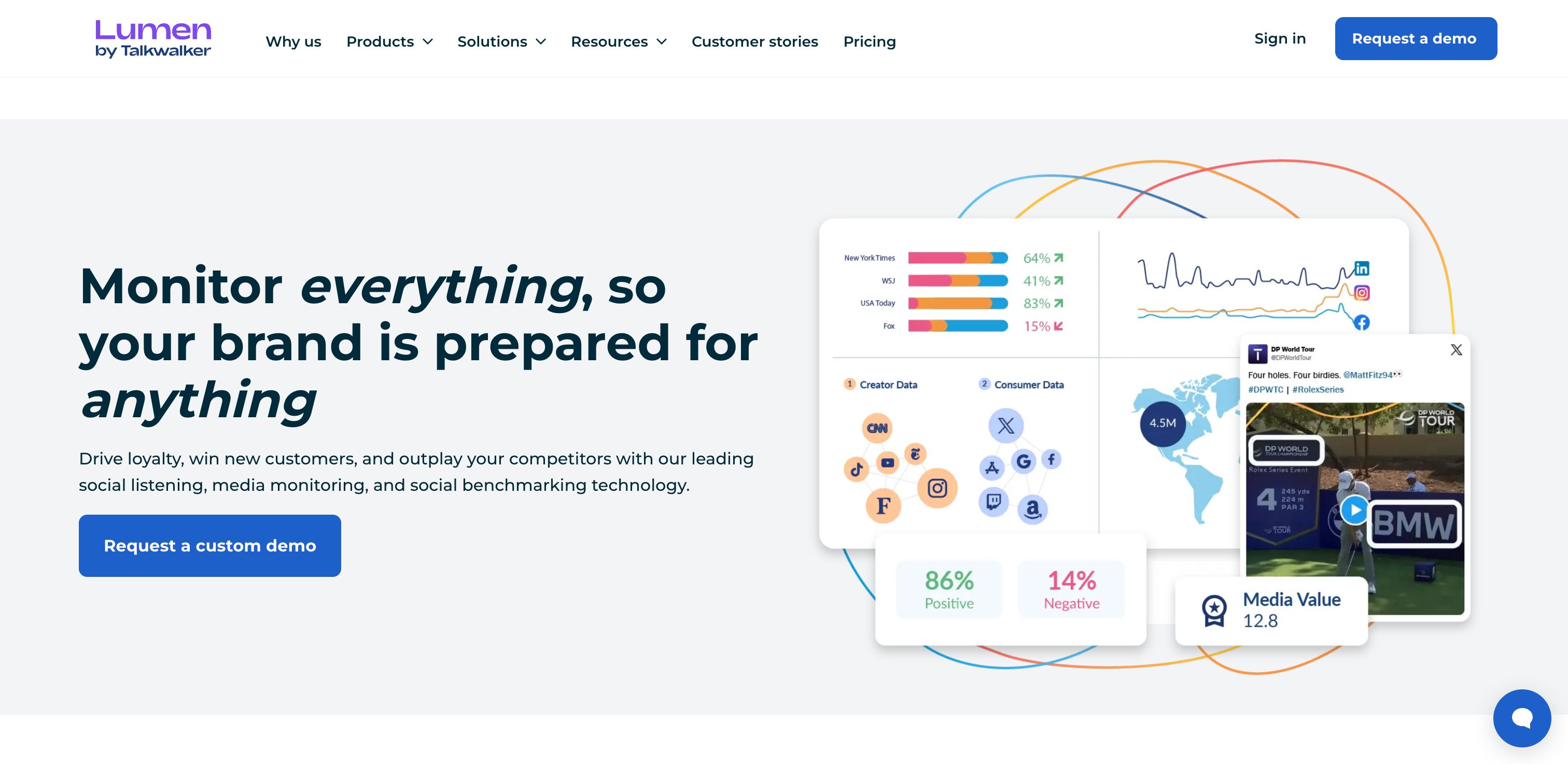
Talkwalker was founded in Luxembourg in 2009 and acquired by Hootsuite in April 2024; it now operates as Hootsuite's enterprise listening layer (branded Lumen) and powers Hootsuite's own listening.
Its calling card is visual intelligence. The Blue Silk AI engine is trained on around 3 trillion data points and processes 2,000+ images a second, matching against 30,000+ logos, scenes and objects, so it catches a photo of your product even when nobody typed your name.
Key features
- Image, video and audio recognition that surfaces untagged visual mentions
- Blue Silk GPT: click any spike in a dashboard and the AI explains what's driving it
- Sentiment across 120+ languages, plus predictive KPIs that flag trends before they peak
- Pre-built "IQ Apps" dashboards that shortcut setup
Data coverage
150M+ websites and 30+ social networks (including Reddit, Pinterest, Twitch and Vimeo), plus news, podcasts and TV/radio/print archives, across 239 countries. Quick Search offers a 30-day lookback; the archive runs 24+ months.
Pricing
Quote-only, sold through Hootsuite. No self-serve entry.
Watch out for ⚠️
A steep learning curve, and a roadmap now tied to Hootsuite's priorities.
Brand24

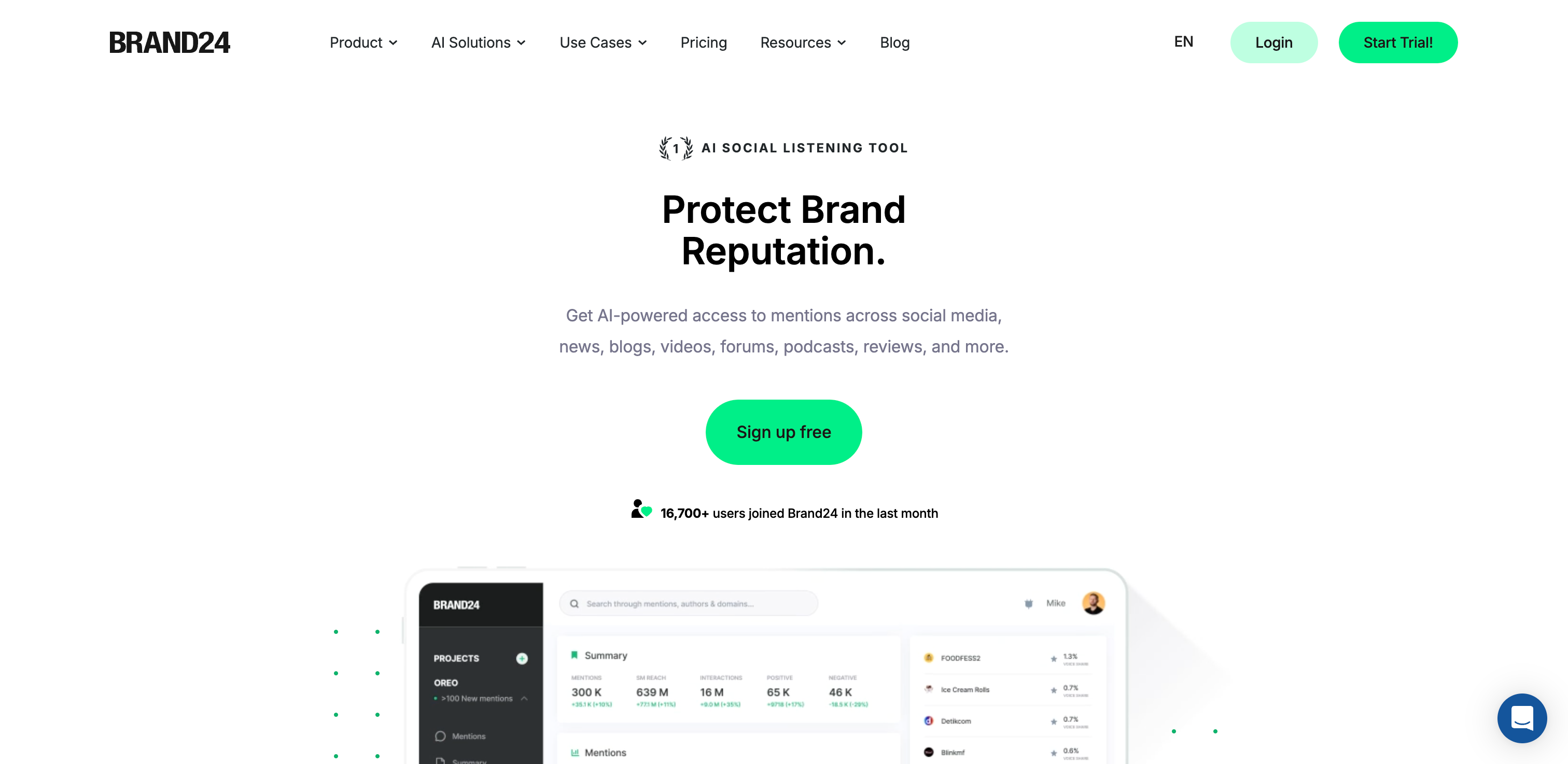
Founded in Poland in 2011 and acquired by Semrush in 2024, Brand24 is the most approachable of the classic tools. It offers transparent pricing, a 14-day trial, and no sales call needed to get started.
It tracks mentions in real time and scores each one, then rolls them into clear brand-health metrics without much setup.
Key features
- Metrics that include mentions, reach, sentiment, Share of Voice and a composite Presence Score for brand visibility
- AI Brand Assistant: ask questions of your live mention data in plain language, and auto-benchmark against competitors
- Anomaly detection and Storm Alerts for early crisis warning (in one test it flagged a negative spike in under four minutes)
- Chatbeat, a dedicated feature that tracks how ChatGPT, Claude, Gemini and Perplexity describe your brand
- Slack and Microsoft Teams notifications, plus API and MCP access
Data coverage
Social (Facebook, Instagram, X, TikTok, YouTube with transcriptions, Reddit, LinkedIn), news, blogs, podcasts, forums and review sites.
Pricing
Individual $199/mo (billed annually) for 3 keywords and 2,000 mentions, up to Enterprise from $1,499/mo. 30-day data history on every tier.
Watch out for ⚠️
The entry price has climbed well past its old budget position, the starter plan updates every 12 hours, and Reddit depth is shallower than other tools.
Mention

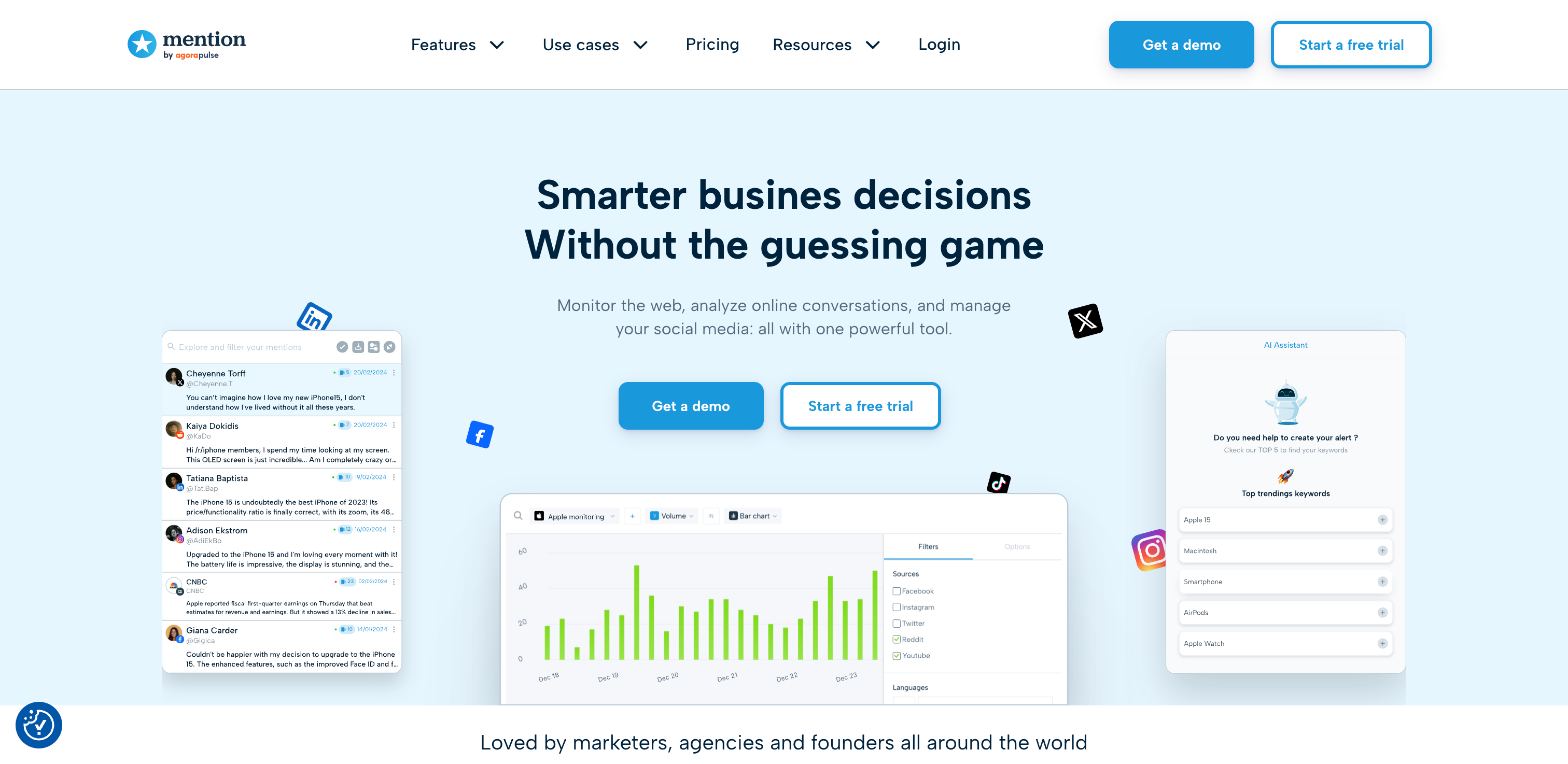
Mention tracks a very broad source set with unusually strong review-platform coverage (75+ sites including Google, Trustpilot, Amazon and Glassdoor).
Its alerts are fast and its Boolean operators are really powerful, supporting queries up to 2,000 characters for precise filtering.
Key features
- 75+ review sites alongside social, news, forums and the web
- Advanced Boolean query building and competitive-analysis dashboards
- Fast real-time alerting
Data coverage
Social, web, news, forums and review platforms.
Pricing
The old self-serve tiers are gone. Mention now sells a single demo-gated "Company" plan, and both API access and historical data are paid add-ons. Its Publish and Respond features have been retired in favor of sister product Agorapulse.
Watch out for ⚠️
No public pricing, and no historical data, so data starts when you create the alert.
Awario

Awario (launched in 2018 by a bootstrapped Finnish team) is the value pick with real capability.
Rather than lean on a single data supplier, it crawls 13 billion+ web pages a day plus platform APIs, and it puts Boolean search and real-time monitoring on every plan, features usually reserved for pricier tools.

Key features
- Awario Leads, a social-selling feed that surfaces people asking for recommendations or complaining about competitors
- Reply to posts directly from the app
- White-label PDF reports for agencies, plus sentiment, reach and Share of Voice
- Boolean search on every tier
Data coverage
Social, news, blogs, forums and the broader web; multi-language.
Pricing
Starter €29/mo (annual) for 3 topics and 30,000 mentions, up to Enterprise €249/mo (100 topics, 1M mentions, API and an account manager). 7-day trial.
Watch out for ⚠️
It tracks forward from the moment you add a keyword (no deep archive), analytics are simpler, and non-English sentiment is weaker. It carries the lowest G2 score in this group at 3.9/5.
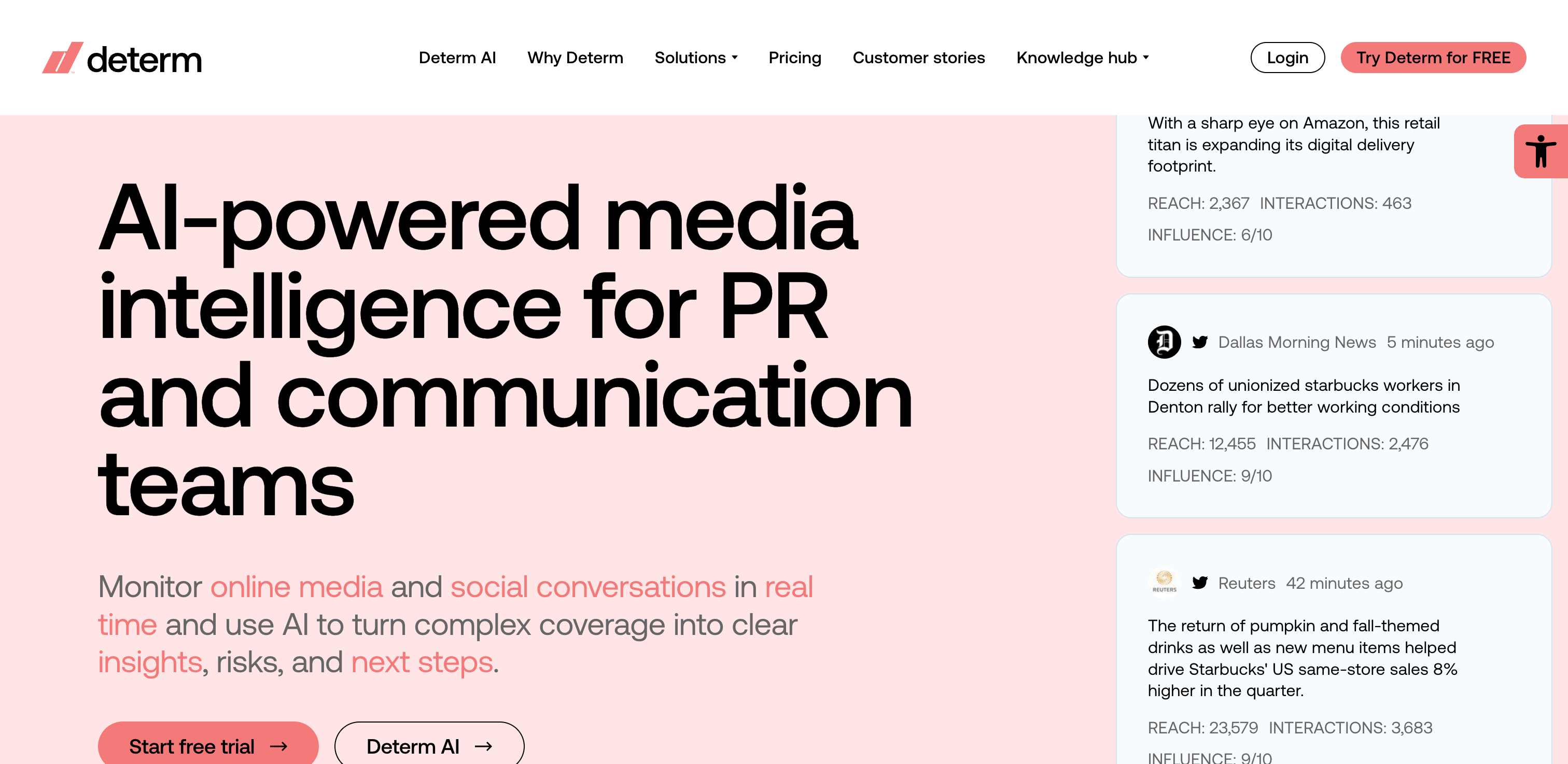
Determ

Determ (formerly Mediatoolkit) is a Croatian tool built for PR and comms, and it has two standout traits. First, strong coverage of non-English and European sources, with multilingual sentiment that outperforms most budget tools.
Second, a pricing structure where every tier includes unlimited seats, which can completely change the economics once your team grows past a handful of users.
Key features
- Real-time media monitoring with crisis alerts and trend detection
- Synthia, an AI assistant that explains sudden spikes or drops in mentions
- Boolean search and configurable dashboards
- Multilingual coverage suited to international markets
Data coverage
Social, news, blogs and forums, with particular strength across European languages.
Pricing
Focus €99/mo (~$108) up to Command €499/mo, unlimited seats throughout. Default history is 3 months, extendable back to 2020 on request. 5-day trial (14 after a demo).
Watch out for ⚠️
Some mentions can slip through, so test it on your own keywords; entry-tier topic caps are low.
Mentionlytics

Mentionlytics packs a lot of capability into an accessible price. Its signature feature is SIA, the Social Intelligence Advisor; an AI layer that delivers a daily brief and actionable recommendations rather than making you dig through the dashboard yourself.

Key features
- SIA daily briefs, AI summaries and anomaly detection
- Sentiment and emotion analysis, competitor and influencer tracking, Share of Voice
- An AI-visibility view that tracks your brand across ChatGPT, Perplexity, Copilot, Gemini and AI Overviews
- Coverage of Telegram and Bluesky, which many competitors skip
Data coverage
X, Facebook, Instagram, LinkedIn, YouTube, TikTok, Reddit, Pinterest, Bluesky and Telegram, plus news, blogs and forums drawn from thousands of sources.
Pricing
Basic around $69/mo (5,000 mentions, 12-hour updates), with real-time monitoring on higher tiers. 14-day trial, no card required. It holds one of the highest G2 ratings in the category at 4.9/5.
Watch out for ⚠️
Reporting feels lighter once you've used a bigger platform, and the interface shows its age.
BrandMentions

BrandMentions is a broad, accurate mention tracker. It covers social, news, blogs, forums and review sites, scores each mention with a Performance Score, and offers unlimited projects on its agency plan, which is handy for teams juggling many clients.

Key features
- Real-time mention tracking with per-mention Performance Scores
- Competitive analysis and unlimited projects on higher tiers
- Broad source coverage including forums
Data coverage
Social, news, blogs, forums and review sites.
Pricing
Starter $79/mo (billed annually) for 5 keywords and 5,000 mentions with daily updates; hourly updates on Pro ($249) and real-time on Expert ($399). 7-day trial.
Watch out for ⚠️
There's no API at any tier, real-time is gated to the top plan, and sentiment is more basic than the AI-first tools.
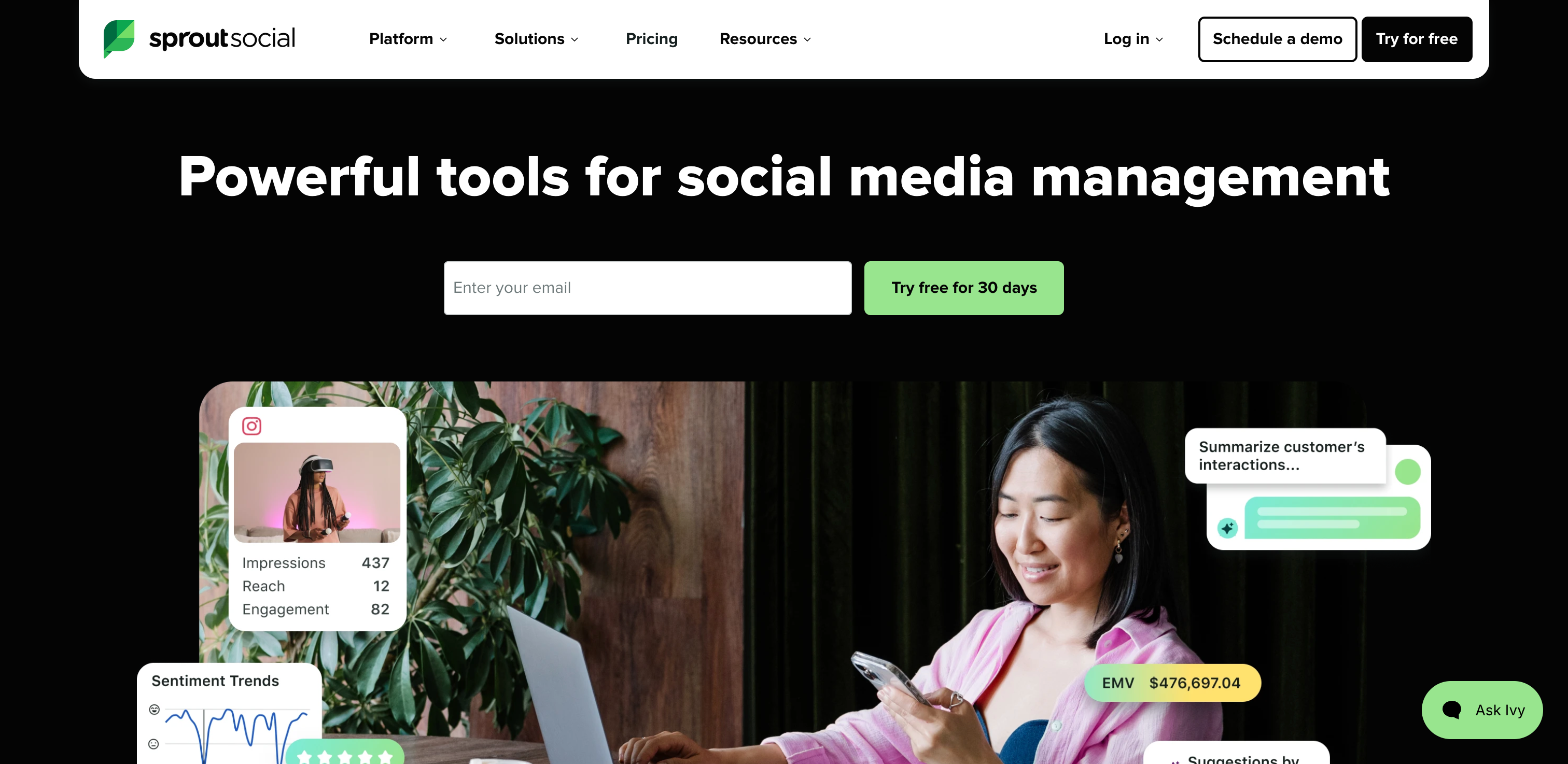
Sprout Social

Sprout Social is a social media management platform first, used by 30,000+ brands, with listening layered on top.
If your team already lives in Sprout for scheduling and community management, adding monitoring in the same place is convenient, and its analytics are really strong.
Key features
- Trellis, an AI agent you can ask listening questions in plain language, plus AI Assist that builds queries without Boolean knowledge
- Smart Inbox for triaging and responding to mentions across accounts
- Sentiment, Smart Categories and Listening Spike Alerts (its listening engine analyzes hundreds of millions of messages a day)
- Review management across sites like Google, Yelp and Trustpilot
- Deep integrations with Salesforce, HubSpot, Shopify, Zendesk and Slack
Data coverage
Facebook, Instagram, X, LinkedIn, Pinterest, YouTube, TikTok, Threads, Reddit, Bluesky and Google Business Profile.
Pricing
Per seat, billed annually: Essentials $79, Standard $199, Professional $299, Advanced $399, Enterprise custom. Listening is a separate paid add-on available from Standard up, with its price set through an account manager. 30-day automatic history.
Watch out for ⚠️
Per-seat pricing climbs fast, listening costs extra on top, and the core product lacks Reddit, forum and podcast depth.
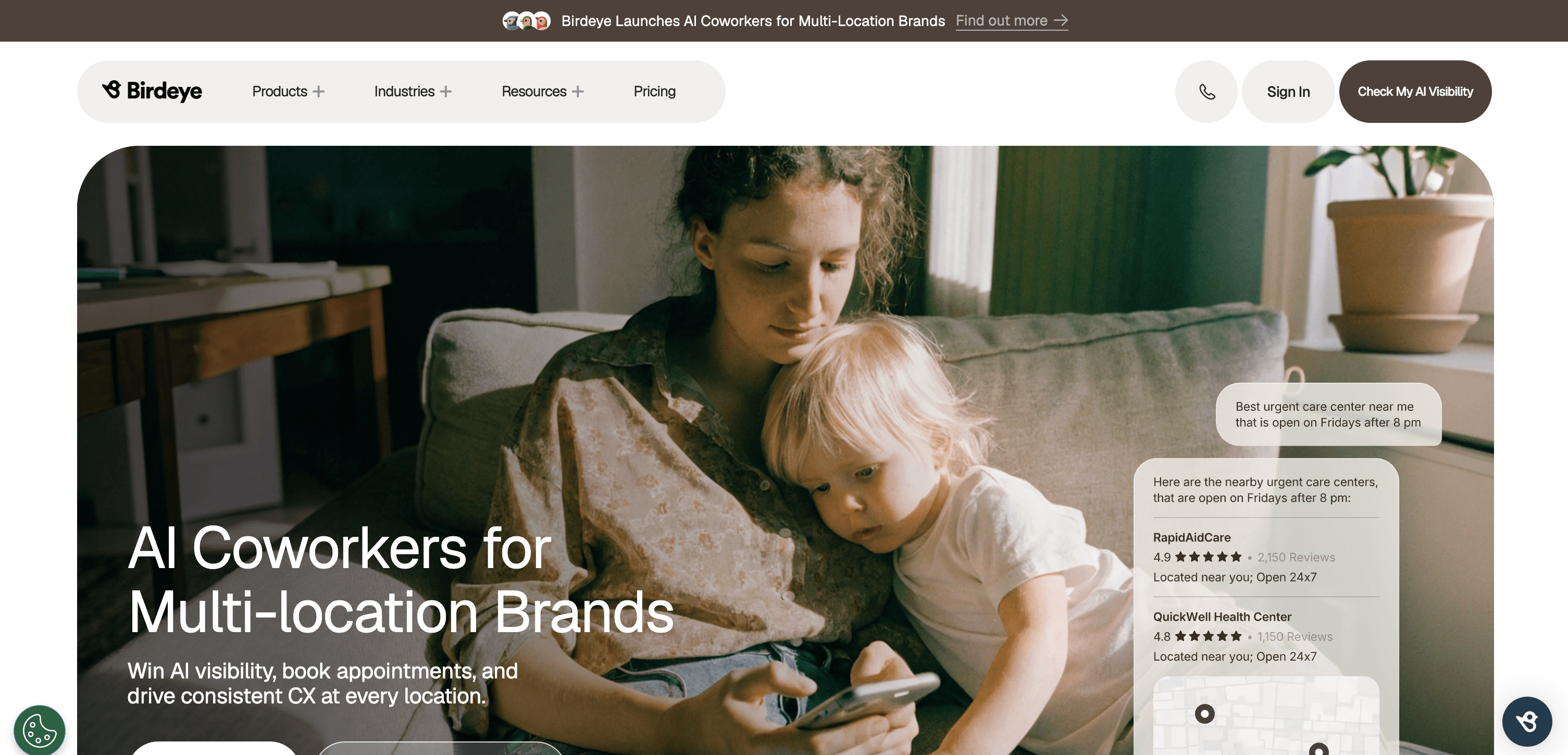
Birdeye

Birdeye is the most comprehensive reputation platform on this list, used by 150,000+ businesses.
In 2026 it repositioned around AI agents – autonomous assistants (BirdAI) that take action with your approval: requesting reviews, drafting responses in your brand voice, updating listings and answering customer messages across every location.
It pulls reviews from Google, Yelp, Facebook, TripAdvisor and industry sites into one dashboard, automates review requests through your CRM, and uses its BirdAI layer to summarize feedback and draft responses. It also fixes listings across 50+ directories and runs NPS and pulse surveys.
Key features
- 200+ review sites
- CRM/field-service-triggered review requests
- Listings AI across 50+ directories
- Unified inbox + 24/7 chatbot
- Social AI
- Surveys/payments/benchmarking
- AI-search-visibility tracking for ChatGPT and Gemini
Pricing
Custom, and users note it sits at the premium end.
Watch out for ⚠️
AI responses that can read generic.
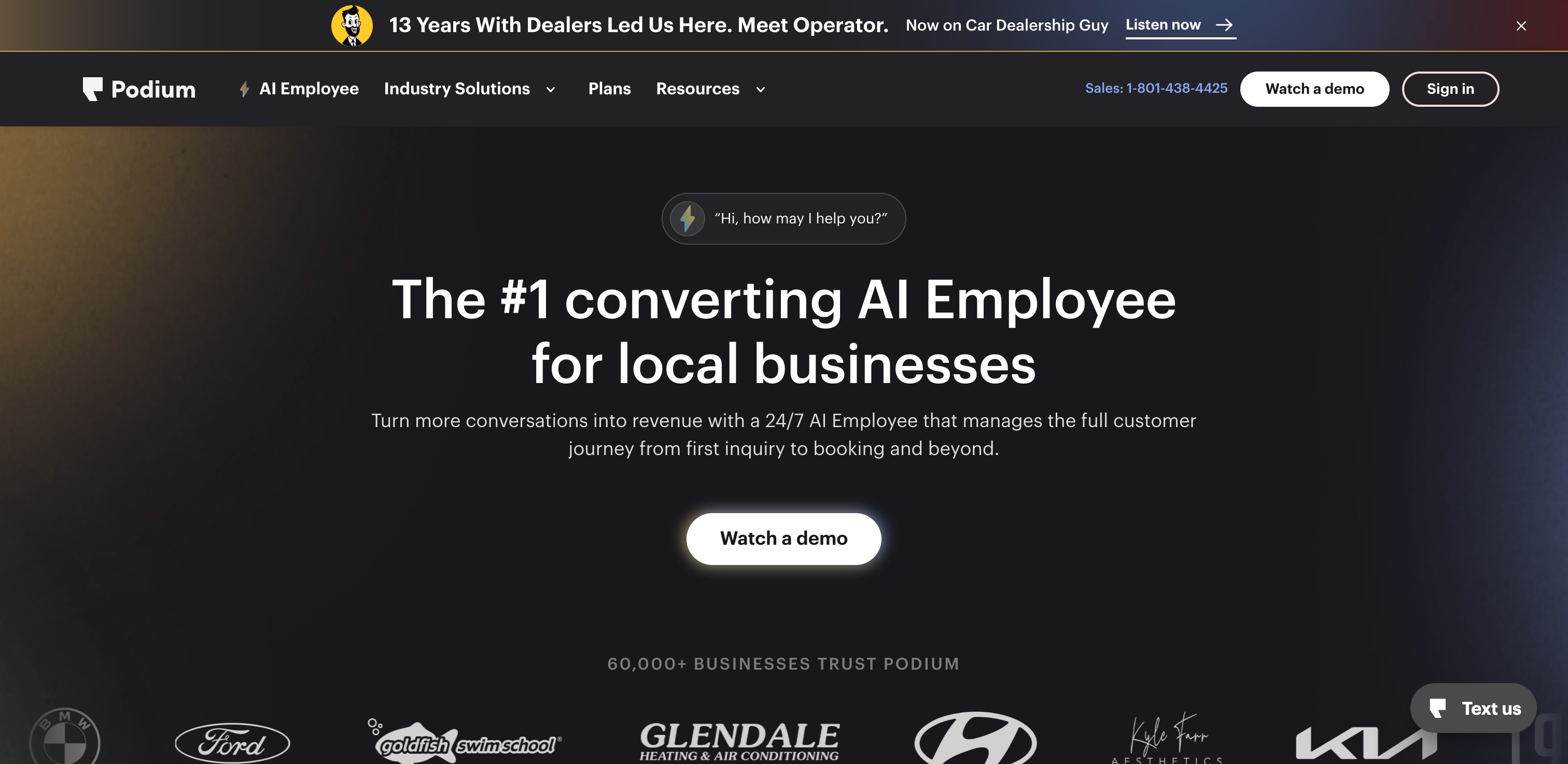
Podium

Podium started as a reviews company and grew into a full customer-communication platform. Automated review requests are still its strongest feature (send an SMS after a job or appointment asking for a Google review) but it now bundles messaging, payments and AI on top, built for businesses that win or lose deals in a text thread.
Key features
- Automated SMS review requests, with monitoring across 100+ review sites in one dashboard
- A unified inbox consolidating SMS, webchat, social DMs and phone calls
- Text to Pay (send a payment link by text) with fraud protection on remote payments
- Podium Phones: unified voice and SMS with call recording, AI transcription and call summaries
- AI Employee, a 24/7 AI agent that answers messages, follows up with leads, books appointments and drafts review replies, escalating to a human when needed
Pricing
Custom and quote-based, but customers report the tiers to be at roughly Core ~$399/mo, Pro ~$599/mo and Enterprise custom, with the AI Employee add-on running $99–$399/mo on top.
Watch out for ⚠️
It isn't a social listening or publishing tool, it manages conversations, not your social presence. Costs climb quickly past the headline price (the AI features that sell the demo are paid add-ons), contracts run annually, and most buyers use only 60–70% of what they pay for. It would be overkill for a single location that just needs Google review replies.
Yext

Yext (NYSE: YEXT) is an enterprise digital-presence platform. Its core is a central Knowledge Graph that gives you verified facts about your brand and every location, which it then pushes directly to 200+ publishers (Google, Apple, Bing, Amazon Alexa and more) without going through a data aggregator.
This makes its listings faster and more accurate at scale than aggregator-based rivals, and it pairs that with review management across the same wide publisher network.
Key features
- Direct listings distribution to 200+ publishers, with duplicate suppression and per-location analytics (impressions, clicks, calls, direction requests)
- Yext Scout, an AI-search-visibility agent that tracks how ChatGPT, Gemini, Perplexity, Claude and Google cite each location, and benchmarks it against up to 20 local competitors
- Review monitoring, generation and AI-assisted responses with bulk actions and approval workflows
- Branded local landing pages and social content management
- AI agents that execute Scout's recommendations: updating listings, correcting data, responding to reviews
- A developer API and MCP access, so your own AI tools can read and write the Knowledge Graph
Pricing
Custom and quote-based. Legacy small-business packages historically ran from a few hundred to around $1,000 a year, but the platform is now sold as enterprise solutions priced by location count and modules.
Watch out for ⚠️
The big one is lock-in. Yext maintains an overlay on directory data, so if you cancel, the corrections it pushed can revert to old, inaccurate information. Contracts are annual, and the price and complexity put it out of reach for smaller operators.
Reputation, Trustpilot and ReviewTrackers

- Reputation targets large enterprises in regulated industries, bundling reviews, surveys, governance and a proprietary reputation score (custom pricing, enterprise complexity).

- Trustpilot is the consumer-facing review platform for collecting and showcasing verified reviews, though you'll need separate tools for messaging and social.

- ReviewTrackers focuses on review analytics and sentiment at scale, at a more approachable price.
Reviews deserve a place in any monitoring setup: around three-quarters of customers read them before buying, and AI answer engines increasingly cite them as third-party validation.
They're also an early churn signal; we broke that down in how to spot customer churn signals in reviews, along with what's actually accessible programmatically in app store review data access.
Around 68% of Google searches now end without a click, and 42.5% of U.S. marketers already track their brand in ChatGPT and Perplexity.
You can rank first on Google and still be invisible in an AI answer, which is these tools are now a key part of any brand monitoring stack.
Profound

Profound is the inevitable leader in AI visibility, tracking brand mentions and citations across 10-plus AI engines: ChatGPT, Perplexity, Claude, Gemini, Copilot, Meta AI, Grok, DeepSeek and Google's AI Overviews and AI Mode.
It adds Agent Analytics and content-performance tracking tied to revenue, and counts Indeed, MongoDB, Ramp and Zapier among its customers. Pricing starts around $300/mo and climbs to enterprise.
Peec AI

Peec AI offers prompt-level tracking with unlimited seats, multi-country views, a Looker Studio connector and API access, from around €89/mo. It's great for marketing teams that want competitive share-of-voice inside AI answers without enterprise pricing.
Otterly.ai

Otterly.ai tracks ChatGPT, Perplexity, Google AI Overviews and Copilot from $29/mo (Claude and Gemini as add-ons), with a page-level GEO audit and a 7-day trial.
If you already pay for Semrush or Ahrefs, both now bundle AI-visibility modules worth switching on first.
Why AI visibility is really a coverage problem
An AI answer isn't conjured from nowhere. When someone asks ChatGPT or Perplexity to recommend a tool, the model builds its reply from the content it was trained on and the sources it pulls in live, and a surprising share of that comes from forums and reviews.
Reddit alone made up roughly 40% of citations in a study of ~150,000 AI answers, and brands with a strong Quora and Reddit presence get cited up to four times more often in ChatGPT.
That fundamentally changes what an AI-visibility tool can do for you. Tracking whether you get mentioned is only half the challenge; the other part is seeing the conversations behind the answer (the threads and reviews the model is drawing on) because that's what you'd have to influence to change the result.
Which makes AI visibility, underneath, the same coverage problem as everything else here: you can't act on what your tools can't see. We expand on where this is heading in what ChatGPT Ads mean for social and review intelligence.
Best free brand monitoring tools
You don't need a budget to get started with brand monitoring.
These free brand monitoring tools will catch your name across news and the major forums, and plenty of founders run on that setup until their mention volume justifies paying.
Here's what each one covers:

- Google Alerts: the default free option. It emails you whenever Google indexes a new page containing your keyword, which makes it reliable for news, blogs and press coverage. The trade-offs are that it doesn't touch social platforms, it can't read sentiment, and it often reacts days after a mention goes live.

- F5Bot: free, real-time email alerts whenever your keyword appears on Reddit or Hacker News. It's the simplest way to keep an eye on two of the highest-signal communities on the web, and especially useful for B2B, tech and developer brands.

- ForumScout: a free tier that monitors the niche message boards and forums bigger tools tend to ignore, which is often where early product feedback and complaints surface first.
What free tools can't do
Free tools can’t filter out irrelevant matches, read sentiment, cover most social platforms (TikTok, Instagram, LinkedIn), or keep any history you can analyze later.
In practice that means more noise to wade through, no trend analysis, and blind spots on the exact platforms where most conversations happen.
They're a good starting point, not a monitoring strategy, so when you find yourself forwarding alert emails by hand, or realizing how much you're not seeing, that's the signal to move to a paid tool.
Why you need historical data
Historical depth is a real dealbreaker, here’s why.
Real-time alerts tell you what's happening now; historical data tells you whether it matters.
Because a spike in mentions is meaningless until you can see whether it's ten times a normal week or a routine bump. A crisis is far easier to contain when you can trace it back to the first complaints weeks ago instead of reacting to today's blowup. And a trend is only useful if you can see the whole arc: whether you're catching it on the way up or long after it peaked.
None of that works if your data starts the day you went looking, and default retention varies wildly:
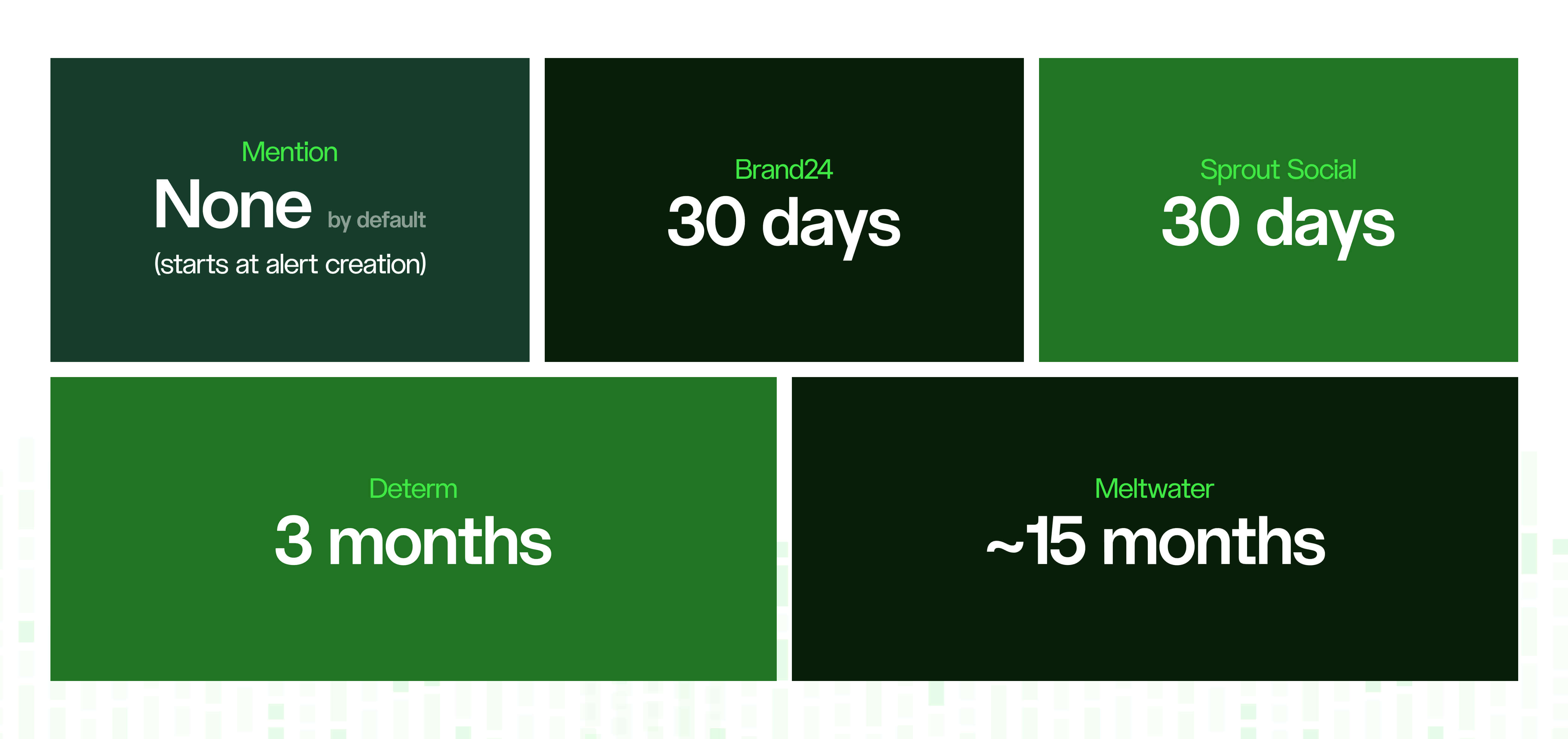
If you only start collecting when you notice a problem, you're analyzing it without the run-up. You can't tell whether a trend is emerging or already fading.
What should you measure for brand monitoring?
Once you're in a tool, we recommend focusing on a few metrics:
- Mention volume: how much you're being talked about, and when it spikes
- Share of voice: your slice of the conversation versus competitors
- Sentiment: the tone of those mentions (accuracy matters most for common-word brand names)
- Reach: how far a mention traveled
- AI citation rate: how often you show up in AI answers, and who shows up instead
- Unlinked mentions: mentions that name you without a link still shape how models and readers see you.
The majority your metrics miss
But every one of these metrics only counts people who chose to say something publicly, and really, most of your market never does.
The people posting reviews and firing off tweets are a small, vocal slice of your customers; the majority forms opinions, buys and churns without ever leaving a trace in a mention feed. So treat monitoring as one input rather than the whole truth, and pair it with representative data like surveys to hear from everyone else. One way to do that is in using social data to stress test survey findings💡
Buy a tool or build on the data?
Once you hit a coverage wall with a bought tool, a different question opens up.
Do you keep stacking subscriptions, or feed the data you actually need into your own stack?
Buying a platform gets you a dashboard and its coverage limits. Building on a social and review data source gets you the coverage you define, in your own systems, feeding whatever tool, warehouse or model you like, without a per-seat bill for everyone who wants a look.
This is the "headless" model that emerged as platforms locked down access: separate the data layer from the dashboard, so when one platform changes its terms, you swap the collection method instead of rebuilding your stack.
Neither path is universally right. But when you're paying for two or three tools to cover what one should, the equation changes. We lay out both sides in should you build vs. buy your social media data pipeline.
And before you build anything that touches public data, get the legal footing right: find out whether web scraping is legal in 2026.
The bottom line
Pick the tool that fits your job from the profiles above, but pressure-test it on your own brand first, and watch what it misses as closely as what it catches.
If the answer turns out to be that no single tool sees enough, that's usually the sign you've outgrown buying the dashboard and it's time to own the data underneath it.
If that's where you are, see the coverage your tools have been missing: the whole, representative picture of your market, delivered into your own stack and kept intact when the platforms change the rules. 👀
Frequently asked questions
What is the best brand monitoring tool?
There's no single best tool, the right one depends on your job. Brandwatch and Talkwalker lead at the enterprise end, Brand24 and Mentionlytics are strong self-serve picks, Birdeye owns multi-location reviews, and Profound leads AI-visibility tracking. Match the tool to your channels and budget rather than chasing the biggest name.
What's the difference between brand monitoring and social listening?
Brand monitoring tracks individual mentions of your name so you can read and respond. Social listening is the strategic layer on top: analyzing themes, sentiment and share of voice over time to shape decisions.
Why is brand monitoring important?
Because most opinions about you are never tagged or linked, they surface in reviews, forums and AI answers you don't control. Catching them early lets you fix issues before they spread, find advocates, and base decisions on what your market thinks rather than guesswork.
Are there free brand monitoring tools?
Yes, for the basics. Google Alerts covers newly indexed pages, F5Bot covers Reddit and Hacker News, and ForumScout covers niche boards. None filter for relevance, read sentiment, or keep history.
How do I monitor my brand on Reddit and in forums?
Some general tools cover Reddit shallowly and miss deeply nested comments. F5Bot is a solid free option; for depth, test a tool against your own brand during a trial. It matters more than it used to, because forums are among the most-cited sources in AI answers.
How do I track how my brand shows up in ChatGPT?
Dedicated AI-visibility tools like Profound, Peec and Otterly run your key prompts across the major engines on a schedule and record whether you're mentioned and who's mentioned instead. Several mainstream tools now add this too: Brand24's Chatbeat and Meltwater's GenAI Lens among them.
Should I buy a tool or build monitoring in-house?
Buy when you want a dashboard fast and its coverage fits. Build when you keep hitting coverage or integration limits, want data in your own systems, or are paying for several tools to do one job.
.png)



More insights you might like

%20thumbnail.jpg)