TikTok Data Coverage in 2026: What Social Intelligence Teams Need to Know
If you’re in the social data space, you’ll know TikTok has been a huge question mark lately. ❓
Would it stay online in the US? Who would end up owning it? And could you build anything lasting on top of a platform that might vanish overnight?
And most importantly: how do you actually get TikTok data? A commercial API has been rumoured for years; talked up, expected, but never delivered.
Yes, one of the largest social networks on the planet still doesn’t enable the ecosystem to analyse it at any real scale.
Let's clear it all up. This guide walks through how TikTok data access works in 2026: which doors are open, which are shut, what you can realistically collect, and what all of it means for consumer insight, trend tracking, and brand monitoring.
The short answer
No, not through TikTok's own tools. All of TikTok's official routes exclude commercial use: the Research API is reserved for non-profit academics, the ad library covers European advertising only, and the business APIs return nothing but your own account. So for competitor tracking, sentiment analysis, and trend detection at scale, social intelligence teams access TikTok data through a data partner rather than going to the platform directly.
💡 If you're weighing that up, we've broken down build vs buy for a social data pipeline.
Here's the full picture ⬇️
Key takeaways
- TikTok is stable now as a platform. The divest-or-ban deal closed in January 2026, ending the shutdown risk that hung over the platform all through 2025.
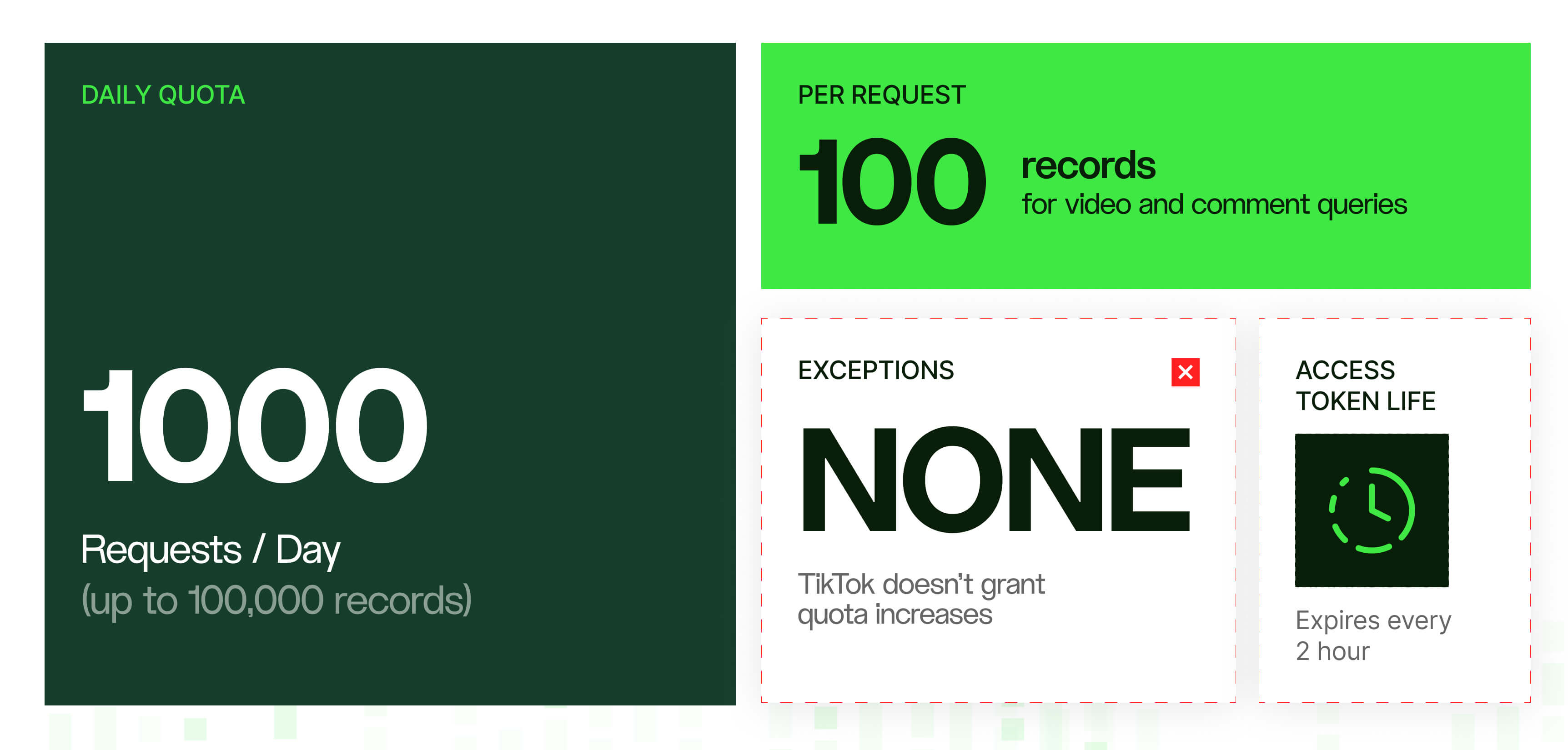
- The official research route is academic-only, capped at 1,000 requests a day, with no commercial use allowed.
- A commercial API still isn't a real option. TikTok invited a handful of large SaaS platforms into a limited-scope API beta, and the conversations rumble on, but nothing broadly available has landed, so commercial teams still can't get direct access.
- "Coverage" isn't a single number. What you can actually pull from TikTok depends on what you need: its videos carry little text to analyse, its content is short-lived, and its engagement counts are slow to update. So both how complete your data is and how current it is can vary a lot.
- For most teams, a data partner is the route that makes sense. TikTok's official channels are all closed to commercial use, so it comes down to build vs. buy: stand up and maintain your own collection pipeline, or get the data ready to use and spend your time on insight instead of infrastructure.
TikTok social data access at a glance
There are four official doors into getting TikTok social data. Only one is fit for collecting data, and even that one isn't made for businesses.
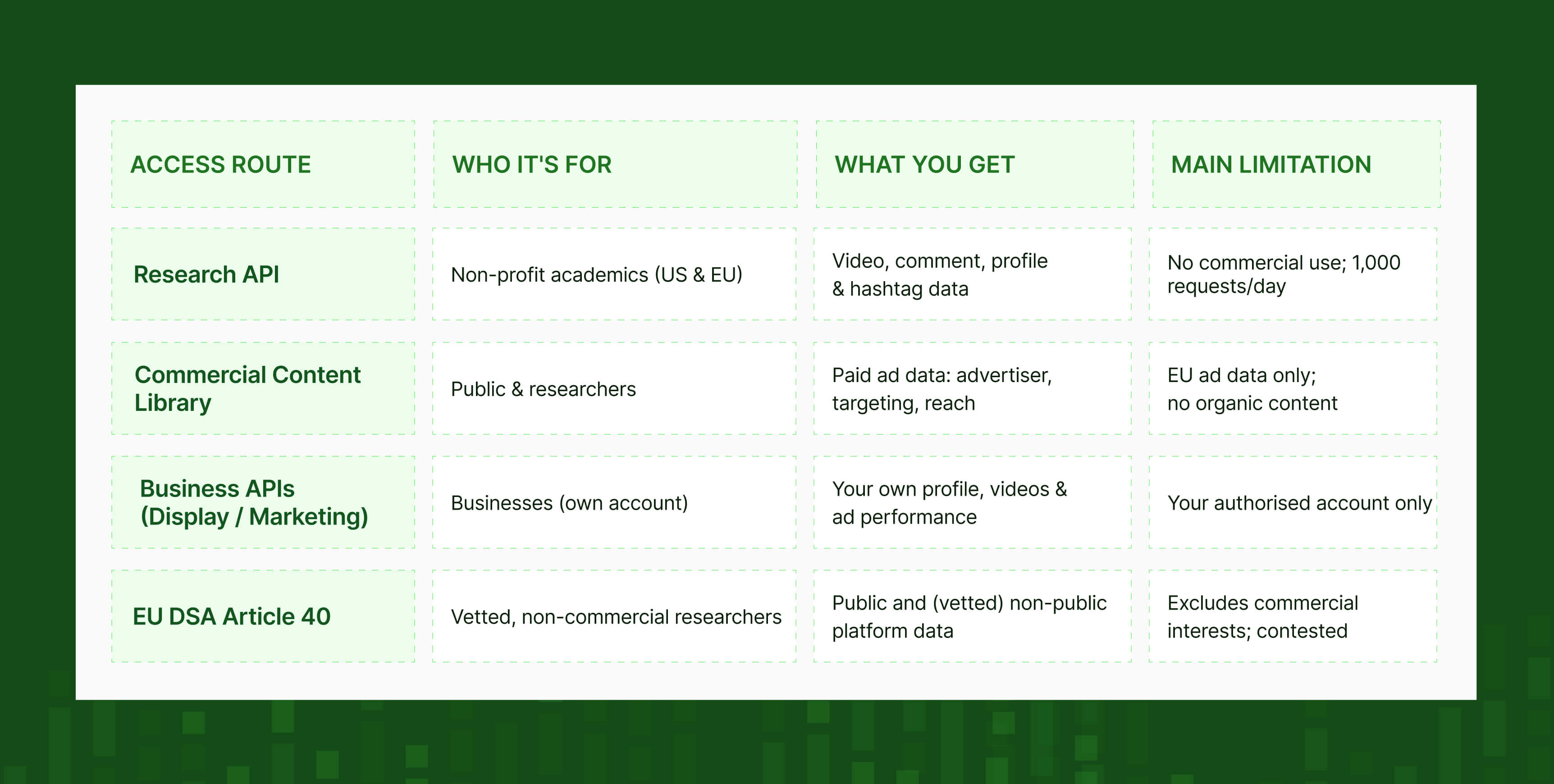
We'll take each of these in turn, but first, the news that changes everything else.
Is TikTok a stable platform to build social data on in 2026?
For the past couple years, anyone relying on TikTok data had to factor in the odds of the app going dark in its biggest Western market. That worry is now behind us.
In January 2026 the US divestiture closed, and a new company, TikTok USDS Joint Venture LLC, took over the app's US operations: now serving more than 200 million Americans and 7.5 million US businesses. The majority sits in American and global hands, with ByteDance keeping a 19.9% minority stake.
US user data is now held in a secured US-based cloud, walled off from the old setup. The recommendation algorithm, the system that chooses what shows up in each person's feed, is retrained and maintained inside that same environment, on US data. So the feed Americans see is now shaped by a US-based, US-trained version of the algorithm.
How does TikTok's US algorithm affect trend data?
TikTok's US recommendation algorithm now runs separately from the global one, so US and international trend signals can diverge. Because the US system is retrained and maintained on US user data inside a secured US cloud, it optimises for what US audiences engage with, not for the platform's worldwide patterns.
What does that mean for social data? A recommendation engine learns from the data it's trained on: feed it US signals and it surfaces the content US viewers respond to. So a trend climbing in the US feed might barely register elsewhere, and a format going viral internationally could take longer to surface stateside.
That’s why we need a shift to stop treating TikTok as or one uniform source for social intelligence work:
- Keep separate baselines for US and non-US signal instead of blending them into a single trend line.
- Don't extrapolate across markets – a US spike isn't automatically a global one, and vice versa, so check the other surface directly before you claim it.
- Tag data by market at collection, so cross-market comparisons stay like-for-like.
One thing to remember: TikTok isn't everywhere
TikTok’s divestiture sorted out its future in its biggest Western market, but zoom out to the rest of the world and the map still has some alarming gaps.
- In India, TikTok has been banned since 2020, which takes one of the planet's largest consumer markets off the table completely as there's simply no TikTok data to collect there.
- And in mainland China, TikTok doesn't run at all; that market has its own version, Douyin, a separate app behind its own walls that isn't part of the same data ecosystem.
So the takeaway for social intelligence work is this: TikTok gives you a strong read on plenty of markets, but it's a blind spot in two huge ones. It's stable and safe to build on, just don't mistake it for a mirror of the whole world. If your remit is global, lean on it as one regional lens among several.
How can social intelligence teams access TikTok data?
TikTok gives you a handful of official routes. Telling them apart saves a lot of wasted effort, because only one is meant for collecting data, and that one shuts commercial users out.
The TikTok Research API: academics only
The Research API is the closest thing TikTok offers to a real data feed. It returns video metadata, comments, profile information, and hashtag or keyword search. The sticking point is who's let in.
💡 For the same picture on another gated source, see what you can and can't get from app store review APIs.
Per TikTok's own documentation, access is limited to researchers at non-profit universities in the US and Europe. Creators, advertisers, and commercial users are told flatly that they don't qualify. And even the researchers who do get in run into tight limits:
There's a freshness catch, too. The Research API reads from an archived index rather than the live platform, so the data lags behind reality in two ways.
- New videos can take up to 48 hours to appear in search
- And view and follower counts keep climbing for days after a post goes live, often reading lower than the true figure until they catch up.
So if your work hinges on same-day accuracy during a fast-moving moment, this route won't deliver it ⚠️
The Commercial Content Library: an EU ad-transparency window
TikTok's Commercial Content API opens up paid advertising data – the advertiser behind an ad, its targeting, when it ran, and roughly how many people saw it.
It's a useful lens for competitive ad monitoring, but with two major caveats to be aware of:
- It currently covers ad data from EU countries only, and expands from there over time
- It's ads, not organic content, so it won't show you the wider conversation.
TikTok's business APIs: your own account, not the platform
The Display and Marketing APIs are the tools businesses can use freely, but they only reach your own authorised account: your profile, your videos, your ad performance.
Handy for reporting on yourself, but that's all it can do. These APIs only hand back your own owned content: your posts, your performance.
❌ You get nothing on competitors, no read on the wider conversation or the topics you're tracking, and no access to the earned and shared content where people talk about your brand rather than hearing from it.
For understanding anyone or anything you don't control, they're a dead end.
What about a commercial API?
TikTok has run a limited, invite-only beta with a handful of large SaaS platforms, and industry conversations have carried on for years, but nothing broadly available has materialised. Unless you're one of a few hand-picked testers, a commercial API isn't a route you can plan around today.
The EU's Article 40 research route, and why it's closed to businesses too
Under the EU's Digital Services Act, TikTok counts as a Very Large Online Platform: the label the European Commission applies to any service reaching more than 45 million monthly users in the EU. That designation comes with a duty, under Article 40 of the DSA, to give researchers access to platform data.
The conditions are where it falls apart for commercial use. To qualify, researchers have to be independent from commercial interests and disclose their funding. For the deeper tier that reaches non-public data, they also need a research-institution affiliation and have to commit to publishing their findings free of charge.
And even for the researchers it is built for, it's rocky. In October 2025 the European Commission preliminarily found TikTok in breach of its duty to give researchers adequate access to public data, one of several open cases on the issue. So even the official, regulator-backed research channel is contested and constrained.
So Article 40 was never built for commercial use. Which means that, one way or another, none of TikTok's official routes are open to the work social intelligence teams do.
What does this mean for social intelligence teams?
Whether you're on a SaaS team building a product on top of social data, or on the brand side trying to read your market, TikTok's official access simply wasn't designed for you.
Through official channels, you can't get:
❌ Anything you don't own. You can see your own account; not competitors, not creators, not the wider public conversation about your category.
❌ Earned and shared content – the posts and comments where people talk about your brand, rather than the ones you publish yourself.
❌ Topic- and trend-level data at scale, since the only route that returns broad public data is reserved for non-commercial academics.
Put those gaps together and they rule out most of what social intelligence exists to do in the first place: competitive benchmarking, brand and topic monitoring, trend detection across the platform, crisis and early-signal spotting, and voice-of-customer from the open conversation instead of your own replies.
That's what working with a data partner solves. You’re able to get managed access to the public conversation at scale – with the coverage, freshness, and much of the compliance groundwork already handled – so you can run the use cases the official channels put out of reach.
What social data can you get from TikTok?
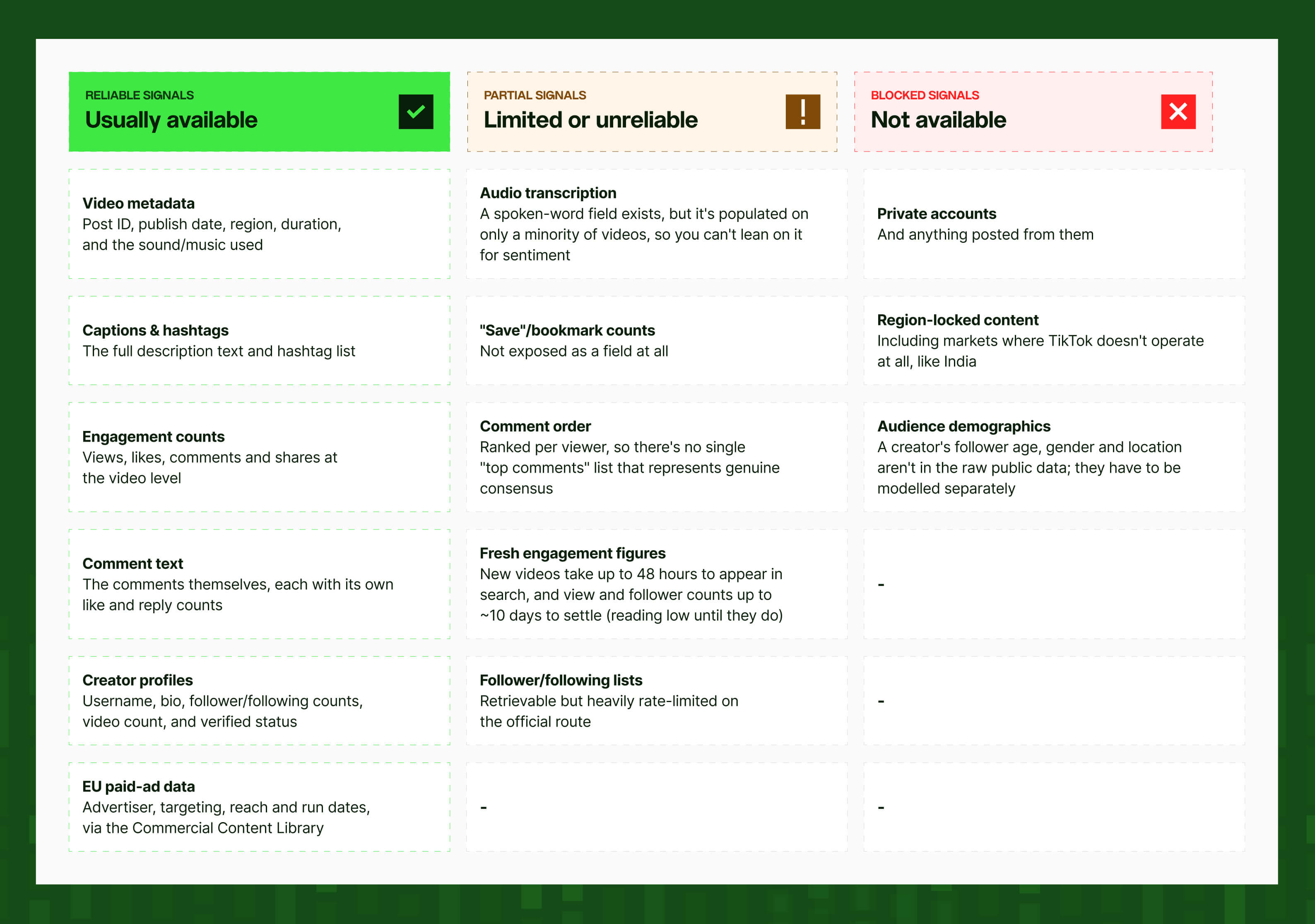
The public TikTok data itself is rich: video metadata and captions, hashtags and sounds, engagement counts, comment text, creator profiles, and paid-ad data across the EU. The problem is that TikTok's official routes won't hand it to commercial teams.
💡 Working with Datashake (or any provider focused on publicly available social data) you can pull that same public TikTok data at scale through a single managed feed, without an academic credential or an invite to a closed beta.
That said, coverage still isn't limitless. Some of it comes with gaps or delays, and a few things are off-limits to everyone. Here's how it breaks down.
TikTok is video-first, so the text is thin
Captions are often just a few words and a couple of hashtags. Most of the meaning lives in the spoken audio and the text on screen, which means you'll need transcription and visual analysis before you can read sentiment with any confidence. Budget for that step, because the caption rarely tells the story.
Comments don't have a fixed order
TikTok ranks comments per viewer, so there's no single "top comments" list that stands in for consensus. Two people watching the same video see different replies first. That makes comment sentiment directional, so any reports need to reflect that.
The content is short-lived
TikTok is built around what's happening right now, and its historical archive is shallow by design. That makes it a brilliant read on the present and a weak one for long, backward-looking trend lines.
💡 It's really a coverage question, which we unpack in why social data is so often incomplete.
Why does data coverage matter for TikTok social listening?
Social listening is only as reliable as the data underneath it. If you're working from a partial slice of the conversation, every number you report (sentiment, share of voice, trend momentum, etc) is drawn from a skewed sample, and you usually can't tell by how much.
With TikTok, the stakes are higher than for most platforms, because it's not just somewhere people post, it's increasingly where they search.
For younger audiences especially, TikTok has become a front door to discovery: Gen Z routinely turn to it to research products, places and brands the way earlier generations turned to a search engine.
That shifts what social listening is really for. It's no longer just measuring what people say about you; it's understanding what content they're consuming and acting on, and, from there, aligning what your brand does with how consumers actually behave.
Miss a slice of that, and you're not just under-counting mentions; you're misreading the behaviour you're trying to influence.
Pull only the top few videos on a hashtag, or only the comments a personalised feed happens to surface, and you'll build a story on top of a lopsided sample. You might miss a complaint while it's still small, read sentiment as warmer or cooler than it really is, or hand a stakeholder a competitive picture that's just noise.
In-depth coverage is what closes that gap. In practice, it comes down to three things:
- Breadth: enough of the relevant conversation to be representative, not just the loudest or most recent posts.
- Depth: comments, replies, and full threads, where the real sentiment and nuance live, rather than surface metrics alone.
- Consistency over time: the same data, captured the same way, so week-on-week trends reflect real change instead of gaps in collection.
💡Not sure where you stand? Here’s our framework for evaluating data coverage.
How fresh is TikTok data?
Less instant than the marketing implies. On the official Research API, freshness looks like this:
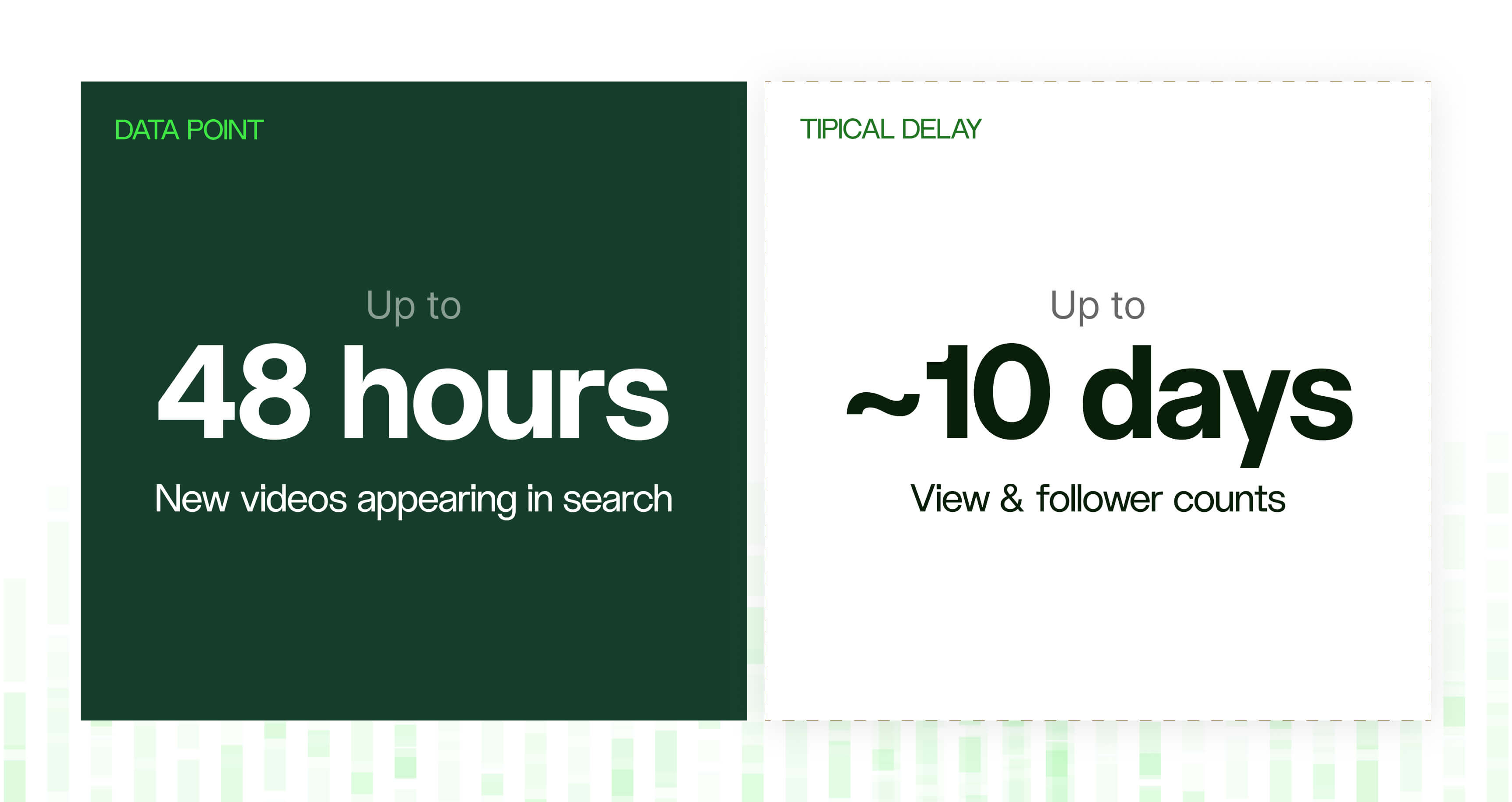
Engagement figures behave the same way; they tend to read lower than the live numbers until they catch up.
The rule is simple: if a use case falls apart when your data is a few hours old, check the real latency before you lean on it. 👀
Is it legal to collect and use TikTok data?
Collecting publicly visible content is defensible. But it isn’t unrestricted. Even publicly visible posts can count as personal data under GDPR, so you need a documented lawful basis to collect them, agreements with any data supplier, and a way to honour deletion requests. "Public" doesn't put the data outside privacy law.
Under GDPR, public posts can still count as personal data, and how you collect and use them brings obligations with it. In May 2025 the Irish Data Protection Commission fined TikTok €530 million over user-data handling, on top of an earlier nine-figure penalty. Regulators have been consistent that "but it was public" isn't, on its own, a defence.
💡 Our guide to GDPR and social media data covers what that means in practice.
A practical compliance checklist
A defensible position usually comes down to having four things in place for social intelligence work:
- A documented reason for why you're collecting the data
- An agreement with whoever supplies it
- Data minimisation – only what you actually need
- A deletion process to honour removal requests
One thing to never assume is that a given approach is automatically "fully compliant." It depends on your specific use, your jurisdiction, and how you handle the data once you've got it. The realistic goal is a documented, defensible position, not a magic guarantee.
What should social intelligence teams do about TikTok in 2026?
Put it all together and the strategy is really about matching the platform to the job:
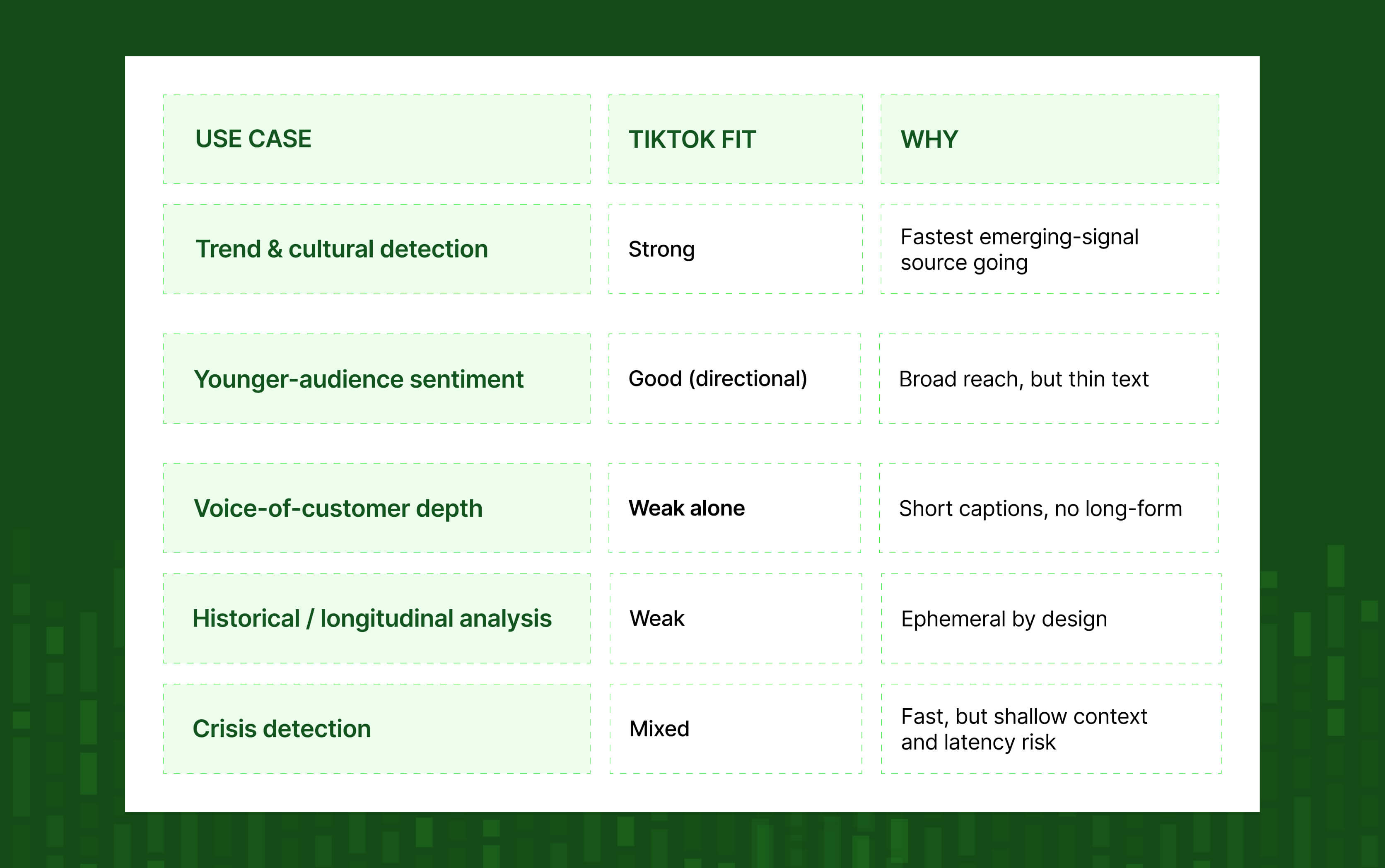
Five principles fall out of that:
- Build with more confidence than last year. The ownership question is settled; TikTok is a durable source now.
- Keep US and global signal in separate columns. With the US algorithm trained on US data, don't assume a trend in one market carries over to the other.
- Pair TikTok with text-rich sources when you need depth, reasoning, or long baselines. It rarely carries that weight on its own.
- Test freshness; don't trust the label. Confirm the actual latency for anything time-sensitive.
- Get the compliance groundwork down first, and design for deletion from day one rather than bolting it on later.
With no official TikTok channel open to commercial data at scale, the choice comes down to building and maintaining your own collection or using a partner that delivers it ready to use – and for most teams, building in-house isn't worth the cost and upkeep.
TikTok data in 2026: FAQs
What is the TikTok Research API?
The TikTok Research API is TikTok's official tool for accessing public platform data, including video metadata, comments, profiles, and hashtag search. It's available only to approved researchers at non-profit universities in the US and EU, and it can't be used for commercial purposes.
Can businesses use TikTok's Research API?
No, TikTok's Research API isn't available for commercial use. Access is limited to non-profit academic and research institutions in the US and EU, so businesses, agencies, and advertisers don't qualify. For commercial projects, teams generally use a specialist data partner instead.
How can businesses access TikTok data?
Because TikTok's official APIs exclude commercial use, most businesses access TikTok data through a specialist data partner rather than going to the platform directly. A good partner also handles data freshness and the GDPR groundwork: a documented lawful basis, data agreements, and deletion handling.
Is it legal to collect public TikTok data?
Collecting public TikTok data is generally legal, but public posts can still count as personal data under GDPR, and TikTok's terms apply. A defensible approach means having a documented lawful basis, data agreements, minimal collection, and a way to honour deletion requests, not assuming "public" means unrestricted.
How fresh is TikTok data?
TikTok data isn't truly real-time. On TikTok's official Research API, new videos can take up to 48 hours to appear in search, and view and follower counts up to around 10 days to settle. Always confirm the real latency of your specific data source before relying on it.
Can you get historical TikTok data?
Historical TikTok data is limited. TikTok is built around current activity, so its archive is shallow by design, and deleted or private posts are out of reach through every route. For long-term trend analysis, TikTok works best alongside sources with deeper historical records.
Is there an official EU route to TikTok data?
Yes, but not for commercial teams. The EU's Digital Services Act (Article 40) lets vetted researchers request data from TikTok, but access is restricted to researchers independent from commercial interests. The European Commission also found TikTok's researcher access inadequate in a preliminary ruling in October 2025.
Who owns TikTok in the US now?
Since January 2026, TikTok's US operations are owned by TikTok USDS Joint Venture LLC, a majority American- and global-owned company. ByteDance, TikTok's original parent, retains a 19.9% minority stake, and US user data is held in a secured US cloud.
Is TikTok banned in the US?
No, TikTok isn't banned in the US. After a divestiture that closed in January 2026, the app operates legally under TikTok USDS Joint Venture LLC, which is majority American- and global-owned, with ByteDance holding a 19.9% minority stake.
What data does TikTok's ad library provide?
TikTok's ad library (the Commercial Content API) provides data on paid ads, including the advertiser, targeting details, when the ad ran, and how many people saw it. It currently focuses on ads shown in the EU and doesn't cover organic, non-paid posts.
Does TikTok have a commercial API?
Not one that's generally available. TikTok has run a limited, invite-only beta with a handful of large SaaS platforms, and talks have been ongoing for years, but there's no commercial API you can sign up for today. Commercial teams access TikTok data through a data partner instead.
.png)



More insights you might like