Facebook Social Data API in 2026: What You Can (and Can't) Access
%20Access.jpg)
Getting data out of Facebook through official channels feels like it should be a solved problem by now.
The platform has been around since 2004, a huge share of the internet has logged into something with a Facebook account at some point, and the Graph API (Meta's core interface for accessing Facebook data) has existed in some form for well over a decade.
But it is still far from being solved.
Meta has spent the years since the 2018 Cambridge Analytica scandal narrowing what its official channels hand over, and every major policy move since has tightened that door:
- The 2018 API lockdown that put the Pages API behind mandatory App Review
- The August 2024 shutdown of CrowdTangle
- and a Facebook Terms of Service rewrite as recent as January 2025
And that tightening is the day-to-day reality of running an app on the platform at all:
- Every permission gets reviewed against your specific use case rather than granted as a blanket licence
- Any rejection resets the App Review clock, so one ambiguous privacy policy link or an off-spec screen recording can send you back to the start
- Business Verification runs on its own recurring review cycle
- And with a new API version shipping roughly every six months, staying compliant is something you do continuously, not something you ever really see the end of.
Here's what Facebook data coverage looks like in 2026: what's accessible through the Graph API, the Ad Library, and Meta's research programmes, what's permanently off the table, and why having an API isn't the same as getting the data you want.
Quick answer: what data can you get from Facebook in 2026?
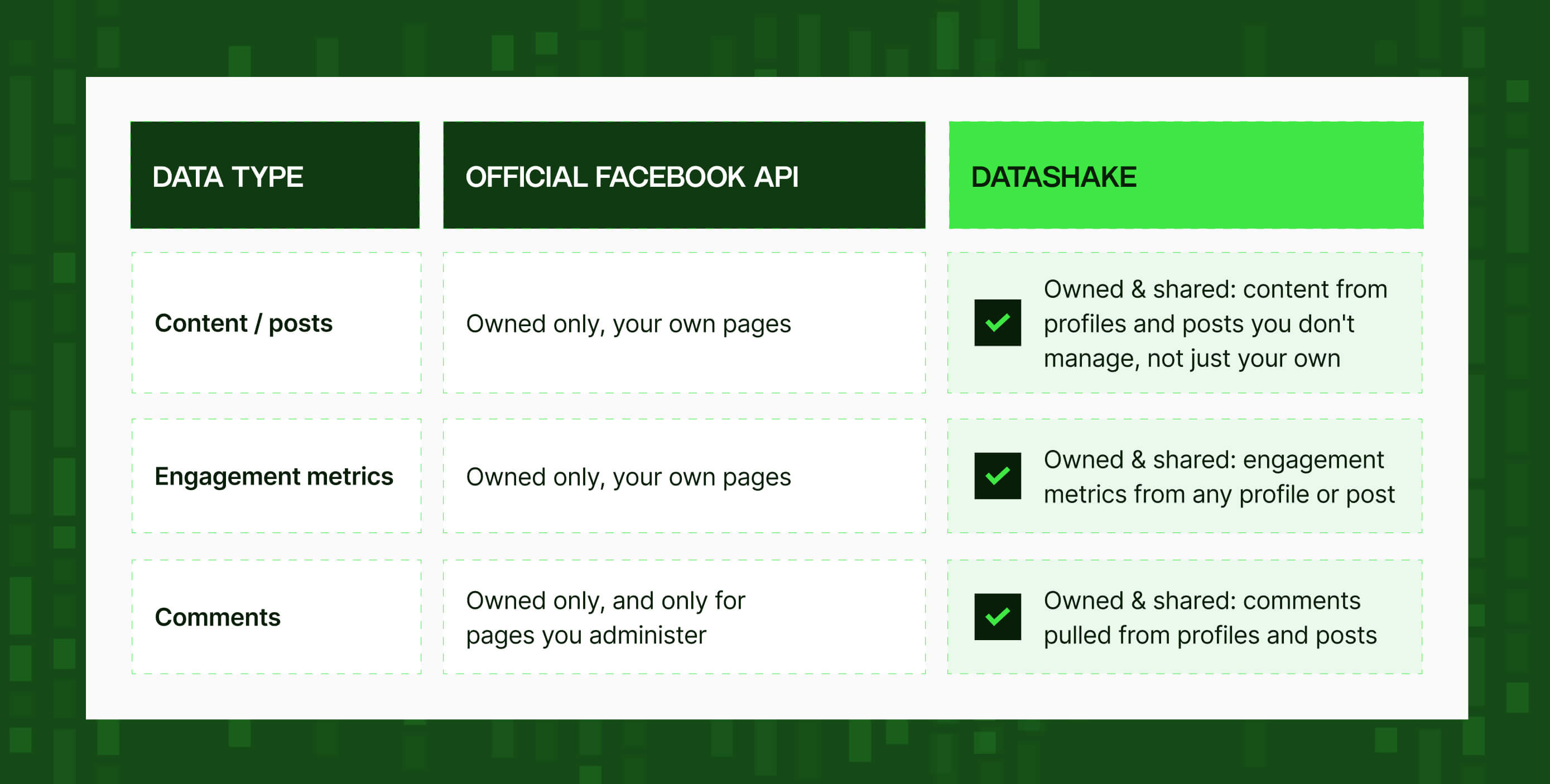
Through official channels, you only get owned data: full access to Facebook assets you own or manage, and nothing on any other business's Page, Group, or ad account. Meta's APIs cover your own Page, your own ad account, and your own user data well.
What they don't cover is shared data and earned data: content, engagement, and conversation that live outside your own channels, on Pages and profiles you don't manage. Yet that’s exactly the data social intelligence teams want: what's happening on a competitor's Page, what a category of businesses is being told, what the market looks like beyond your own four walls.
A narrow research-only path exists for vetted academics, and a handful of aggregate, anonymised datasets are open to everyone. Neither changes the shape of the problem: what's happening across this market, not just on my own Page, is the question official channels were never built to answer.
Key takeaways
- Every meaningful Facebook Pages permission – reading posts, engagement, even ratings – only works for Pages you or your organisation manage. There's no official route to another business's Page data.
- The Meta Ad Library API exists because of EU transparency law, not because Meta wanted to open up ad data. Commercial ad coverage is limited to the EU and UK, and it has no engagement metrics at all.
- CrowdTangle, the closest thing to an open research tool Facebook ever had, shut down in August 2024. Its replacement is restricted to vetted academic and non-profit researchers.
- Meta rewrote its Terms of Service at the start of 2025 specifically to close a court-created loophole around scraping public data while logged out; the legal ground here keeps moving.
- If your team needs Facebook data about the market, not just your own Page, official APIs aren't the mechanism that gets you there.
Facebook data access at a glance
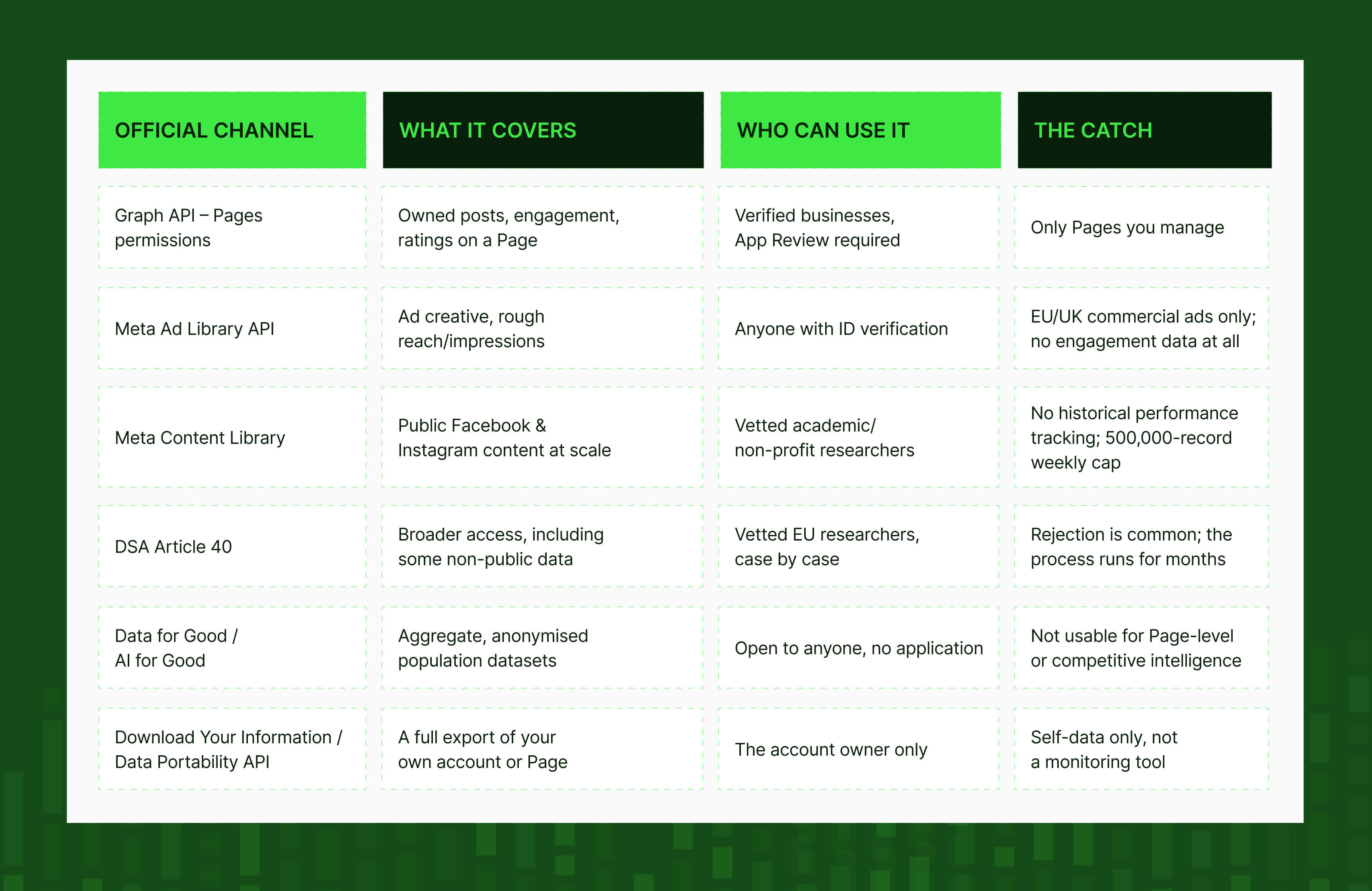
Facebook API access timeline: what's changed since 2018
2018
The Cambridge Analytica fallout triggers a sweeping API lockdown: Meta restricts Groups, Events, and Instagram Platform API access and requires App Review for the Pages API; by August, public content discovery through the API is locked behind App Review and limited to Page content and certain verified profiles
Early 2024
Third-party access to Facebook Groups is cut off, reportedly with little warning and no clear replacement
February 2024
A US court rules Meta's terms didn't cover logged-out scraping of public data; Meta drops its claim instead of appealing
August 2024
CrowdTangle, the default tool for tracking public content at scale, is retired despite public pushback from journalists and researchers
January 2025
Meta rewrites its Terms of Service to close the logged-out scraping gap for good
June 2025
The Meta Content Library gets a real expansion – lower follower thresholds and new content types – though eligibility stays restricted to vetted researchers
February 2026
Graph API v25.0 ships as the current version, continuing the standard two-year support cycle
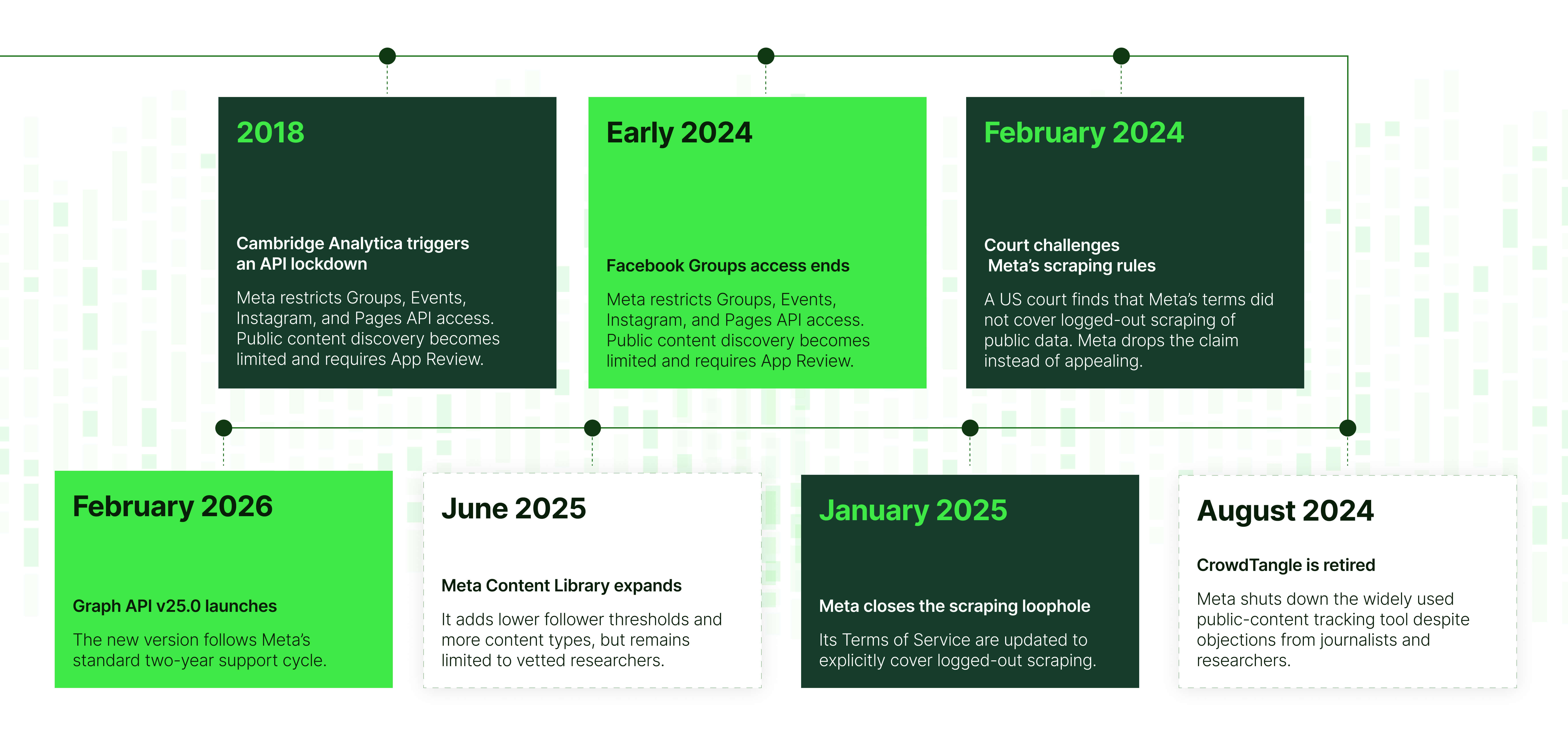
How can social intelligence teams access Facebook data?
There are six official routes into Facebook data:
- The Graph API and Pages permissions
- Reviews and recommendations, a special case of the above
- The Meta Ad Library
- The Meta Content Library
- The EU's DSA Article 40 research route
- Data for Good and the self-service export tools
1. The Graph API: built for managing your own Page, not anyone else's
The Facebook Graph API is Meta's general-purpose data API: the foundation that the Marketing API, the Pages API, and the Ad Library API all sit on top of.
It's the starting point for almost anything you'd want to call "official Facebook data access."
Getting anything useful out of it means clearing three separate gates:
- Register a Meta developer app and specify the exact data and permissions your use case needs
- Complete Business Verification, which is free, but requires official business documents (see below) and takes 5 to 15 business days per cycle
- Submit for App Review – Meta manually approves the specific permissions you're requesting, typically in 2 to 7 business days for a clean submission
Clear all three, and you're still capped by a rate limit that scales with your own app's active users, not a flat quota: roughly 200 calls per hour for every active user your app has. A brand-new app might have a handful of active users, so that limit works out to a few hundred calls an hour, no matter how many permissions App Review just approved.
Even fully approved, the permissions that are most key – pages_read_engagement, pages_manage_engagement, and pages_read_user_content – are scoped to Pages your app or its authenticated user actually manages.
Meta's documentation is explicit that during development, you can only see content from Pages whose admin also has a role on your app, and that reaching public content on other Pages requires submitting the feature for App Review.
Once approved, access is broader, but it's reviewed and granted use case by use case, not a general licence to read whichever Page you like.
In other words: the Graph API does one job well: letting a business monitor itself. It was never built to let a third party monitor someone else's Page, and Meta has tightened that boundary rather than loosened it since 2018.
💡 If you need to monitor beyond what you own (competitor Pages, franchise locations, a market, etc) this is where official channels stop being the answer. It's the same wall App Store review data hits: first-party APIs are self-service tools, not market intelligence tools.
👀 Say you run a five-location restaurant chain and want to compare how each location is rated against its own.
Your app, once approved, can read engagement and recommendations on all five Pages; if your business manages all five.
Now say you want the same view of a competitor's five locations. Officially, there's no path to that at all. The only way in is if that competitor hands your app a role on their own Page, which, if they're a competitor, they have no reason to do.
2. Can you get Facebook reviews and ratings through the API?
Only for Pages you manage, and only since Facebook replaced star ratings with recommendations.
Reviews are not a quick API call away, yet they’re usually among the most important data type for anyone doing review or reputation intelligence.
Facebook moved away from 1–5 star ratings between 2018 and 2019 in favour of a binary recommend/don't-recommend system that requires written context. Existing star reviews stayed visible, and Pages still show an aggregate numeric score, but the underlying mechanic changed.
The pages_read_user_content permission does technically expose this recommendation data through the Graph API; but, again, only for Pages you administer, behind the same Business Verification and App Review gate as everything else. There's no official endpoint for pulling recommendations off a Page you don't manage. No "get me the reviews for this competitor" call exists, and hasn't since the pre-2018 API was locked down. ❌
3. What is the Meta Ad Library, and what can you get from it?
The Meta Ad Library is a public, searchable database of ads running across Facebook, Instagram, Messenger, and Audience Network.
The Ad Library was built to answer for political and social-issue ad transparency and has since been extended, unevenly, to commercial ads under pressure from the Digital Services Act.
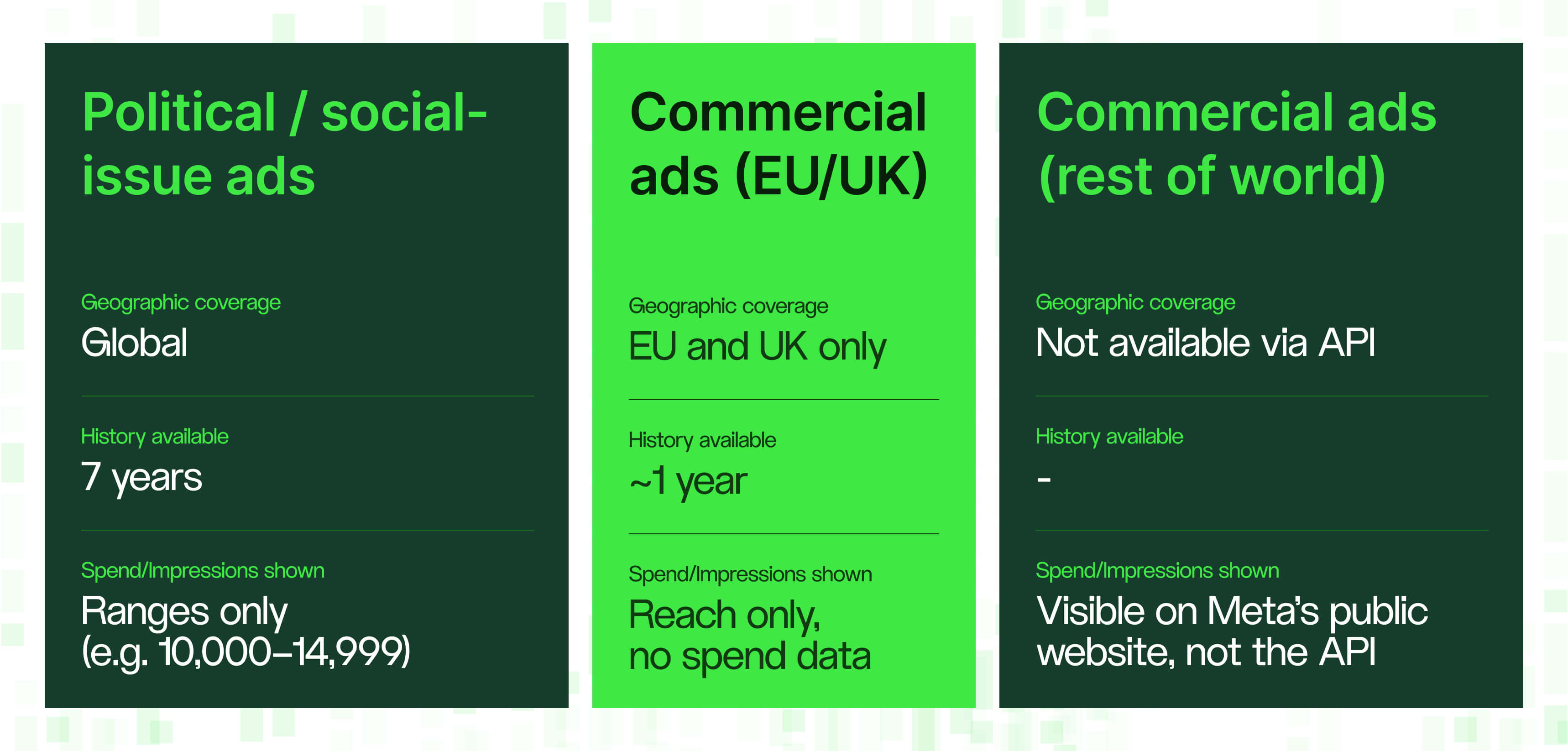
Even within that narrower EU/UK window, the data is thin. You get ad creative, delivery dates, and a rough reach figure. There are no engagement metrics anywhere in the API: no likes, comments, shares, or click-through rate. You can confirm an ad ran and roughly how far it reached, but you can't tell whether it worked.
4. What is the Meta Content Library, and who can access it?
The Meta Content Library is Meta's research-only tool for searching public Facebook and Instagram content at scale, restricted to vetted academic and non-profit researchers.
For years, CrowdTangle was the closest thing Facebook had to an open window into public content at scale. Meta shut it down on 14 August 2024. Its replacement, the Meta Content Library, is a wildly different tool, not a like-for-like swap.
Who's eligible
Researchers "affiliated with an academic institution or another not-for-profit organisation whose core activity is scientific or public-interest research", applying through a university-run review process that takes two to six weeks.
Independent journalists and unaffiliated researchers aren't eligible; a real step back from how open CrowdTangle used to be, and Meta's update notes as of June 2025 don't mention that changing.
What's missing even if you do get in:
- No historical tracking. The tool's documentation confirms it doesn't support tracking a post's performance over time: you get a point-in-time snapshot, not a running history.
- A hard volume cap. Every researcher is limited to 500,000 content items per rolling seven-day period, counting UI and API queries together.
- A more restrictive access model than its predecessor. Registration is more complicated and export rights narrower than CrowdTangle's, so it’s a step back for transparency even where the underlying data has grown.
5. What is DSA Article 40, and can businesses use it?
Article 40 of the EU's Digital Services Act is a legal provision that, in theory, forces large platforms like Facebook to give vetted researchers access to data for studying systemic risks.
In practice, it's open only to academic researchers, not businesses, and even they face long odds. It's the most serious regulatory attempt yet to open these platforms up beyond what they'd volunteer.
But this is a legal and compliance process, not a grant application, and it demands institutional resources the majority of research teams don't have.
So this route it is not, currently, a practical source of data for a business. ❌
6. Data for Good, and the self-service export tools
Two more official channels round out the list, and neither one helps you get data about other than your own page:
- Data for Good / AI for Good – aggregate, privacy-preserved datasets like the Social Connectedness Index, mapping how socially connected different regions are to each other. Not usable for competitive intelligence or Page-level analysis.
- Download Your Information and the Data Portability API – a full export of your own account or Page, and (for EU users, under Digital Markets Act rules) a way to port your own data to a third-party app. Both are self-initiated, self-data-only, and not fit for programmatic or bulk use.
Is there a commercial Facebook data API?
No, Meta doesn't sell broader Facebook data access at any price.
There isn't a paid, general-purpose tier that hands over public Page data, reviews, or content across businesses you don't manage. The Graph API's commercial-facing side (the Marketing API) is made for running and measuring your own ad campaigns, not for pulling data about the wider market.
If you've been searching for "Facebook data API pricing" hoping to find a plan that unlocks broader access for the right fee, that plan doesn't exist, the restriction is about what the data is for, not what you're willing to pay.
What does this mean for social intelligence teams?
Every one of the six channels above answers "tell me about my own stuff" or "here's some aggregate context."
❌Every one of the six channels above answers "tell me about my own stuff" or "here's some aggregate context." None of them answers "tell me what's happening across this market, this competitor set, or this category of businesses" – which is probably what you want answered 👀
➡️ What's happening outside your own channels is often where a meaningful share of the intelligence sits: the comments on a competitor's post, the reviews piling up on a rival's Page, the conversation building across a category you don't manage a single asset in…
It's the same pattern TikTok's official channels follow: a research API for academics, a business-tools suite scoped to your own account, an ad transparency library built for a different purpose than competitive research.
Official channels are compliance infrastructure and self-service tooling, not intelligence infrastructure.
💡 If your social data already feels incomplete, this is usually why: the tools were never designed to fill in the picture you're trying to build. Our framework for evaluating whether your social data is representative is a reasonable place to start.
What Facebook data can you get, and what can't you?
✅ You can, through official channels:
- Read posts, engagement, and ratings on Pages you manage, once you've cleared App Review and Business Verification
- Pull ad creative and rough reach data for ads that ran in the EU or UK, or political ads globally, via the Ad Library API
- Get near-real-time public Facebook content at scale, if you're a vetted academic or public-interest researcher approved for the Meta Content Library
- Export a full archive of your own account's or Page's data on demand
- Use aggregate, anonymised population-level datasets with no application at all
❌ You can't, through official channels:
- Read another Page's posts, engagement, or reviews without that Page's direct cooperation
- Search Facebook by keyword or hashtag across public content
- Access Group content as a third party
- Get exact ad spend or engagement figures, or any commercial ad data for campaigns run purely outside the EU/UK
- Track a Page's or post's performance retroactively over time, even inside the Content Library
- Get research-grade access without an academic or public-interest institutional affiliation
How fast can you get this data? Facebook data rate limits and approval timelines
Even within what you can access, there are mechanical constraints before you commit engineering time to any of this.
Facebook rate limits, in numbers
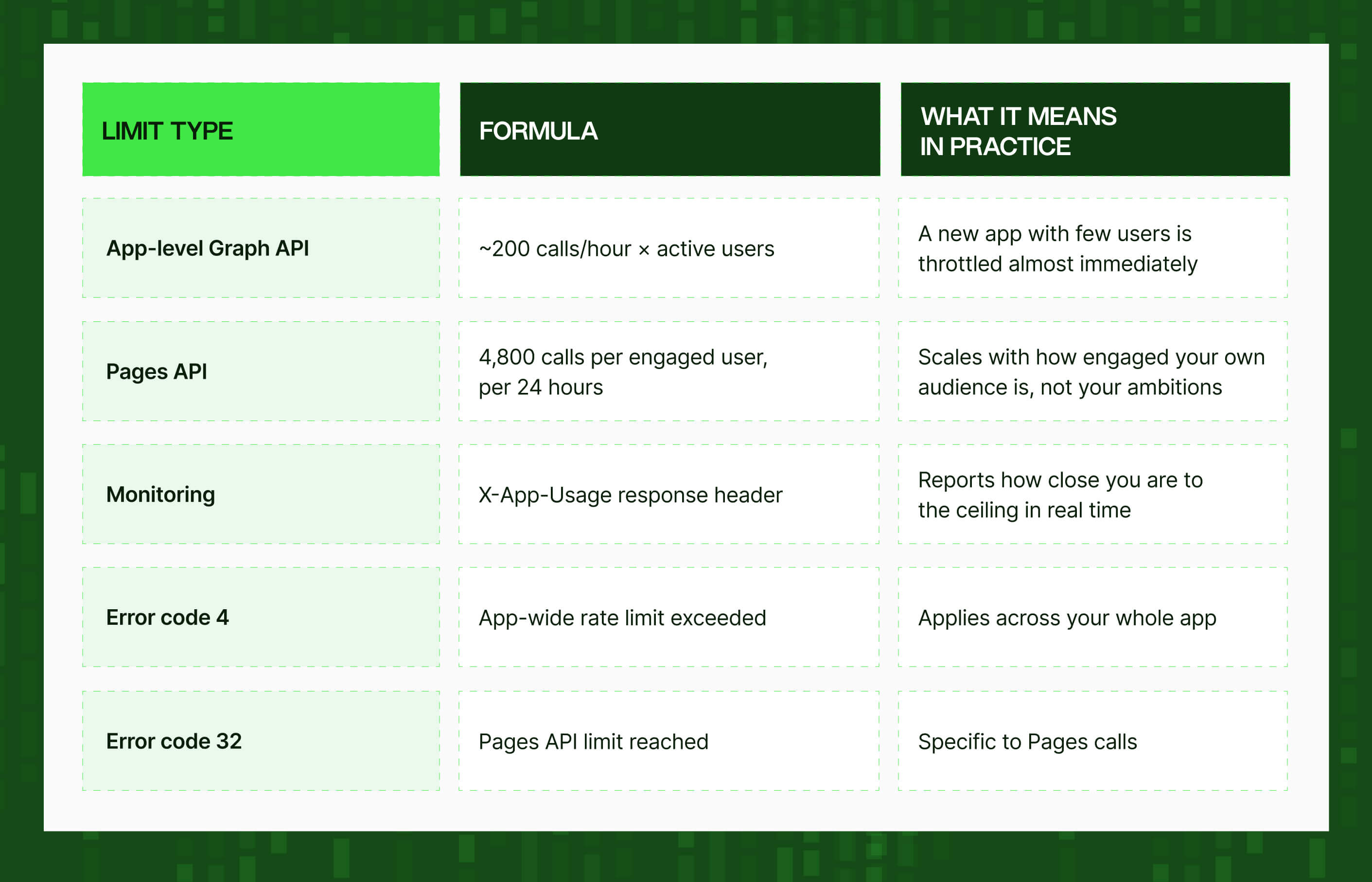
Meta's rate-limiting documentation sets out several separate ceilings depending on what you're calling:
- App-level Graph API: ~200 calls/hour × active users – a new app with few users is throttled almost immediately.
- Pages API: 4,800 calls per engaged user, per 24 hours – scales with how engaged your own audience is, not your ambitions.
- Monitoring: the X-App-Usage response header reports how close you are to the ceiling in real time.
- Error code 4: app-wide rate limit exceeded – applies across your whole app.
- Error code 32: Pages API limit reached – specific to Pages calls.
How long do App Review and Business Verification take?
⚠️ Neither of these is a same-day process, and both gate access before rate limits even become relevant.
- App Review: officially 2 to 7 business days for a complete submission, but any rejection resets the clock, and real-world timelines of six weeks or more aren't unusual when a privacy policy link, a permission scope, or a screen recording isn't exactly right the first time.
- Business Verification: a separate, free prerequisite for broader access. It needs official government-issued business documents (incorporation certificates, tax registration, or bank statements showing your legal business name and address) and typically takes 5 to 15 business days per review cycle.
Version churn: what's changed as of 2026
Meta ships a new Graph API version roughly every six months, with each guaranteed to stay live for about two years.
v25.0 is current as of February 2026, and the Marketing API side has already seen several changes land this year, including retired reach and impression metrics and a webhooks certificate migration that broke integrations that hadn't kept up.
Is it legal to collect and use Facebook data?
In January 2024, a US federal court ruled in a scraping dispute involving Meta that Meta's then-current Terms of Service only restricted automated data collection by logged-in users exercising account privileges; meaning collecting public data while logged out fell outside that particular restriction.
The following month, rather than keep litigating, Meta filed to dismiss its own remaining claim in the case, what Bright Data's CEO called "a total concession". Meta had the option to keep fighting on the facts of that specific contract and chose to walk away instead.
How Meta closed the gap for good in 2025
Meta responded by rewriting its Terms of Service, effective 1 January 2025, to explicitly close that gap: the current terms prohibit automated collection "regardless of whether such automated access or collection is undertaken while logged-in to a Facebook account."
Where that leaves you in 2026
We've written a full breakdown of where web scraping law stands in 2026 if you want the longer version, but the short version for Facebook specifically: the lowest-friction position is data obtained through properly authorised official API access, with the relevant permissions and verification in place.
A practical compliance checklist
If your team is weighing up how to approach Facebook data this year, a few questions are worth answering before you build anything:
- Whose data is it? Official channels only reliably cover your own Page, not somebody else's.
- Is it personal data? Individual-user information pulls in GDPR and CCPA considerations regardless of how public it looks, separately from anything Meta's terms say.
- Do you have the institutional backing this requires? The Meta Content Library and Article 40 both assume legal review, security documentation, and a genuine research or public-interest case.
- Is your use case ad transparency, specifically? The Ad Library API is worth a serious look if so, and largely irrelevant if not.
- Who owns the maintenance? App Review resubmissions, version deprecations, and rate-limit changes are an ongoing cost, not a one-time setup.
What should social intelligence teams do about Facebook in 2026?
Realistically: use official channels for exactly what they're good for – managing and reporting on your own Facebook presence – and recognise early that they were never going to answer the market-wide questions social intelligence teams usually need answered.
For anything broader – competitor Page monitoring, review aggregation across a category of businesses, market-wide sentiment – the question changes. It stops being "can we build this”, and becomes should we. ❓
And even if your team clears App Review, gets through Business Verification, and builds something solid, you're not done, you're now tasked with babysitting it. ⬇️
- Every version deprecation means checking what broke
- Every policy tightening (and there's been one most years since 2018) means re-reading the docs to see what changed.
- It’s all a standing line on your roadmap, indefinitely, for a view that only ever covers your own Page, at the very best.
That's what Datashake solves. 👀
Instead of your team owning that maintenance cycle for data that stops at the edge of your own account, a dedicated review and social data provider takes on the collection and normalisation itself: across the businesses you actually need visibility into, not just the ones you manage. Datashake absorbs the platform churn so you don't have to keep relearning it.
💡 If you’re doing competitor monitoring, review aggregation, or market-wide sentiment, and need data you can count on, talk to us.
Facebook data in 2026: FAQs
Can I get a competitor's Facebook Page data through the official API?
No. The permissions that expose posts, engagement, and ratings (pages_read_engagement and pages_read_user_content) only work for Pages your app or its authenticated user manages. There's no documented, permissioned way to pull another business's Page data without their direct cooperation.
What happened to CrowdTangle?
Meta shut it down on 14 August 2024. Its replacement, the Meta Content Library, exists but is restricted to vetted academic and public-interest researchers, doesn't support historical performance tracking, and caps exports at 500,000 records a week.
Is scraping Facebook data legal in 2026?
It's unsettled, and it's moved twice in under two years. A January 2024 US court ruling found Meta's then-current terms didn't bar logged-out scraping of public data; Meta dropped its case the following month rather than keep fighting it, then rewrote its Terms of Service effective 1 January 2025 to close that gap going forward.
How long does Meta App Review take?
Officially 2 to 7 business days for a complete submission, but any rejection restarts the clock, and six weeks or more is common when a screencast, privacy policy link, or permission scope isn't right the first time.
What is the Facebook Graph API's rate limit?
Roughly 200 calls per hour for every active user your app has, and separately, 4,800 calls per engaged user per 24 hours for Pages API calls. Both scale with your own app's usage, not a flat number, so a small app hits the ceiling fast regardless of what it's approved for.
Can I get Facebook ad data for campaigns run outside the EU or UK?
Only political and social-issue ads, which get global coverage with seven years of history. Commercial ads running purely outside the EU/UK are visible on Meta's own consumer Ad Library website but aren't exposed through the Ad Library API at all.
Does the Facebook API give you review or rating data?
Only for Pages you manage, through the pages_read_user_content permission, behind Business Verification and App Review. There's no official endpoint for ratings or recommendations on a Page you don't administer.
What does Meta Business Verification require?
Government-issued business documents (an incorporation certificate, tax registration, or business bank statements) showing your legal business name and address exactly matching your Business Manager account. It's free and typically takes 5 to 15 business days per review cycle.
Is there a commercial Facebook data API from Meta itself?
No. Meta has never offered a paid tier that grants broader access to Page, review, or content data across businesses you don't manage. What's commercial about the Graph API is the Marketing API, and that's scoped to your own ad accounts.
Can I access Facebook Groups data through an official API?
Not as a third party. Meta cut off third-party Groups API access in early 2024, and no general-purpose replacement has been introduced since.
Has the Meta Content Library gotten any better since it launched?
Yes, in real ways. A June 2025 update lowered the follower threshold for included content from 25,000 to 1,000, and added Facebook Marketplace listings, Instagram Channels, and Fundraisers as new content types. Eligibility hasn't changed, it's still academic and non-profit researchers only.
How does Facebook's official data access compare to TikTok's?
Both platforms offer a research-only API restricted to academics, a business-tools suite scoped to your own account, and an ad transparency library built for a different purpose than competitive research – see our breakdown of TikTok's data coverage in 2026 for the platform-specific detail.




More insights you might like

%20thumbnail.jpg)
.png)