Social Data API Evaluation: What to Check Before You Integrate (2026 Guide)
%20thumbnail.jpg)
If you're evaluating social data APIs right now, you're probably navigating something like this: a vendor with a polished demo and a coverage page that looks comprehensive, pricing that seems reasonable at your current scale, and a sandbox environment that (so far) is returning the data you need.
What you don't yet know is whether:
- The rate limits will hold at 10x volumeh
- The SLA means what you think it means
- The historical data is as deep as claimed
- Or what happens to your pipeline the next time a platform changes its API without warning.
This guide covers all the evaluation criteria teams tend to skip (and some can cost a lot down the line) ⬇️
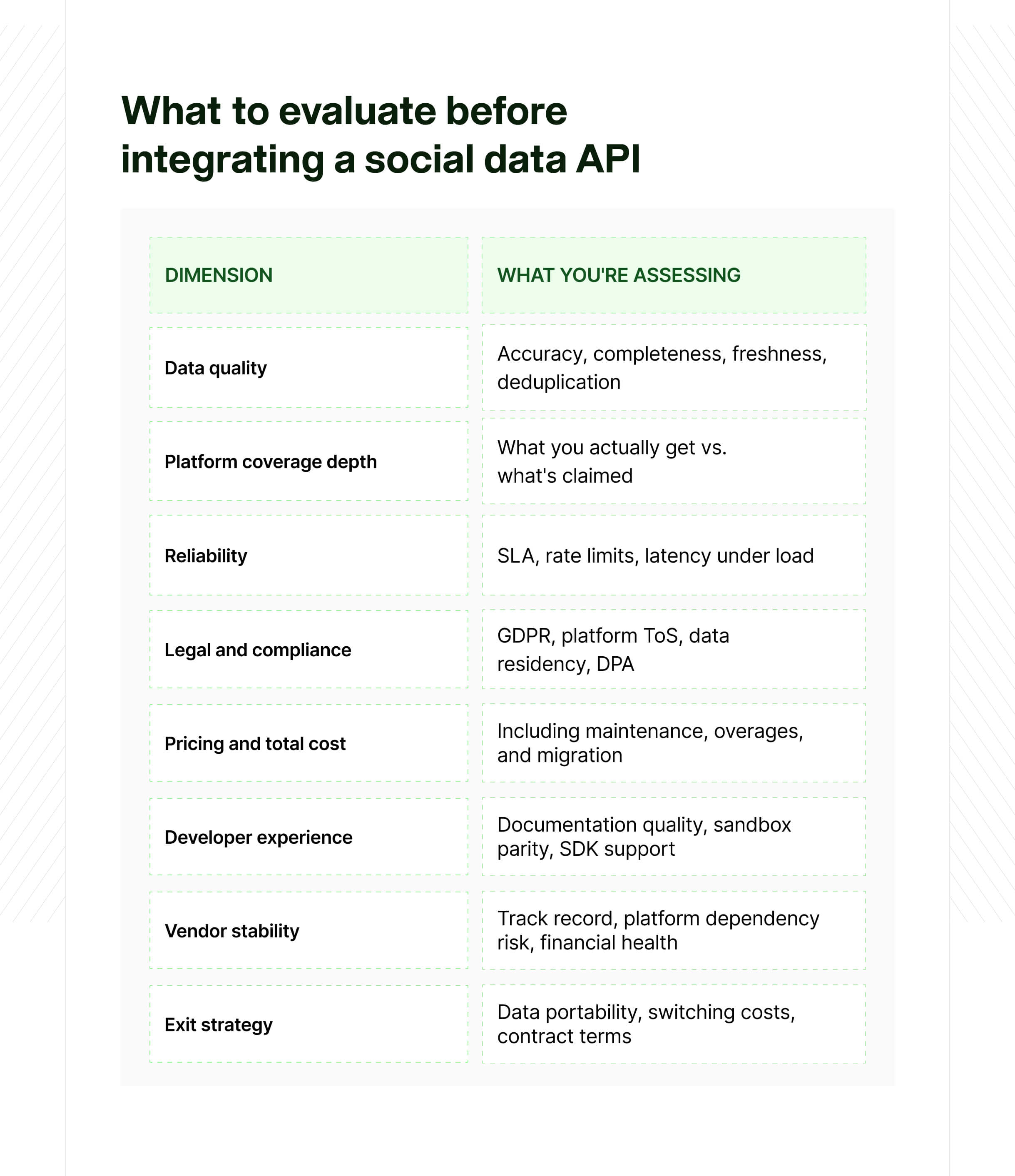
What to evaluate before integrating a social data API
1. Define your requirements before talking to a single vendor
Walk into a vendor demo without defined requirements and you'll walk out with theirs.
Four things to define before evaluating any social data API
Which platforms are non-negotiable?
Not "social media", specific platforms. Every platform has its own authentication flow, data schema, rate limits, and deprecation timeline. Each one requires a different integration approach. It’s key to know your must-haves upfront.
What's your latency tolerance?
"Real-time" is not binary. A vendor claiming real-time delivery might mean 30 seconds or 30 minutes depending on their infrastructure tier. Hours of latency is a pretty huge failure for crisis detection or trend alerting use cases. But for retrospective analytics, it may be fine. Know which you're building before any vendor conversation.
What data types do you actually need?
Public posts, comments, engagement metrics, author profiles, sentiment signals, historical archives: these all have different access rules, legal implications, and pricing tiers. Specificity here prevents discovering gaps after you've already integrated.
Native API or aggregator?
This is the architectural decision everything else flows from.
Native vs. aggregator: how to decide
Platform-native APIs (X API, Meta Graph API, LinkedIn API, TikTok API) give direct, maximally granular access to one platform. The right choice when you need a single platform's deepest capabilities and have dedicated engineering capacity for ongoing maintenance.
Aggregator or unified APIs abstract multiple platforms behind one integration layer – normalising schemas, managing rate limits, handling authentication across sources. They’re the right choice when you need four or more platforms simultaneously, or when social data is a feature of your product rather than the product itself.
🚦The decision rule of thumb: If you need 1–2 platforms and social data is central to your product, native APIs may be worth the overhead. If you need 3+ platforms and social data is infrastructure, a unified API will likely win on total cost.
2. Native social media APIs: what they actually cost to build and maintain
The most persistent myth in social data integration: that building directly against native platform APIs is the cost-efficient path because there's no monthly subscription fee.
The fee exists, it just shows up on your engineering headcount, not your SaaS invoice.
The engineering cost of a multi-platform social media API
Building and maintaining a five-platform integration is a conservatively estimated 10–20 engineering weeks: a one-time cost of $30,000–$75,000 before any ongoing maintenance. For each platform added, the burden compounds: OAuth token refresh logic, media pipeline differences, rate limit accounting, schema changes on each update cycle.
💡 Read more: The True Cost of Building Review Scraping In-House
Multiply that across X, LinkedIn, Instagram, TikTok, Facebook, and YouTube (each with its own token scopes, character limits, and deprecation cycles) and you've created a permanent engineering maintenance function, not a one-time project.
And maintenance is not a one-off cost either. Budget 15–20% of initial development cost annually to keep a system running. A $500,000 build requires $75,000–$100,000 per year just to maintain.
Should you build or buy a social media API integration?
Is this a core differentiating capability, or is it infrastructure?
If it's infrastructure, the engineers keeping it running are the engineers not shipping features. And that tradeoff gets more expensive every time a platform changes its API without warning.
⚠️ Watch out for: The assumption that "it's just REST endpoints". Six months after launch, the engineers who said that are typically drowning in maintenance tickets because X changed rate limits, Meta deprecated a field, or TikTok changed its auth flow without adequate notice.
💡 We've covered this decision in depth in our blog Should You Build vs Buy Your Social Media Data Pipeline?
3. Social media API data quality: what to test before you integrate
In most vendor evaluations, coverage is the headline and data quality is the footnote. That ratio inverts fast the first time a dashboard shows a brand crisis that never happened, or misses one that did.
Accuracy: verify against the source
Does the API return what it claims to return?
Comparing API data with trusted sources during a proof of concept is key. Providers that over-rely on cached data can drift significantly from real values without surfacing the divergence.
👀 How to test: Pull your actual target queries and cross-reference API responses against what you can independently verify on-platform. Don't test with vendor-provided samples.
Completeness: audit null rates before you commit
Are all expected fields populated?
Null rates across key fields – engagement metrics, timestamps, author handles, language tags – tell you quickly whether an API delivers usable data in practice versus on paper.
Missing data leads directly to inaccurate analysis. Request a real dataset for your target query and audit it before any commercial conversation.
Freshness: ask for numbers, not words
Ask for specific latency figures per platform, not a general claim about real-time capability.
The move from periodic snapshots to continuous data streams represents a fundamental shift in what social listening can deliver, but only if the provider's infrastructure actually supports it for your specific platforms.
Deduplication: find out where it happens
Social data is uniquely prone to duplication. Retweets, reposts, bot amplification, and cross-platform sharing all create near-identical records.
During high-activity events (product launches, crises, elections this duplication problem compounds dramatically.
👀 Ask directly: where in the pipeline does deduplication happen, and what's the methodology?
Why sampled social media APIs miss up to 50% of the data you need
You won't see this one in the sandbox. You'll see it six months in, when someone asks why your data contradicts what's actually happening on the platform. ⬇️
Research comparing Twitter's Streaming API against its full Firehose found that the Streaming API can identify the most central users in the full dataset only about 50% of the time.
The sampling mechanism is undocumented – and in high-activity conditions, it can be deliberately influenced, creating results that diverge systematically from ground truth without any signal that anything is wrong.
The majority of social data providers providers access platform data through public API tiers with sampling constraints. A provider claiming "full coverage" of a platform through a sampled API is making a claim about data return completeness, not about representativeness relative to all activity on that platform.
👀 Ask every vendor directly: "Do you have a licensed firehose relationship with this platform, or are you accessing it through a public API tier?"
4. How to evaluate social media API platform coverage
When a vendor says they cover LinkedIn, TikTok, or Instagram, "cover" can mean very different things depending on the data tier they actually access.
The three access tiers that determine what you actually get

A provider claiming LinkedIn coverage is almost certainly returning public post and company page data – not the engagement analytics, follower demographics, or audience insights that LinkedIn restricts to its own ad products.
If your use case requires depth beyond public posts, validate access tier explicitly, platform by platform. ⚠️
💡 If you want a framework for stress-testing coverage claims, Is Your Social Data Representative? is the place to start
How far back does social media API historical data go?
Access to historical data is not guaranteed just because a provider claims it.
Historical data is affected by retroactive deletions: removed posts, suspended accounts, and policy-violating content will be absent from or incomplete in any archive.
A vendor claiming five years of historical data may have significant completeness gaps for anything older than 18 months.
👀 For longitudinal analysis or competitive benchmarking: verify historical depth and completeness directly, not through a sales claim. Ask for query-specific sample data from 2+ years ago.
5. Social media API policy changes: how platform risk affects your integration
In 2023-2024, both X (formerly Twitter) and Reddit restructured access in ways that destroyed businesses that had been built on the assumption of stable, affordable data.
X (Twitter) API pricing changes
In February 2023, Twitter announced the shutdown of its long-standing free API tiers with only seven days' notice. Enterprise API access was initially priced at $42,000 per month for the cheapest tier.
By late 2024, X had doubled its Basic tier from $100 to $200 per month, cut free tier post limits from 1,500 to 500, and reduced top-up allowances. The changes were driven partly by $1 billion+ in annual debt interest on declining platform revenue, a financial pressure that didn't exist two years earlier and could recur with any major platform.
Reddit API changes
Reddit followed in April 2023. After announcing pricing that would make several major third-party apps economically unviable, over 7,000 subreddits went dark in protest: the largest coordinated user action in the platform's history.
Behind it, Reddit had struck a $60 million annual data licensing deal with Google for AI training data, signalling that platforms had started treating their data as a monetisable asset class separate from advertising.
Are social media APIs getting more restrictive?
Privacy regulation, the deprecation of third-party cookies, and platform liability concerns have made every major social platform more restrictive about data access. The direction is clear: less open access, more verification, stricter terms.
How to assess a social data API vendor's exposure to platform policy changes
- If this provider relies on native platform APIs, what is their exposure to a unilateral pricing change?
- How quickly did they adapt to the X and Reddit changes of 2023, and what was the disruption window for customers?
- Do they have direct licensing relationships with any platforms, or are they building entirely on public-access endpoints?
- What contractual protection do they offer if a platform restricts access mid-contract?
What are your legal obligations when using a social media API?
Every social platform's Terms of Service imposes obligations on how data can be collected, stored, used, and retained.
Some require you to delete data within a defined time window. Some prohibit downstream resale. Some require you to refresh data at defined intervals.
These obligations exist regardless of which provider you use, you inherit them the moment you access that platform's data.
Discover them at the start of your build, not after.
6. Social data API rate limits, SLAs, and reliability: what to evaluate
Social media API rate limiting: what to test
Rate limits are one of the most common reasons social data integrations fail in production, and one of the least visible during evaluation.
The reason is structural: sandbox and free-tier environments almost always have generous limits relative to what you'll actually need at scale. They're designed to let you test, not to simulate production load. So everything works fine during the POC, the integration ships, traffic increases, and then you hit a wall that was never visible in testing.
Before committing to any provider, map your peak request volume (requests per second, per minute, per hour, at your highest expected load) and compare it explicitly against the provider's stated limits. Then get answers to:
- Are limits applied per API key, per account, or per endpoint? Per-endpoint limits are easy to miss when you're only testing one or two calls.
- What does the API return when you hit the limit? A well-behaved API returns a 429 with a Retry-After header. A poorly-behaved one fails silently or returns a generic 500.
- Do retry policies support exponential backoff with jitter? Without jitter, retries from multiple clients synchronise and hammer the limit repeatedly. This is a common cause of cascading failures.
- Are burst allowances available above the sustained rate? Some providers allow short bursts beyond the sustained limit – useful if your traffic is spiky rather than constant.
👀 The test: Before signing, run your expected peak load in the sandbox for a sustained period. If the vendor won't give you a production-parity environment to test against, that's a signal in itself.
How to read SLAs accurately
99.9% uptime sounds great until you understand what vendors actually count as downtime. Rate-limited responses (HTTP 429) are frequently not counted as failures in a vendor's SLA calculation, meaning you can experience significant request failures while their status page stays green.
A strong SLA specifies uptime guarantees, p95 and p99 response time targets (not median), and rate limit policies that match your projected usage with headroom. Also check:
- Is uptime calculated per region or across the whole platform? Aggregation can hide real impact.
- Are maintenance windows excluded? If so, how much notice, and for how long?
- Does the vendor publish a status page with historical incident data?
What happens when an OAuth token expires in a social media API integration?
Access tokens expire: Instagram tokens last 60 days, YouTube tokens last 1 hour, TikTok tokens have expired silently with no warning.
The problem is that every platform handles token expiry differently:
- Instagram long-lived tokens last 60 days. Miss the refresh window and access is revoked entirely, requiring the user to re-authenticate manually.
- YouTube access tokens expire after just 1 hour. The platform provides a refresh token to get a new one automatically but only if your integration is built to use it.
- TikTok has historically expired tokens silently, with no warning header, or error code that clearly identifies expiry as the cause, and no consistent behaviour across API versions. Teams have spent days debugging what turned out to be a stale token.
- X (Twitter) OAuth 2.0 tokens expire after 2 hours for user context calls, with refresh tokens that themselves expire if unused for 6 months.
The downstream effect depends on how the failure is handled. ⬇️
A well-built integration catches a 401 response, triggers the refresh flow, and continues without interruption. A poorly-built one either crashes, returns empty data silently, or logs an error that gets buried – all of which corrupt your pipeline in different ways and with different levels of visibility.
What to check before going live:
- Does the vendor handle token refresh automatically end-to-end, or does that logic live in your code?
- What does the integration return when a token expires mid-job: a clear error, empty data, or silence?
- Are token refresh failures surfaced as alerts, or do they fail silently?
- For platforms requiring manual re-authentication after expiry (Instagram, TikTok), what is the recovery workflow?
👀 The test: Ask your vendor to walk you through exactly what happens when an Instagram token expires mid-collection. If they can't describe the behaviour precisely, the refresh logic probably isn't as robust as they think.
7. Social media API pricing: the true cost beyond the monthly fee
The listed price is almost never the real price.
Five hidden cost layers to map before signing
Historical data surcharges
Social data providers tend to price live data and historical access as separate tiers, sometimes with a significant gap between them.
If your use case requires backfilling six months of brand mentions, competitive data, or trend history before your pipeline goes live, that's not included in the monthly rate you negotiated.
👀 Ask specifically: what does historical access cost per platform, per time range, and per volume? Get it in writing before you sign anything.
Overage rates
Overage multipliers can be 3–10x the base per-unit cost – meaning a pricing model that looks affordable at your current volume can become financially unworkable during a product launch, a brand crisis, or a high-activity news cycle, exactly the moments when you need the data most.
👀 Before signing, ask for the overage rate in writing and model what you'd pay during a spike. If the vendor can't give you a clear answer, that's the answer.
Engineering integration time
A low sticker price on a poorly documented API can cost your developers weeks just to get to a working integration, before you've written a line of the product code you actually wanted to build.
And every hour spent decoding undocumented pagination behaviour or inconsistent error responses is an hour not spent on your roadmap.
Infrastructure overhead
The API fee covers data delivery. It doesn't cover the servers, databases, bandwidth, monitoring, alerting, and pipeline tooling required to operate the integration at scale.
For teams feeding social data into Snowflake, BigQuery, or Databricks, those infrastructure costs compound quickly and need to be budgeted separately from the API subscription. Model the full solution cost, not just the vendor fee.
Migration costs
Vendors that use proprietary data schemas, non-standard delivery formats, or that contractually restrict data exports impose a switching cost that isn't visible at signing but grows every month you stay.
👀Before committing, verify: can you export your full historical dataset in a portable format? What does re-ingestion with a different provider look like? If the answer is unclear or evasive, factor that ambiguity into the total cost.
Run your cost model at 1x, 3x, and 10x your expected usage before committing to any pricing tier. Locking in annually at a price that only works at current volume is a common and avoidable mistake.
8. Social media API developer experience: what good documentation looks like
The quality of an API's documentation predicts integration speed and long-term maintainability more reliably than anything in a sales demo.
Teams using structured evaluation frameworks reported 37% fewer post-integration issues than teams relying on demos and sales conversations alone.
The 10-minute documentation test
Can your developer read the docs and make a successful authenticated API call in under 10 minutes? If not, that friction compounds throughout the entire integration. Look for:
✅ Working code examples in multiple languages (not just cURL)
✅ Complete error code documentation with explanations and handling guidance
✅ Pagination documentation (undocumented pagination is a common integration failure point)
✅ A changelog showing how actively the API is maintained and how changes are communicated
✅ An active developer forum or community with staff participation
Sandbox environments: a test for production parity
A sandbox that doesn't reflect production isn't a testing environment, it's a false sense of security.
The most common sandbox failure mode is that the vendor's sandbox data is cleaner, more complete, and more consistent than what you'll actually receive in production.
- Fields that return null in production are populated in sandbox
- Schema inconsistencies that appear under real query conditions don't show up on curated test data
- Rate limit behaviour that only triggers under sustained load never surfaces during a handful of test calls.
Request production-parity sandbox access as a non-negotiable part of every evaluation. If the vendor can't or won't provide it, treat that as a significant red flag – it either means their sandbox is known to diverge from production, or they don't have enough confidence in production quality to expose it early. ⚠️
➡️ Once you have access, don't just verify that the API returns data. Test the conditions that only reveal themselves under pressure:
- Run your actual target queries, not the vendor's suggested demo queries. The difference in data quality between a curated example and your real use case can be significant.
- Simulate sustained peak load for a meaningful period, not a single burst. Rate limit behaviour, latency degradation, and queuing only appear under sustained pressure.
- Force error states deliberately. Kill a token mid-job. Exceed the rate limit intentionally. Send a malformed request. How the API behaves under failure conditions tells you more about its production reliability than any number of successful calls.
- Run the same query across multiple consecutive days and compare the responses. Schema drift (fields appearing, disappearing, or changing format between calls) is one of the most expensive integration problems to diagnose after go-live.
- Check null rates across every field you plan to use in production analytics, not just the fields in the demo.
Ask "how?" not just "do you?"

9. Build your exit strategy before you sign
Planning your exit before you need it reveals something about the vendor: providers who resist data portability questions are signalling how they think about dependency.
Confirm these before signing
- In what format can you export all historical data collected through the API?
- What restrictions exist, if any, on re-ingesting that data with a different provider?
- What happens to data stored in the vendor's systems when the contract ends?
- Is there a data export SLA, a guaranteed timeframe to retrieve your data before service ends?
- Does the contract contain exclusivity provisions that would prevent running parallel evaluations?
Social media API abstraction layer: how to build for vendor flexibility
➡️ great tip here is to build a thin abstraction layer between your systems and the vendor API.
Your internal code calls your own wrapper; the wrapper calls the vendor. When you switch, you replace the wrapper, not the internal architecture. This costs slightly more upfront but saves enormous migration cost later.
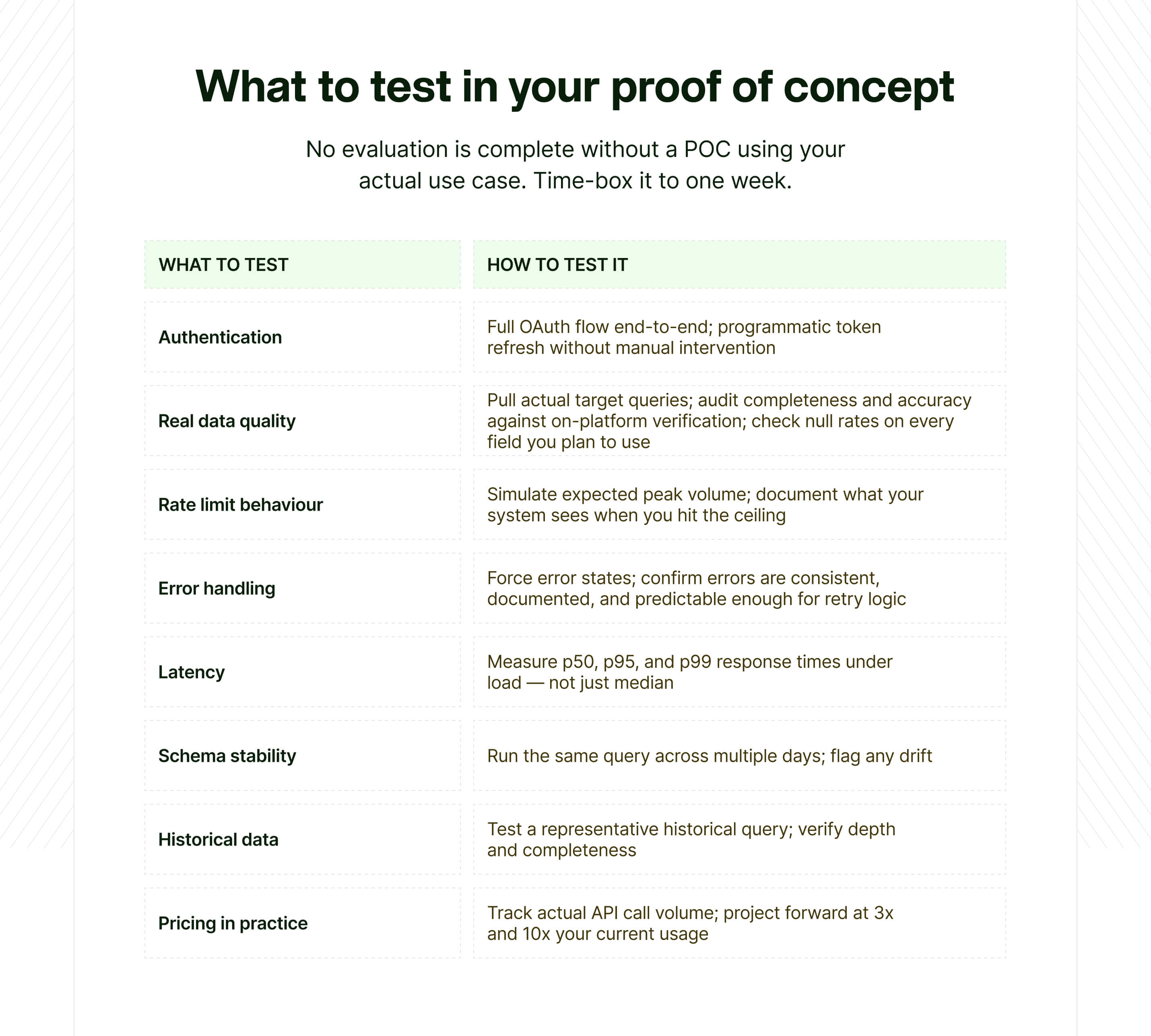
12. What to test in your proof of concept
No evaluation is complete without a POC using your actual use case. Time-box it to one week.
Red flags that should end the evaluation
❌ No public status page or incident history. If they can't show you what went wrong and how they handled it, you have no basis for trusting their reliability.
❌ Vague SLA language. "We aim for high availability" is not an SLA. Walk away from any provider that won't commit to specific uptime guarantees in writing.
❌ A sandbox that doesn't reflect production. If sandbox data quality, schema, or behaviour diverges from production, everything you tested is invalidated.
❌ No deprecation notice policy. If they can't tell you how much notice they give before breaking API changes, you're building on an unstable foundation.
❌ Documentation more than 12 months behind the current API. Stale docs signal an organisation that treats the API as an afterthought.
❌ No reference customers. If no comparable production customer will vouch for them, that absence is data.
❌ No clear overage policy. If they can't tell you what you pay at 10x current volume, you're accepting open-ended financial exposure.
💡 Datashake covers 150+ sources, maintains 98.3% uptime, and handles source changes and API updates so your integration stays stable when platforms shift. Book a call and we'll walk you through exactly how we answer every criterion in this guide: coverage depth, data quality, compliance, and pricing at scale.
.png)



More insights you might like