The True Cost of Building Review Scraping In-House

How much does it cost to build review scraping in-house?
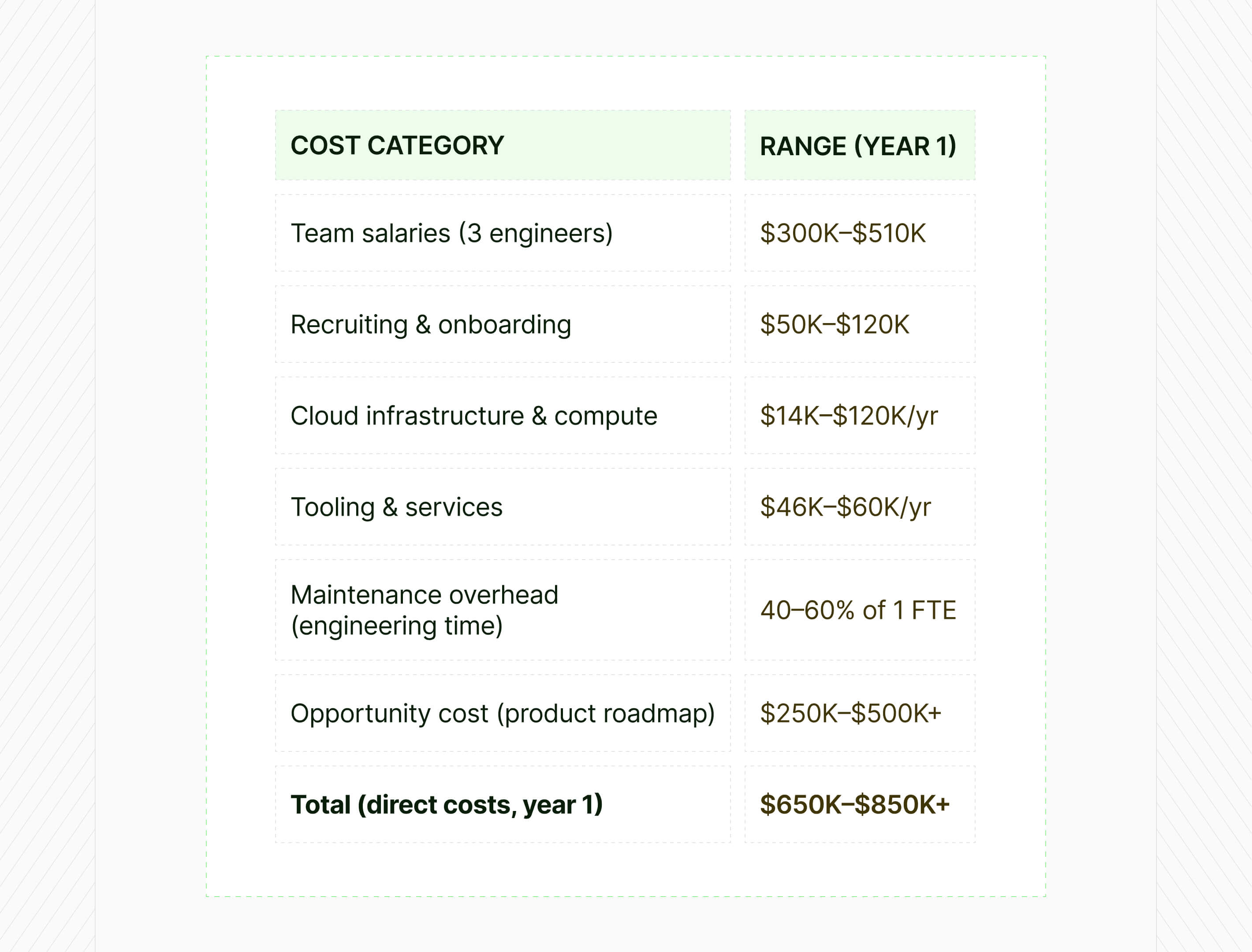
Building and maintaining an in-house review scraping operation typically costs $650,000–$850,000 in year one alone, based on a minimum team of three engineers, infrastructure, tooling, and recruiting overhead. By year three, cumulative costs exceed $925,000. This excludes opportunity cost, the product work your engineers don’t do while they maintain the pipeline.
Building your own review scraping pipeline looks like a reasonable decision on paper. You get control. You avoid vendor dependency. And the initial cost estimate seems manageable: a few weeks of engineering time, some infrastructure, and you're off.
That estimate is almost always in ways that only become visible six to twelve months in, when the pipeline breaks again and the engineer who built it has moved on to something else.
This post breaks down the real cost – from the people required to the infrastructure bills to the legal exposure to the data quality failures you won't catch until they're already in production
💡 If you're working through this decision across your full social and review data infrastructure, our broader build vs buy analysis for social data pipelines covers the same cost structure across a wider set of sources..
1. The people cost
A fully-loaded engineer – salary plus payroll taxes, benefits, equipment, tooling, office overhead – costs significantly more than their base pay suggests.
According to recent compensation data, a mid-level software engineer in the US has a base salary of $100,000–$130,000 per year. Fully loaded (including benefits, payroll taxes, and overhead) that figure multiplies to roughly 1.25–1.4x base, or $125,000–$182,000 annually. Senior engineers and DevOps specialists command more.
A functional in-house review scraping operation is not a one-person job. At minimum, you need:
- A senior scraping engineer: $120,000–$180,000 base (US)
- One to two mid-level engineers for maintenance and redundancy: $100,000–$130,000 each
- A DevOps/infrastructure engineer to manage proxies, monitoring, and scaling: $80,000–$120,000
That's a minimum team cost of $300,000–$510,000 in salaries before you add benefits and overhead. X-Byte's enterprise analysis puts total first-year in-house costs (including infrastructure, compliance tooling, and talent acquisition) at $650,000–$850,000.
The hiring cost
Recruiting a senior engineer typically costs 15–25% of first-year base salary in recruiter fees alone: around $18,000–$45,000 per hire before that person has written a single line of code.
Add onboarding time (conservatively $8,000–$15,000 in blended productivity loss during the first quarter), and you're deep in cost before the scraper exists.
The turnover cost
Engineering attrition in European tech sits at around 12% annually, which sounds manageable until you run the maths.
Replacing a single engineer costs 50–200% of their annual salary once you account for recruiting, onboarding, and lost institutional knowledge. For a scraping infrastructure team, the knowledge loss is particularly severe: the people who built the pipeline are often the only ones who understand why it was built the way it was.

2. The engineering complexity is huge
Review data at the scale that's actually useful for a product – consistent coverage across G2, Glassdoor, Trustpilot, Yelp, the app stores, and dozens of niche platforms – is not a single engineering project. It's a collection of separate, structurally different data extraction problems, each requiring its own logic, each subject to its own failure modes.
💡 If you're trying to evaluate whether your current review and social data coverage is actually representative of the conversations that matter to your product, this framework gives you a practical way to audit it.
Initial scraper development for a single complex source typically requires 20–80 hours of developer time. Across 20–30 review sources (which is what meaningful competitive intelligence takes) you're looking at months of engineering work just to reach first deployment.
The maintenance burden is where the real cost lives
Building the scraper is a one-time cost. Keeping it running is not. Teams initially budget 10% of engineering time for scraper maintenance; within a year, it routinely consumes 40–60% of a dedicated engineer's capacity. Review platforms update their structure regularly. Each change requires engineering intervention. At scale, these updates become a continuous workload.
The engineering team you hire to build review scraping infrastructure doesn't go on to build product features once the scraper is live. They maintain the scraper, that's their job now.
💡 This is the same dynamic that makes social data coverage harder than it looks. The sources you're not monitoring are often the ones where the most relevant conversations are happening. Why your social media data is incomplete explains why that gap is structural, not just a tooling problem.
3. Infrastructure cost is required, and it’s not cheap
Beyond salaries, keeping a review scraping pipeline running requires infrastructure that is easy to undercount.
Data infrastructure and compute
Cloud infrastructure for running scrapers, processing data, storing results, and handling failures runs $1,200–$10,000 per month depending on scale. For a programme covering dozens of sources with daily or near-real-time refresh requirements, compute costs sit toward the top of that range.
Add monitoring tooling, alerting systems, and data storage, and annual infrastructure operating costs for a moderately sized in-house team run $50,000–$100,000 – and recurring, not one-time.
Tooling and third-party services
Production-grade data pipelines require a stack of supporting services: job orchestration, data validation tooling, error logging, quality monitoring.
These aren't large individual line items, but they accumulate quickly and represent a long-term operational commitment. Each tool adds per-seat license fees, admin overhead, and dependency management.
Total first-year infrastructure costs across a typical enterprise in-house operation (compute, storage, tooling, and services) range from $60,000 to $180,000 annually before a single engineer salary is counted.
4. Silent failures are the hardest cost to quantify, and the most damaging
One of the most underappreciated problems with in-house review scraping is that failures are frequently invisible. The scraper doesn't stop running. It just stops returning useful data, and you may not know for days or weeks.
Website structures change without warning. A renamed CSS class, a container that becomes a shadow DOM, pagination that switches from numbered links to infinite scroll – these invisible shifts break static selectors instantly, causing hours of undetected data loss.

The failure modes to know about
- Schema drift: New fields appear, old fields move, type formats shift, and downstream processing keeps running as if nothing changed.
- Duplicate inflation: Failed retries written twice make record counts look healthy while the actual data degrades. You won't see it until something downstream breaks.
- Model lag: For AI or ML products built on review data, the pipeline failure and the model performance problem can feel completely unrelated. Weeks pass between when data starts degrading and when the impact surfaces.
- The business cost of stale data: 85% of companies blame degraded data for poor decisions and lost revenue, according to IBM. The stakes are higher with review data: customers write reviews in real time. A sentiment shift, a recurring complaint, a competitor's sudden rating drop – if your data is two weeks old, you're not providing intelligence. You're providing history.
💡 Stale review data has the same problem as sentiment scores stripped of context: it tells you something happened, not what it means or what to do about it. Our blog post about sentiment not being a strategy makes the case for why the analysis layer only works when the data layer is right.
What it costs to fix
Scraper downtime is not a minor inconvenience. Global 2000 companies lose over $400 billion annually due to system downtime, with 90% of medium and large organisations losing upwards of $300,000 during a single hour of data disruption.
Review scraping downtime is your product's intelligence layer going blind. That has direct customer impact for a social listening or reputation management SaaS.
💡 For teams using review data to train or fine-tune models, the stakes of a degraded pipeline are higher than they are for a dashboard. Why social data is becoming the most valuable AI training asset explains what makes coverage quality and freshness so critical at the collection stage.

5. There’s serious opportunity cost
None of the costs above account for what your engineers don't build while they're maintaining scrapers.
When senior engineers spend time on infrastructure maintenance and data quality firefighting instead of product development, the opportunity cost impacts both current productivity and future growth potential. Every sprint spent diagnosing a broken data pipeline is a sprint not spent on the features that differentiate your product.
For a company with $50M ARR where a 1% revenue improvement from better data would generate $500,000 annually, a six-month delay in deploying that capability due to infrastructure build time represents $250,000 in missed opportunity – on top of the $456,000 in direct build costs.
Research consistently shows that developing non-core infrastructure capabilities internally diverts engineering focus and delays core product innovation. The teams that make this trade-off rarely regret the speed they gain from offloading it, they regret not doing it sooner.
7. The cost three years down the line
Year one costs are high for in-house builds, but they're manageable if the business has the runway. The problem is years two and three.
In-house scraping costs don't stabilise, they escalate.
As the number of monitored sources grows, as platforms upgrade their defences, and as technical debt accumulates in the scraping codebase, a team that cost $250,000 in year one typically costs $300,000 in year two and $375,000 in year three. Vendor costs, by contrast, stay predictable.
💡 The alternative to building and owning the collection layer isn't just buying a dashboard tool. Headless social listening explains the model that separates data infrastructure from visualisation – which is how most teams get the control they were trying to achieve by building in-house, without the maintenance overhead.
There's also what researchers call the "sunk cost trap". By the time organisations realise the in-house approach is economically irrational, they've already invested 3–6 months of engineering time, built downstream dependencies on their custom data format, and trained teams on their tooling. The transition cost makes it difficult to change course even when the numbers clearly justify it.
Typical three-year total cost of ownership for in-house review scraping: $925,000+ (year 1: $456K+, year 2: $300K+, year 3: $375K+) — excluding opportunity cost, legal incidents, and the cost of data quality failures.
8. What this means if you're evaluating the decision right now
There are legitimate reasons to build scraping infrastructure in-house. If your business depends on a genuinely proprietary data collection methodology, if you have deep technical expertise in scraping specifically, or if the data you need is available nowhere else – it can make sense.
But for review data, those conditions rarely hold. The sources are the same for everyone. The challenge isn't proprietary data strategy, it's engineering execution at scale across hundreds of sources that are actively hostile to automated access.
The questions worth asking before committing to a build:
- How many review sources do you actually need?
- What's your acceptable data freshness threshold?
- Do you have legal counsel who specialises in data collection?
- What would your engineering team build instead if they weren't maintaining scrapers?
Summary: What does in-house review scraping actually cost? (Year 1 breakdown)
Frequently Asked Questions
How much does it cost to build a review scraping team in-house?
Building a minimum viable in-house review scraping team – three engineers covering scraper development, maintenance, and DevOps – costs $650,000–$850,000 in year one when you include salaries, recruiting, onboarding, infrastructure, and tooling. By year three, cumulative direct costs typically exceed $925,000, not including opportunity cost.
Is it cheaper to build or buy review data collection?
For most companies, buying is significantly cheaper. A specialist review data API costs a fraction of the total engineering cost of building and maintaining in-house infrastructure. The break-even point for building only makes sense at very high data volumes with highly proprietary collection requirements: conditions that rarely apply to standard review intelligence programmes.
How long does it take to build a review scraping pipeline?
Initial development for a single complex review source typically takes 20–80 hours of developer time. Achieving reliable coverage across 20–30 sources – which is what a production-grade review intelligence programme requires – typically takes 3–6 months of engineering effort before first deployment. Stabilising that pipeline usually takes another 6–12 months.
Why do review scrapers break in production?
Review scrapers break because platforms update their page structure, data formats, and pagination logic without notice. Schema drift (field names and types changing), layout redesigns, and dynamic content loading all cause silent failures where the scraper continues running but returns incorrect or incomplete data. Teams typically don’t discover the failure until downstream processes break, often days or weeks later.
How many engineers do you need to maintain a review scraping system?
At minimum, one dedicated engineer for every 10–15 actively monitored sources, once the system is in production. Research shows that scraper maintenance consumes 40–60% of a dedicated engineer’s time within 12 months of deployment. For a programme covering 30+ sources, expect a team of 2–3 engineers to be primarily occupied with maintenance rather than new development.
What’s the difference between scraping review data and using an API?
A review data API delivers structured, normalised data from multiple platforms in a consistent schema, with reliability guarantees, compliance baked in, and no maintenance overhead on your side. In-house scraping requires building and maintaining separate extraction logic for each source, managing schema inconsistencies across platforms, and absorbing all infrastructure and maintenance cost internally. The data coverage is also typically narrower – specialist providers monitor sources that are impractical for individual teams to cover.




More insights you might like